What Is Commercial Freezer High Ambient Performance?
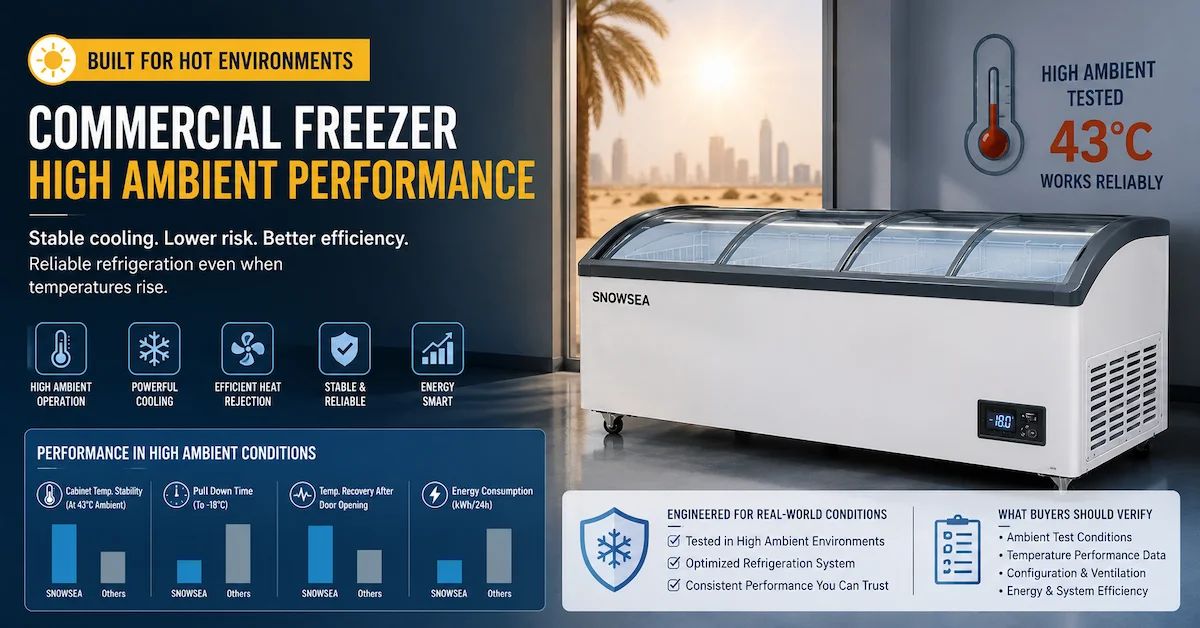
Commercial freezer high ambient performance describes how effectively a freezer continues to deliver its required refrigeration function when the surrounding environment creates a higher thermal load.
It is easy to reduce this question to:
“Does the freezer still run when the room is hot?”
That is not enough for technical procurement.
A commercial freezer may continue operating while its pull-down slows, temperature distribution changes, compressor runtime increases, or energy consumption rises. What matters is whether the complete system still meets the actual storage requirement.
For a B2B buyer, high-ambient performance should therefore be judged by several related questions:
- Can the cabinet reach and maintain the required temperature?
- How does cooling speed change?
- Are different storage areas still reasonably consistent?
- How does the freezer recover after access?
- What happens to energy consumption?
- Does the refrigeration system remain appropriately matched?
- Does the tested unit represent the production configuration?
A useful rule is:
High ambient performance is not simply whether a freezer keeps running. It is whether the complete refrigeration system can maintain the required product-storage condition under a clearly defined operating scenario.
Why Hotter Surroundings Make Refrigeration More Demanding
A freezer is constantly removing heat from inside the cabinet and rejecting it into the surrounding environment.
When the surrounding air becomes hotter, two things become more important.
First, the cabinet can face a greater thermal load from its surroundings.
Second, the refrigeration system still has to reject heat through the condenser into that hotter surrounding air.
This makes high-ambient operation a system-level problem.
Looking only at cabinet temperature misses what is happening at the condenser. Looking only at compressor size misses what is happening inside the storage space.
The freezer has to work as one thermal system.
High Ambient Performance Is More Than a Target Temperature
Suppose two freezers both eventually show the required temperature on their controllers.
Are they performing equally?
Not necessarily.
One may:
- Take much longer to pull down
- Run the compressor for longer periods
- Have warmer areas near the door
- Recover slowly after opening
- Consume considerably more electricity
- Struggle when fully loaded
The controller display is useful, but it does not describe the complete operating picture.
This is one reason Snowsea's commercial freezer temperature uniformity guide should be considered together with high-ambient testing.
Condenser Heat Rejection Becomes Critical
The condenser has to release heat from the refrigeration system into the surrounding air.
As ambient conditions become more demanding, condenser performance deserves closer attention.
Important factors can include:
- Condenser design
- Available airflow
- Fan performance where applicable
- Installation clearance
- Dust or obstruction
- Refrigeration-system matching
A larger condenser is not automatically the answer to every hot-environment problem.
Likewise, a powerful compressor cannot compensate for every heat-rejection limitation.
Condenser performance needs to be evaluated together with airflow, refrigeration capacity, cabinet load, and the intended operating environment.
For related engineering considerations, see Snowsea's commercial freezer condenser design guide.
Does a Larger Compressor Solve High Ambient Problems?
Not by itself.
The compressor is only one part of the refrigeration circuit.
High-ambient performance also depends on how the compressor works with the:
- Condenser
- Evaporator
- Refrigerant circuit
- Airflow system
- Cabinet insulation
- Door system
- Controller
- Target storage temperature
Simply increasing compressor capacity without reviewing the rest of the system can create a poorly balanced design.
A better procurement question is:
Does the refrigeration system match the freezer size, target temperature and expected operating environment?
Snowsea discusses this more broadly in its commercial freezer compressor sizing guide.
Installation Conditions Can Change Real-World Performance
A freezer may perform well during a controlled test and behave differently after installation if condenser ventilation changes.
Consider a unit tested with clear airflow around the refrigeration compartment.
Now place the same freezer:
- Tight against a wall
- Beside heat-producing equipment
- In a poorly ventilated service area
- In a hot kitchen
- In a warehouse with limited cooling
The product has not changed, but the operating environment has.
For this reason, “destination country” alone is not enough information for an OEM project.
A buyer in a warm region should ideally describe:
Actual ambient condition + installation space + ventilation + nearby heat sources + usage pattern
That gives the supplier much better engineering information.
High Ambient Performance Is Not the Same as Outdoor Suitability
This distinction prevents a lot of poor specifications.
A commercial freezer intended for a high indoor ambient temperature should not automatically be considered suitable for outdoor installation.
Outdoor conditions can introduce additional factors such as:
- Direct sunlight
- Rain
- Dust
- Wind
- Weather exposure
- Corrosion
- Electrical protection requirements
Those are separate design questions.
High indoor ambient capability and outdoor suitability are not interchangeable specifications.
If an outdoor project is planned, it should be identified clearly during the RFQ stage rather than inferred from a high-temperature requirement.
How Ambient Conditions Affect Pull Down Time
Pull down time describes how quickly a freezer moves from a defined starting state toward a defined target condition.
A pull-down result obtained under one ambient environment cannot automatically represent performance under a much hotter one.
This is why buyers should ask:
- What was the starting condition?
- What ambient environment was used?
- Was the freezer empty or loaded?
- Where were temperature probes installed?
- How was the endpoint defined?
For a detailed breakdown, see Snowsea's commercial freezer pull down time guide.
The important purchasing point is simple:
Pull-down data should always be read together with the ambient condition in which the test was performed.
Temperature Uniformity Still Matters in Hot Conditions
Reaching the target at one sensor is only part of the story.
Technical buyers may also want to know whether:
- Upper and lower zones behave similarly
- Door-side areas become significantly warmer
- Product loading blocks circulation
- Different shelves cool at different rates
- Warm spots become more noticeable under greater thermal load
Multi-point temperature data can provide much better evidence than a controller display alone.
A freezer may look acceptable from one measurement location while another part of the usable storage zone behaves differently.
That is why high-ambient testing and temperature mapping work well together.
Door Opening Can Make the Application Much Harder
A freezer operating in a warm room with the door continuously closed faces one type of load.
A freezer in a busy supermarket or commercial kitchen may face another.
Repeated access introduces warmer surrounding air and temporarily changes the cabinet's thermal condition.
For high-traffic applications, buyers should consider the combination of:
Ambient condition + access frequency + recovery performance
rather than asking only whether the freezer can eventually reach a target temperature.
Snowsea's commercial freezer temperature recovery guide covers this dynamic behavior in more detail.
Insulation and Door Sealing Affect Heat Gain
Heat reaching the cabinet must be removed by the refrigeration system.
That makes cabinet insulation and door sealing part of the high-ambient discussion.
Relevant considerations include:
- Insulation construction
- Cabinet geometry
- Door area
- Gasket contact
- Thermal bridges
- Glass-door configuration where used
However, it would be too simplistic to judge a freezer only by insulation thickness.
The complete thermal design matters.
For related checks, see Snowsea's freezer door gasket sealing performance guide.
High Ambient Performance and Energy Consumption
A hotter operating environment can make the refrigeration system work under more demanding conditions.
That makes energy consumption worth monitoring, but energy should never be separated from refrigeration performance.
Imagine Supplier A reports lower electricity use, but its cabinet does not maintain the required storage condition.
Supplier B uses more energy but meets the target reliably.
The lower number alone does not make Supplier A the better commercial choice.
Energy efficiency has value only when the freezer is still delivering the refrigeration performance the application requires.
For energy-test interpretation, see Snowsea's commercial freezer energy consumption test guide.
What Should a High Ambient Test Define?
A statement such as “tested under hot conditions” is too vague for procurement.
Buyers should ask what the test actually involved.
| Test Item | What the Buyer Should Verify |
|---|---|
| Ambient condition | What environment surrounded the freezer? |
| Target temperature | What cabinet condition was required? |
| Tested model | What exact configuration was used? |
| Loading | Was the cabinet empty or loaded? |
| Product/load | How was the load defined? |
| Probe locations | Where was temperature measured? |
| Test duration | How long was performance observed? |
| Door operation | Closed or operated during testing? |
| Condenser ventilation | What installation clearance was used? |
| Pull down | How did cooling speed behave? |
| Uniformity | Were multiple cabinet areas measured? |
| Energy | What was electrical use under the same scenario? |
There is no responsible universal number for “good high ambient performance” without these conditions.
The user's own application matters.
One Temperature Reading Is Not Enough
A photograph of a controller showing a cold temperature may look convincing in a sales presentation.
For technical sourcing, it is weak evidence by itself.
A better test record may include:
- Ambient-temperature data
- Cabinet-temperature curves
- Probe positions
- Loading condition
- Time
- Operating behavior
- Energy data where relevant
This allows the buyer to see whether performance was stable rather than simply finding one moment when the display reached the target.
A high-ambient claim has little procurement value unless the operating conditions behind it are defined.
Hot Retail Space, Kitchen or Warehouse?
“Hot climate” can describe very different applications.
A supermarket aisle may have relatively good air conditioning but frequent customer access.
A commercial kitchen may have nearby cooking equipment and concentrated local heat.
A warehouse may have little air conditioning but fewer door openings.
Those environments should not automatically use the same freezer specification.
This is why the RFQ should describe the installation, not only the country.
For international distributors, that detail can also help avoid buying one configuration for several customer groups whose operating conditions are actually very different.
Common Mistakes When Comparing Supplier Claims
| Procurement Mistake | Why It Creates Risk |
|---|---|
| “Works in hot climates” with no test data | The claim cannot be compared |
| Looking only at controller temperature | One point does not describe the cabinet |
| Using mild-condition data for hot applications | The operating load is different |
| Comparing only pull-down time | Stable long-term behavior is ignored |
| Ignoring condenser ventilation | Test installation may differ from the site |
| Comparing loaded and empty tests | Thermal conditions are different |
| Changing the BOM after testing | Previous data may no longer represent production |
| Comparing energy use without temperature performance | Low kWh alone does not prove adequate cooling |
These are not small technical details. They can affect supplier selection, field performance and after-sales risk.
The Tested Sample Should Match Mass Production
Performance data belongs to the configuration that produced it.
If the sample is tested and the final order later changes the:
- Compressor
- Condenser
- Controller
- Fan
- Cabinet dimensions
- Door
- Insulation
- Interior layout
- Other refrigeration components
the earlier data may no longer represent the final product in the same way.
That is why B2B buyers should connect performance approval to configuration control.
For broader production checks, see Snowsea's commercial freezer quality testing procedure.
How Should Buyers Compare High Ambient Freezer Suppliers?
A useful supplier review goes beyond a yes/no question.
| Evaluation Area | Question to Ask |
|---|---|
| Ambient test | What condition was used? |
| Target temperature | What did the freezer have to maintain? |
| Configuration | Does it match the quoted product? |
| Loading | Empty or loaded? |
| Temperature mapping | Were multiple locations measured? |
| Pull down | How did cooling speed change? |
| Door recovery | Was access behavior evaluated? |
| Condenser | How is heat rejection supported? |
| Installation | What ventilation clearance was used? |
| Energy | Was energy measured with temperature performance? |
| Production QC | How is the tested BOM controlled? |
A supplier that can explain the test conditions clearly gives procurement teams more usable information than one relying on a general “tropical” or “high-temperature” marketing claim.
Can High Ambient Performance Be Evaluated for an OEM Project?
Yes, when the buyer provides a defined operating scenario.
Snowsea can evaluate requested high-ambient requirements according to the selected freezer platform and engineering feasibility.
Technical review may involve:
- Cabinet dimensions
- Refrigeration-system matching
- Compressor selection
- Condenser heat rejection
- Evaporator configuration
- Airflow
- Insulation
- Door design
- Controller configuration
- Interior loading arrangement
The project should begin with the operating requirement rather than with a request for one isolated component change.
Buyers can submit project information through Snowsea's OEM/ODM service.
What Should Buyers Send Snowsea for Evaluation?
For a useful technical review, provide:
- Freezer type or reference model
- Required cabinet dimensions or capacity
- Target storage temperature
- Expected ambient operating range
- Installation environment
- Ventilation conditions
- Nearby heat sources, if relevant
- Product being stored
- Typical product load
- Product/package dimensions
- Solid or glass-door requirement
- Expected door-opening frequency
- Pull-down target, if defined
- Temperature-uniformity requirement,if defined
- Energy target or benchmark, if available
- Customer test method, if available
- Destination market
- Sample/testing requirement
- Initial order quantity
- Annual purchasing forecast
- Project schedule
If your company already has an internal high-temperature test method or benchmark freezer, include it.
That makes the technical discussion much more precise than asking for “a freezer for a hot country.”
FAQ
What is commercial freezer high ambient performance?
It describes how effectively a freezer maintains its required refrigeration function when the surrounding operating environment creates a higher thermal load.
How does high ambient temperature affect a commercial freezer?
It can affect cabinet heat gain, condenser heat rejection, compressor demand, pull-down time, temperature distribution, recovery behavior and energy use.
Can a commercial freezer maintain temperature in a hot environment?
That depends on the freezer configuration, target temperature, ambient condition, ventilation, load and application. Buyers should review test evidence for the intended scenario.
Does high ambient temperature increase pull down time?
It can change pull-down behavior because the refrigeration system operates under different thermal conditions. Test results should always include the ambient environment.
Does high ambient temperature increase freezer energy consumption?
It can influence energy use, but the result should be evaluated together with the required temperature and complete test conditions.
Why is condenser performance important in hot conditions?
The condenser must reject heat into the surrounding environment. Hotter conditions can make that task more demanding.
Is a larger compressor better for high ambient operation?
Not automatically. Compressor capacity must be matched with the condenser, evaporator, airflow, cabinet load, controls and other refrigeration-system factors.
Is a high ambient freezer suitable for outdoor use?
Not automatically. Outdoor use introduces additional environmental and protection requirements that should be evaluated separately.
How should buyers compare high ambient freezer test data?
Compare ambient conditions, target temperature, loading, probe positions, ventilation, pull-down, uniformity, energy use and exact product configuration.
Can Snowsea evaluate an OEM freezer for a high ambient requirement?
Buyers can provide their operating conditions and performance requirements for evaluation. Feasibility depends on the selected freezer platform and engineering scope.
Conclusion
Commercial freezer high ambient performance is not proven simply because a compressor runs or a controller briefly shows the required temperature.
Technical buyers should look at the complete operating picture:
- Ambient environment
- Cabinet temperature
- Temperature distribution
- Pull-down behavior
- Door-opening recovery
- Condenser ventilation
- Refrigeration-system matching
- Energy consumption
- Product loading
- Sample-to-production consistency
The most useful supplier evidence is always tied to defined test conditions and a known product configuration.
If your project will operate in a demanding environment, send Snowsea your freezer type, cabinet dimensions, target temperature, expected ambient range, installation and ventilation conditions, product load, door configuration, access frequency, performance target or test specification, destination market, sample requirement, and estimated order quantity through the Snowsea contact page.
Snowsea can evaluate the refrigeration system, condenser heat rejection, airflow, insulation, cabinet configuration, testing scope, OEM feasibility, and commercial project requirements before preparing a technical proposal and quotation.