What Is Commercial Freezer Pull Down Time?
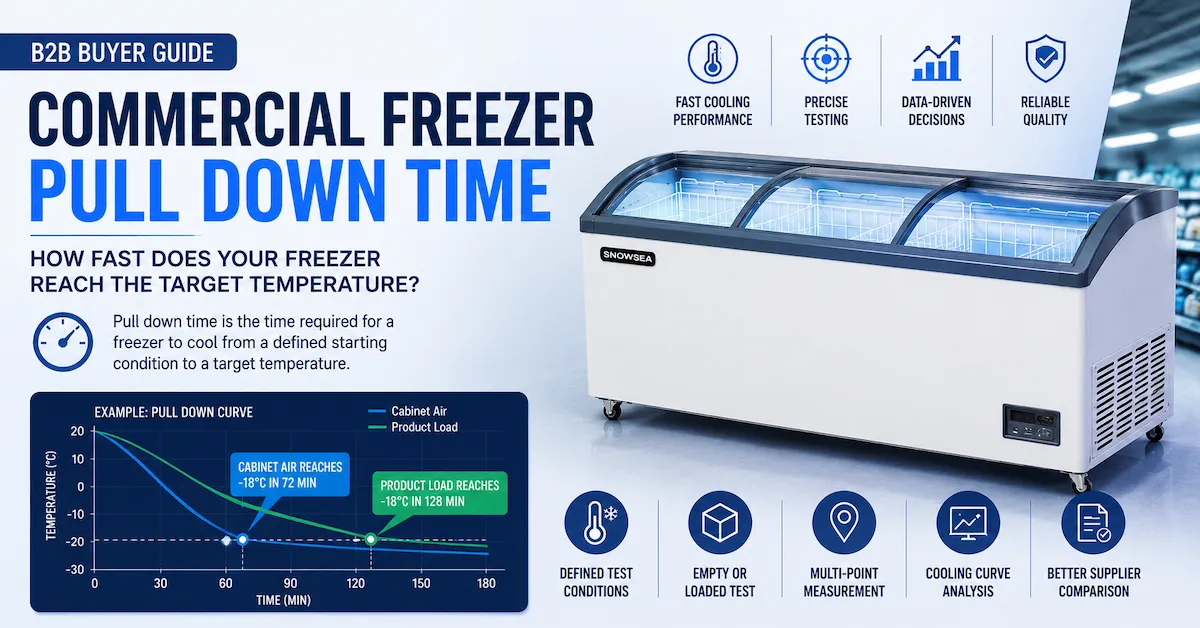
Commercial freezer pull down time is the time required for a freezer to cool from a defined starting condition toward a defined target condition under specified test conditions.
The definition sounds straightforward. Comparing two freezer samples is less straightforward.
A supplier may say that a cabinet reaches its target temperature in a certain number of minutes. Before using that figure in a purchasing decision, a buyer needs more context.
What was the starting temperature? Was the cabinet empty? Where was the probe? What was the ambient condition? Was the endpoint based on one sensor, the controller display, or several positions?
Without those details, a pull-down number can look precise while telling the buyer very little.
A pull-down time is useful only when the starting condition, target condition, ambient environment, loading state, and measurement method are defined.
Pull Down Time Is Different From Other Freezer Performance Metrics
Cooling performance is easier to evaluate when each metric answers one specific question.
| Performance Metric | Main Question |
|---|---|
| Temperature range | What operating temperatures can the freezer target? |
| Temperature uniformity | How evenly is temperature distributed inside? |
| Pull down time | How quickly does the freezer cool from a defined starting state? |
| Temperature recovery | How does it recover after a disturbance? |
| Energy consumption | How much energy is used under defined conditions? |
A freezer can pull down quickly at one measurement point and still have uneven temperatures elsewhere.
That is why pull-down performance should be considered alongside commercial freezer temperature uniformity, rather than treated as a complete measure of refrigeration quality.
Pull Down Time Is Not Door-Opening Recovery
These terms are sometimes used loosely during sourcing, but they describe different situations.
Pull down generally concerns the initial cooling process after the freezer starts from a defined warmer condition.
Temperature recovery looks at what happens after a freezer has already reached its operating state and is then disturbed—for example, by opening the door.
A unit with a strong initial pull-down result does not automatically have the same recovery behavior after repeated access.
For that reason, buyers comparing equipment for supermarkets, foodservice operations, or other frequently accessed locations should review commercial freezer temperature recovery separately.
What Temperature Is Actually Being Measured?
This question is easy to overlook.
Cabinet Air Temperature
Air can respond relatively quickly when refrigeration starts. A probe placed in a favorable airflow position may reach the target earlier than other areas.
Product or Simulated Load Temperature
A product load has thermal mass. It usually responds differently from cabinet air.
That distinction matters when a supplier says:
“The freezer reached the target temperature.”
Did the air reach it, or did the stored load reach it?
Air reaching a target temperature does not prove that the entire product load has reached the same condition.
For B2B projects, the test method should make the measured object clear.
Empty Cabinet vs Loaded Pull-Down Testing
Both methods can provide useful information.
| Test Condition | Useful For | Limitation |
|---|---|---|
| Empty cabinet | Basic engineering comparison | Does not represent a full product load |
| Loaded cabinet | More application-oriented evaluation | Result depends strongly on the load |
| Simulated load | Controlled repeatable comparison | Load material and arrangement must be defined |
A loaded result should answer several additional questions:
- What was loaded?
- How much?
- What was its starting temperature?
- Where was it placed?
- Were shelves fully occupied?
- Was airflow clearance maintained?
Saying “loaded pull-down test” without those details is still incomplete.
What Affects Commercial Freezer Pull Down Time?
There is no single component that determines cooling speed.
Starting Temperature
A cabinet beginning from one condition cannot be fairly compared with another cabinet beginning from a substantially different condition.
Before comparing minutes, compare starting points.
Target Condition
The endpoint matters just as much.
A test ending at one temperature cannot be compared directly with another test ending at a different condition.
Ambient Environment
The freezer is continuously exchanging heat with its surroundings.
Ambient conditions change the refrigeration load, so a pull-down figure without environmental context can be misleading.
Cabinet Size
A larger cabinet can create a different cooling requirement from a smaller unit, even when some refrigeration components appear similar.
Cabinet dimensions should therefore be considered together with refrigeration-system capacity.
Product Load
Cooling an empty interior is different from cooling a cabinet containing a substantial product load.
Product quantity, package size, initial temperature and positioning all affect what the refrigeration system has to handle.
Insulation
Heat entering through the cabinet structure adds to the cooling load.
Insulation thickness, cabinet construction and related thermal characteristics influence how the freezer responds during pull-down and later operation.
Refrigeration-System Matching Matters More Than One Component
Buyers sometimes focus almost entirely on the compressor.
A compressor is important, but freezer performance comes from a system.
Compressor
The compressor has to suit the refrigeration requirement and operating conditions.
A physically larger or higher-capacity compressor is not automatically a better choice if the rest of the system is poorly matched.
For related procurement considerations, see commercial freezer compressor sizing.
Condenser
The condenser must reject heat effectively under the intended operating conditions.
Its design and operating environment can influence overall refrigeration behavior. More detail is available in Snowsea's commercial freezer condenser design guide.
Evaporator
The evaporator is closely related to how refrigeration capacity is transferred into the cabinet.
Its configuration has to work with airflow, cabinet geometry and the intended storage arrangement.
See commercial freezer evaporator design.
Airflow
A cabinet can cool quickly around one probe while another storage zone remains warmer.
Air supply, return paths, shelves and product loading all influence how cooling spreads through the cabinet.
This is why commercial freezer airflow design should be considered alongside pull-down performance.
Fast cooling at one probe does not prove fast pull-down across the usable storage space.
Is Faster Pull Down Always Better?
Not by itself.
Cooling speed matters, but procurement decisions rarely involve only one performance target.
Buyers may also need to evaluate:
- Temperature uniformity
- Temperature stability
- Energy use
- Refrigeration-system matching
- High-ambient behavior
- Component reliability
- Repeatability between samples and production
A freezer aggressively optimized around one short-term test figure may not necessarily offer the best total operating result.
The more useful objective is balanced performance.
A good commercial freezer should combine suitable cooling speed with stable temperature control, system matching, application fit, and repeatable production performance.
How Should a Commercial Freezer Pull Down Test Be Defined?
A useful test specification should remove ambiguity before the test starts.
Buyers can define or request information such as:
- Freezer model and configuration
- Starting cabinet condition
- Target temperature or endpoint
- Ambient test condition
- Empty or loaded state
- Load quantity and arrangement
- Initial load condition
- Probe quantity
- Probe positions
- Data-recording interval
- Door condition
- Power-supply configuration
- Test duration
- Completion criterion
There is no responsible universal pull-down time that can be applied to every commercial freezer without this context.
That is why Snowsea should not be evaluated by a generic claim such as “all good freezers must reach X temperature in X minutes.”
The cabinet type and test method need to be defined first.
What Does “Target Temperature Reached” Actually Mean?
This may be the most important question when comparing supplier reports.
Does test completion mean:
- One probe reaches the target?
- The controller display reaches it?
- The average of several probes reaches it?
- The warmest required probe reaches it?
- A simulated product load reaches it?
- The temperature reaches the target and remains stable?
Those endpoints can produce very different pull-down times.
Before comparing pull-down results, buyers should ask exactly how the supplier defines “target temperature reached.”
Without a common endpoint, a comparison of minutes can be meaningless.
Why a Cooling Curve Is More Useful Than One Number
A single number compresses the whole test into one result.
A temperature-versus-time curve gives the buyer much more information.
It can show:
- Starting condition
- Cooling rate
- Changes in slope
- Differences between probes
- Time to the defined target
- Cycling behavior
- Whether temperature stabilizes afterward
For multi-point testing, several curves can also reveal whether different cabinet zones cool at similar rates.
A supplier that can explain the curve and the test setup gives the technical buyer more evidence than one that provides only a headline cooling time.
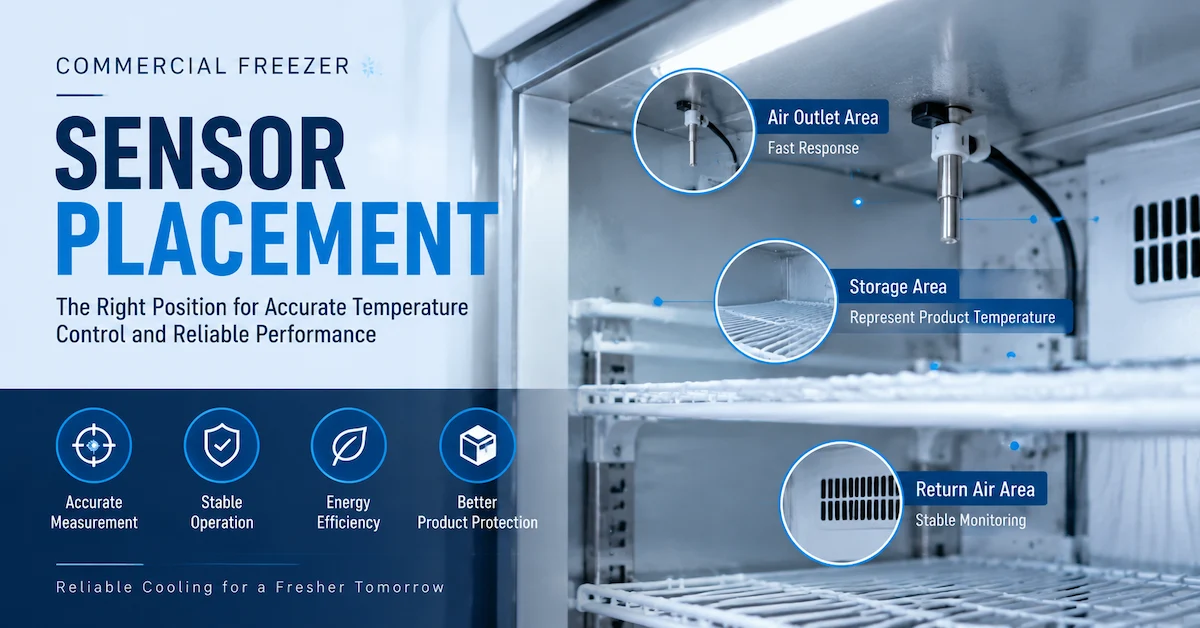
Single-Point or Multi-Point Measurement?
A single probe answers one narrow question:
When did this location reach the target?
It cannot independently show that the entire cabinet reached that condition.
Multi-point measurement can provide better insight into:
- Top-to-bottom differences
- Front-to-rear differences
- Door-side behavior
- Shelf zones
- Slowest-cooling locations
The appropriate probe layout depends on cabinet type and test requirements, so there is no need to invent a universal sensor count.
What matters for purchasing is knowing where measurements were taken.
How Interior Layout Can Affect Pull Down Performance
A freezer is not tested in isolation from its usable storage arrangement.
Shelves, baskets and products can modify airflow and effective cooling paths.
Very dense loading may look efficient from a storage-capacity perspective while making air distribution more difficult.
For customized projects, review the OEM freezer custom interior layout guide.
Buyers should think about both:
How much product fits?
and:
How does that product arrangement affect cooling?
Those questions belong in the same engineering discussion.
Common Mistakes When Comparing Supplier Pull-Down Data
| Procurement Mistake | Why It Creates Risk |
|---|---|
| Comparing only the final number of minutes | Conditions may be different |
| Ignoring starting temperature | Tests may not have equal thermal load |
| Comparing loaded and empty results | They describe different situations |
| Looking only at the controller display | One value may not represent the cabinet |
| Ignoring probe location | The fastest location may dominate the claim |
| Ignoring ambient conditions | Cooling load can change significantly |
| Changing components after sample testing | Earlier data may no longer represent production |
| Ignoring the endpoint definition | Suppliers may stop tests using different criteria |
For a technical buyer, preventing these comparison errors is often more valuable than chasing the smallest advertised pull-down number.
What Should Buyers Ask a Commercial Freezer Supplier?
| Evaluation Area | Buyer Question |
|---|---|
| Starting condition | Where did the test begin? |
| Endpoint | How was pull-down completion defined? |
| Ambient | Under what conditions was the freezer tested? |
| Loading | Was it empty,loaded or simulated? |
| Probe position | Where was temperature measured? |
| Test data | Can time-temperature curves be reviewed? |
| Uniformity | Did different areas cool at similar rates? |
| Configuration | Does the test unit match the quoted production model? |
| QC | How is the approved configuration controlled? |
| OEM | Can a buyer-defined test requirement be evaluated? |
A clear technical answer to these questions is more useful than a general claim of “fast cooling.”
Sample Performance Must Match Production Configuration
Testing a sample is valuable only when buyers know what the sample represents.
If mass production later changes:
- Compressor
- Controller
- Refrigeration components
- Cabinet dimensions
- Insulation
- Fan configuration
- Shelf arrangement
- Other relevant parts
the original result may need to be reviewed.
For broader production controls, see Snowsea's commercial freezer quality testing procedure.
The practical procurement goal is not simply to obtain one good sample. It is to control the configuration that produced the approved result.
Can Pull-Down Performance Be Evaluated for an OEM Project?
Yes, when the buyer provides a meaningful requirement.
For example, a buyer may have:
- A defined target operating condition
- A typical product load
- A specific cabinet size
- Expected ambient conditions
- A company test method
- A probe-position requirement
- A benchmark from an existing product
Snowsea can evaluate these requirements against the selected freezer platform and engineering feasibility through its OEM/ODM service.
Areas for technical review may include cabinet size, refrigeration-system matching, airflow, insulation, controller configuration, and interior arrangement.
The requirement should be evaluated as a complete system rather than solved by simply changing one component.
What Should Buyers Send Snowsea for a Technical Evaluation?
To make a pull-down discussion useful, provide:
- Freezer type or reference model
- Required cabinet dimensions
- Target operating temperature
- Expected starting condition
- Product being stored
- Product/package dimensions
- Typical product load
- Initial load condition, if defined
- Expected ambient environment
- Shelf or basket arrangement
- Pull-down target,if already specified
- Existing test method
- Probe-layout requirement
- Destination market
- Sample/testing requirement
- Initial order quantity
- Annual forecast
- Project schedule
If you already have a cooling curve or benchmark from another freezer, include it.
That is far more useful to an engineering team than simply asking for “the fastest commercial freezer.”
You can also review Snowsea commercial refrigeration products before preparing your RFQ.
FAQ
What is commercial freezer pull down time?
It is the time required for a freezer to move from a defined starting condition toward a defined target condition under specified test conditions.
How is freezer pull down time measured?
The freezer is operated from an agreed starting state while temperature is recorded over time at defined measurement locations until the specified endpoint is reached.
What is a good commercial freezer pull down time?
There is no useful universal number. Freezer type, cabinet size, starting temperature, target condition, ambient environment, loading and measurement method all need to be defined before results can be compared.
Does cabinet size affect freezer cooling time?
Yes. Cabinet dimensions influence the thermal load and must be considered together with insulation and refrigeration-system capacity.
Does product loading increase pull down time?
It can materially change the result because the refrigeration system is cooling both the cabinet and the thermal mass of the load.
Is empty freezer pull-down testing useful?
Yes, particularly for controlled engineering comparison, but it should not automatically be treated as representative of a fully loaded operating freezer.
Does ambient temperature affect pull-down performance?
Yes. The surrounding environment affects the heat load on the cabinet, so ambient conditions should be included with the test result.
What is the difference between pull down time and temperature recovery?
Pull down concerns cooling from a defined starting state. Recovery evaluates how the freezer returns toward its operating condition after a disturbance.
Is faster pull down always better?
No. Cooling speed should be evaluated together with temperature uniformity, stability, energy performance, component matching and long-term operating requirements.
What pull-down test data should I request from a supplier?
Ask for the freezer configuration, starting condition, target criterion, ambient condition, loading method, probe locations and temperature-versus-time data.
Conclusion
Commercial freezer pull down time can be a valuable performance metric, but a bare number of minutes is not enough for a serious B2B comparison.
Technical buyers should ask:
- What was the starting condition?
- What was the target?
- How was the endpoint defined?
- What was the ambient environment?
- Was the cabinet empty or loaded?
- Where were the probes installed?
- Did all relevant areas cool at a similar rate?
- Does the tested sample match the quoted production configuration?
Those questions turn a marketing claim into usable procurement evidence.
If your project has a defined cooling-performance requirement, send Snowsea your freezer type, cabinet size, target operating temperature, starting condition, product load, ambient requirement, shelf or basket arrangement, pull-down target or test method, destination market, sample requirement, and estimated order quantity through the Snowsea contact page.
Snowsea can evaluate the refrigeration configuration, airflow and cabinet requirements, testing scope, OEM feasibility, production considerations, and commercial requirements before preparing a technical proposal and quotation.