What Is Commercial Freezer Temperature Uniformity?
Commercial freezer temperature uniformity describes how consistently temperature is maintained at different points within the usable storage area under defined operating conditions.
That sounds simple, but there is an important detail: one temperature reading does not tell you how the whole cabinet is performing.
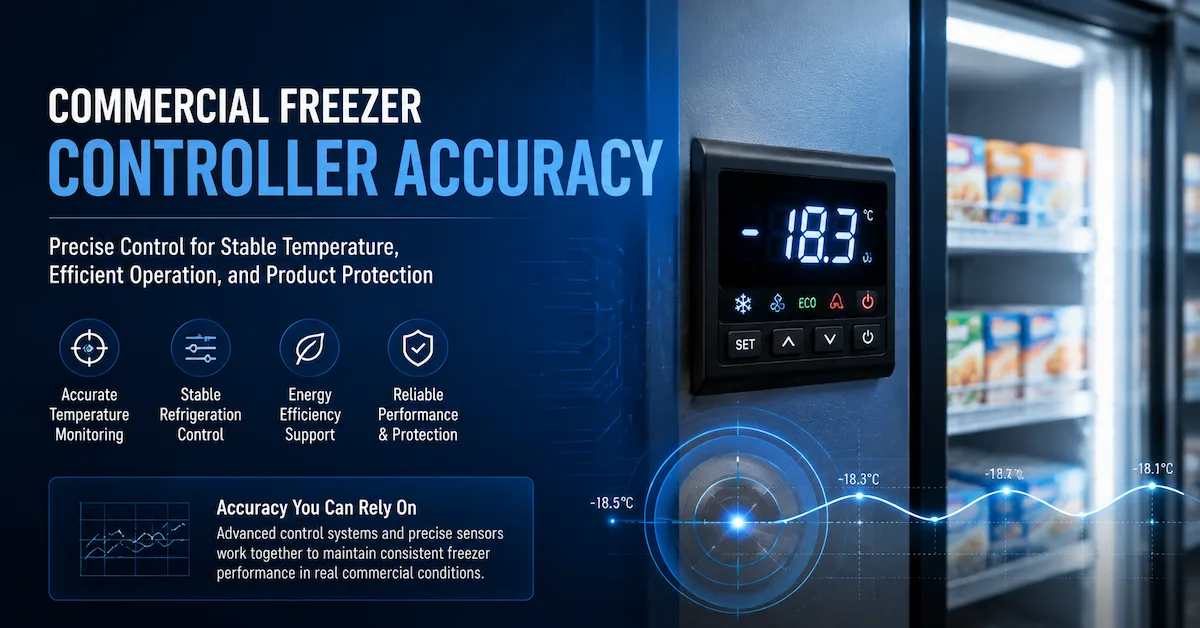
A controller might show -18°C while another location inside the cabinet behaves differently. The display is useful for controlling the refrigeration system. It is not a complete temperature map.
For a distributor, private-label brand, or technical buyer, this distinction matters because stored products occupy the whole usable cabinet—not the spot where one sensor happens to be installed.
A freezer can reach its target temperature and still have uneven temperature distribution inside the cabinet.
Temperature Range and Temperature Uniformity Are Different
These two specifications are often mixed together during sourcing.
| Performance Item | What It Tells the Buyer |
|---|---|
| Temperature range | What operating temperatures the freezer can target |
| Temperature uniformity | How evenly temperature is distributed inside |
| Pull-down performance | How the cabinet cools from a warmer starting condition |
| Temperature recovery | How it recovers after a disturbance |
| Energy consumption | How much energy is used under defined test conditions |
A freezer may therefore have a suitable operating range but still require closer examination of its internal temperature distribution.
If your project is still defining the required operating range, see the OEM freezer custom temperature range guide.
For door-opening behavior, Snowsea also covers commercial freezer temperature recovery.
Why the Controller Display Is Not Enough
Imagine an upright freezer with a digital display reading -18°C.
Does that mean the upper shelf, lower shelf, front edge, rear corner and door-side storage area are all exactly -18°C?
No conclusion like that can be made from the display alone.
The controller may use one sensor location and a control algorithm designed to switch the refrigeration system on and off. Its displayed value is not a substitute for measurements taken across the storage space.
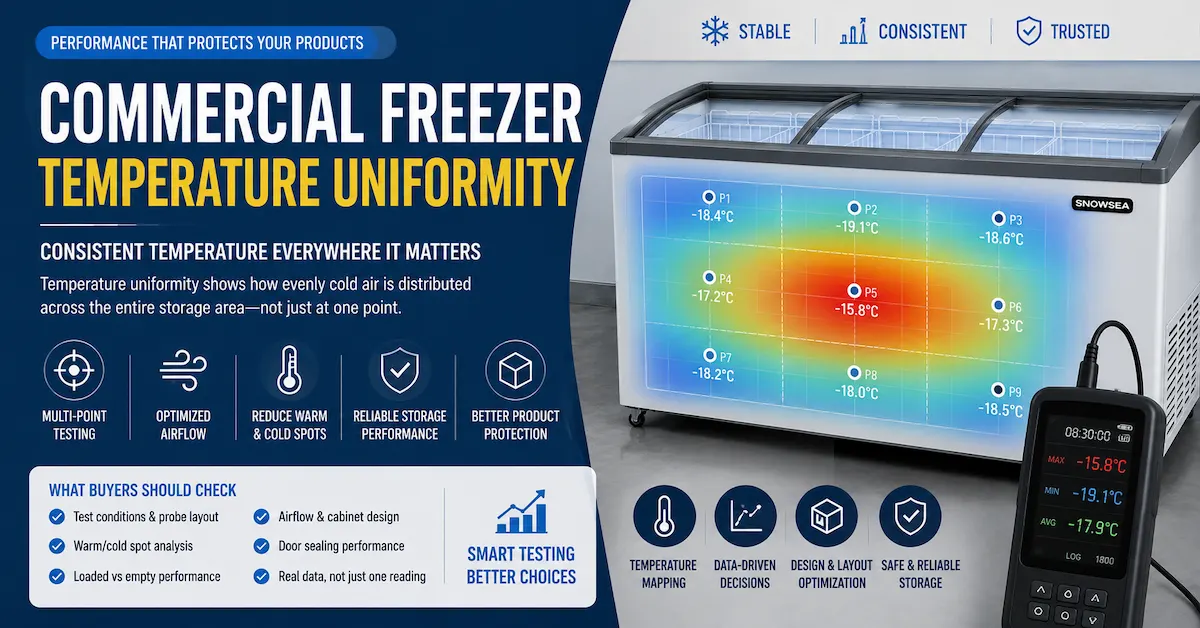
This is why temperature mapping is useful.
A mapping test looks at multiple locations and shows how the cabinet behaves as a thermal system rather than reducing performance to a single number.
What Causes Temperature Differences Inside a Commercial Freezer?
There is rarely one isolated cause.
Airflow
In cabinets using forced-air circulation, the path taken by cold air has a major influence on temperature distribution.
Shelves, baskets and products can change that path. A layout that looks neat may create areas where air movement is restricted.
Snowsea discusses this in more detail in its commercial freezer airflow circulation design guide.
Cabinet Geometry
Height, width, depth and compartment shape matter.
A tall upright cabinet presents a different airflow problem from a chest freezer. A wide display cabinet creates another set of conditions.
Uniformity therefore has to be judged on the actual cabinet architecture.
Product Loading
An empty cabinet and a heavily loaded cabinet do not behave in exactly the same way.
Packages can:
- Block circulation paths
- Change thermal mass
- Reduce open space
- Change the relationship between products and sensors
- Create densely packed regions
This is why the highest possible loading density is not automatically the best thermal arrangement.
The connection between storage layout and cooling performance is also discussed in the OEM freezer custom interior layout guide.
Door and Gasket Area
The door is part of the cabinet's thermal boundary.
Door construction, opening frequency, alignment and gasket sealing can affect heat entering the storage space, particularly around access areas.
For related checks, see freezer door gasket sealing performance.
Refrigeration and Control System
Compressor capacity, evaporator configuration, fan operation and controller logic all contribute to cabinet behavior.
But turning one controller setting up or down is not a universal fix for poor uniformity. The result comes from the complete refrigeration system working with the cabinet.
Temperature Uniformity Is a System Result
This point is worth stressing because it changes how a buyer should evaluate samples.
Temperature uniformity is the combined result of refrigeration capacity, airflow, insulation, cabinet geometry, loading pattern, door design and control behavior.
If a supplier responds to every temperature-distribution question by talking only about compressor size, the evaluation is incomplete.
The same applies if the discussion focuses only on insulation thickness or controller settings.
Each component matters, but buyers are purchasing a freezer system.
How Should Commercial Freezer Temperature Uniformity Be Tested?
There is no useful temperature-uniformity result without a defined test condition.
A technical comparison should identify, where relevant:
- Ambient condition
- Target or set temperature
- Cabinet stabilization condition
- Empty or loaded condition
- Product or simulated load
- Sensor quantity
- Sensor locations
- Recording period
- Data interval
- Door operation
- Defrost behavior where relevant
- Maximum, minimum and average readings
These details are important because two suppliers can produce very different-looking test results simply by using different setups.
A number without its test context is difficult to compare.
A temperature-uniformity result has little procurement value unless the conditions behind that result are also explained.
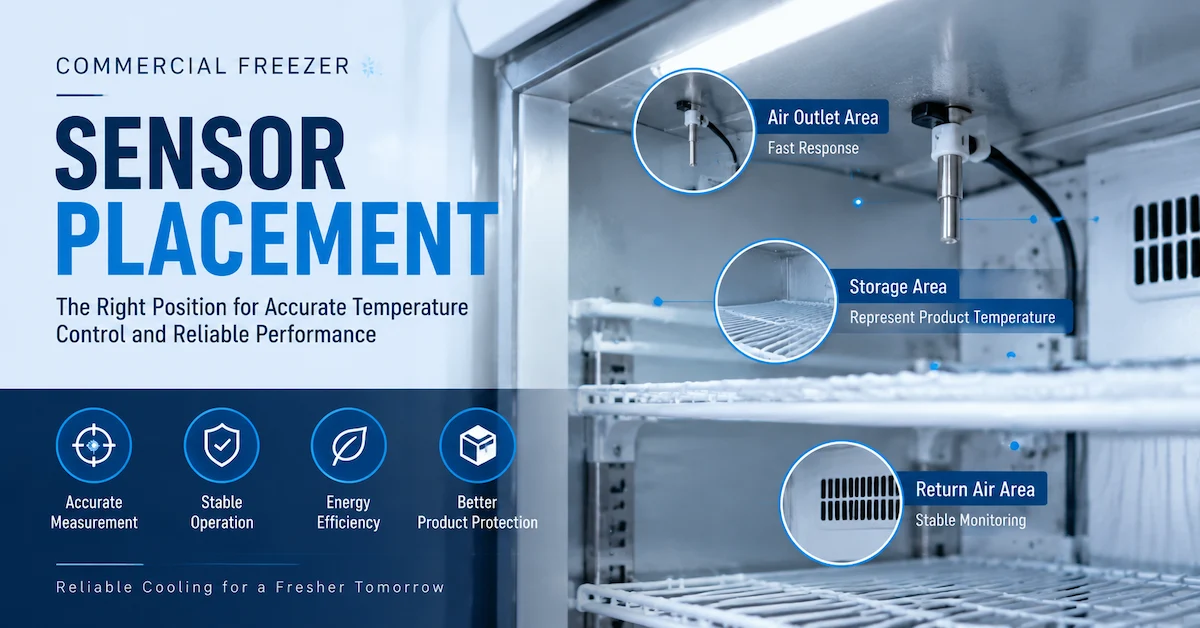
Where Should Temperature Probes Be Placed?
Probe placement should represent the storage space being evaluated.
Depending on cabinet type and the buyer's test method, measurements may include representative areas such as:
- Upper storage zone
- Middle area
- Lower area
- Front
- Rear
- Center
- Near-door locations
- Other thermally relevant positions
The exact pattern should follow the project's test requirement rather than an invented universal layout.
When reviewing supplier data, ask for the probe map.
A graph showing seven temperature curves is much less useful if nobody tells you where those seven sensors were installed.
Empty Cabinet or Loaded Cabinet: Which Test Matters More?
Both can provide useful information, but they answer slightly different questions.
An empty-cabinet test can make basic engineering comparison easier because the setup is simpler.
A loaded test may better represent actual operation, but its result depends heavily on how the load is defined.
For example:
- What product was used?
- How much was loaded?
- Where was it placed?
- Was airflow clearance maintained?
- Were shelves fully occupied?
So a loaded result is not automatically “better” unless the loading method is also documented.
Temperature data should always be interpreted together with the cabinet loading condition.
Warm Spots and Cold Spots: What Do They Mean?
A warm spot is a location that remains warmer than other measured areas during the relevant test period.
It does not automatically mean the freezer is defective.
The first questions should be:
- Is the difference persistent?
- Where is the point located?
- Is it inside the actual product-storage zone?
- Was airflow blocked?
- Was it close to the door?
- Was the cabinet loaded?
- Did the difference appear during a particular operating cycle?
The same logic applies to cold spots.
Making one corner as cold as possible is not the goal. Stable product storage across the intended usable zone is more meaningful.
How Interior Layout Changes Temperature Distribution
Shelf and basket configuration can look like a capacity question, but it is also a thermal question.
A shelf arrangement may affect:
- Supply-air movement
- Return-air path
- Space between packages
- Vertical circulation
- Accessibility
- Storage density
If an OEM project changes shelf quantity or spacing, thermal behavior should not be ignored.
See Snowsea's OEM freezer custom shelf system guide for the mechanical side of shelf configuration.
A useful design rule is:
More usable volume on paper does not always mean better usable refrigeration performance.
How to Read a Temperature Mapping Report
Do not look only at the average temperature.
Start with the test setup.
Then check:
- Where the probes were located
- Whether the cabinet was empty or loaded
- The highest measured area
- The lowest measured area
- How values changed over time
- Whether differences were temporary or persistent
- What happened during compressor cycling
- Whether defrost affected the result where applicable
- Whether the test reflects the buyer's intended application
An average can hide a lot.
If half the cabinet is warmer and half is colder, the mathematical average might look perfectly reasonable while the actual storage distribution is less convincing.
An acceptable average cabinet temperature does not prove that every important storage area behaves similarly.
What Should B2B Buyers Compare Between Freezer Suppliers?
Use the test method as part of supplier evaluation, not only the final temperature number.
| Evaluation Point | What to Ask |
|---|---|
| Test conditions | What ambient and operating conditions were used? |
| Probe layout | Where were temperatures measured? |
| Loading | Was the cabinet empty or loaded? |
| Raw data | Are temperature curves available? |
| Warm/cold zones | Were extremes identified? |
| Airflow | Was product or shelf obstruction considered? |
| Sample | Can the requested configuration be verified? |
| Production | How is the approved configuration controlled? |
| OEM changes | What happens if layout or components change? |
| Documentation | Can the supplier explain the test clearly? |
A clear explanation is often more valuable than a polished performance claim with no supporting context.
Common Procurement Mistakes
Looking Only at Set Temperature
The setpoint tells you what the controller is trying to achieve. It does not describe the complete cabinet.
Comparing Results From Different Test Conditions
A loaded cabinet in a warm environment should not be casually compared with an empty cabinet tested under different conditions.
Ignoring Product Layout
A technically good empty-cabinet result may change after products block circulation paths.
Changing the Sample After Testing
If the final product changes compressor, controller, internal layout, door structure or other relevant components, earlier results may no longer represent the final production configuration.
That is a procurement issue, not just an engineering issue.
Can Temperature Uniformity Be Improved in an OEM Project?
Sometimes a buyer has a specific temperature-distribution target because of the intended product, operating environment, or internal corporate test standard.
In that case, Snowsea can evaluate the requirement together with the selected freezer platform and engineering feasibility.
Areas for review may include:
- Cabinet dimensions
- Airflow arrangement
- Shelf or basket layout
- Door configuration
- Controller configuration
- Refrigeration-system selection
- Product loading pattern
The right solution depends on what the test shows. There is no responsible universal claim that changing one component will always improve uniformity.
Buyers with a defined test method can send it during the Snowsea OEM/ODM evaluation stage.
What Should Buyers Send for a Technical Evaluation?
To make the discussion useful, provide more than a target temperature.
Useful project information includes:
- Freezer type
- Reference model
- Required operating temperature
- Product being stored
- Product/package dimensions
- Typical loading quantity
- Shelf or basket arrangement
- Intended ambient condition
- Cabinet dimension limits
- Temperature-distribution target, if defined
- Existing test specification
- Required probe layout, if applicable
- Destination market
- Initial order quantity
- Annual forecast
- Sample/testing requirement
- Project schedule
If you already have a temperature map from another unit, include it. The same applies to your own corporate test method or probe-position drawing.
That gives an engineering team something concrete to evaluate instead of a vague request for “better temperature consistency.”
FAQ
What is commercial freezer temperature uniformity?
It describes how consistently temperature is maintained at different locations within the usable storage area under defined test and operating conditions.
Why are temperatures different in different parts of a freezer?
Differences can result from airflow, cabinet geometry, product loading, door conditions, refrigeration-system behavior and sensor location.
Is the controller display enough to judge uniformity?
No. A controller normally represents one sensing and control point, not a full map of the cabinet.
How is commercial freezer temperature uniformity tested?
Multiple temperature sensors are positioned in representative storage areas, with the test conditions, loading state, operating period and data-recording method clearly defined.
Where should temperature probes be placed?
They should represent relevant storage zones. The exact layout depends on cabinet type and the buyer's test method or applicable specification.
Does loading affect freezer temperature distribution?
Yes. Product packages and shelf loading can change airflow, thermal mass and the amount of open circulation space.
How does airflow affect temperature consistency?
Poorly distributed or obstructed airflow can create areas that behave differently from the rest of the cabinet.
What is the difference between temperature uniformity and temperature recovery?
Uniformity concerns temperature differences across locations. Recovery concerns how the freezer responds after a disturbance such as door opening.
Can an OEM freezer be optimized for better temperature uniformity?
A buyer can submit a defined requirement for engineering evaluation. Possible areas for review include airflow, layout, cabinet design, refrigeration configuration and controls.
What test evidence should I request from a freezer supplier?
Ask for the test conditions, probe map, loading condition, temperature data or curves, product configuration and an explanation of any significant warm or cold areas.
Conclusion
Commercial freezer temperature uniformity cannot be judged from one digital display, one sensor, or one average value.
For technical procurement, the more useful questions are:
- Where was temperature measured?
- Under what conditions?
- Was the freezer loaded?
- How large were the differences between locations?
- Were warm or cold areas persistent?
- Did shelves or products affect airflow?
- Does the tested unit match the production configuration?
That information makes supplier comparisons far more meaningful.
If your project has a defined temperature-distribution requirement, send Snowsea your freezer type, target temperature, product dimensions, loading arrangement, shelf or basket layout, ambient condition, cabinet-size limits, test method or probe layout, destination market, sample requirement, and estimated order quantity through the contact page.
Snowsea can evaluate the requested configuration, airflow and interior-layout considerations, testing scope, OEM feasibility, and commercial requirements before preparing a technical proposal and quotation.