What Is Commercial Freezer Thermal Bridge Control?
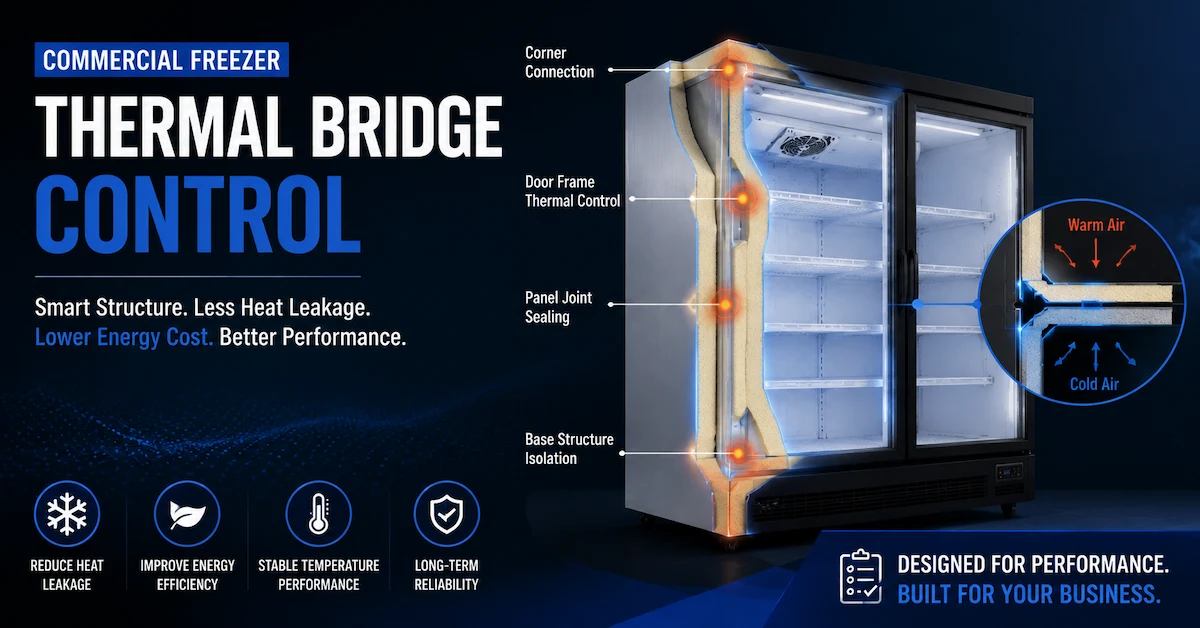
Commercial freezer thermal bridge control refers to the engineering methods used to reduce unwanted heat transfer paths through the freezer structure.
A commercial freezer relies on insulation to separate the warm external environment from the cold storage area. Ideally, heat should be controlled by the insulation layer and cabinet structure.
However, some areas of a freezer may allow heat to transfer more easily than surrounding sections.
These areas are commonly called thermal bridges.
A thermal bridge can occur where different materials, structural connections, or design features create a more direct heat-transfer path.
Typical locations may include:
- Door frame areas
- Panel joints
- Cabinet corners
- Structural connections
- Hardware installation points
- Material transition areas
For B2B buyers, thermal bridge control is not only an insulation topic.
It is a complete cabinet design consideration involving:
- Structure
- Materials
- Assembly process
- Door system
- Sealing
- Testing
- Long-term operating performance
A freezer with good thermal bridge control can better maintain separation between external heat and internal cold conditions.
Why Thermal Bridge Control Matters in Commercial Freezers
Commercial freezers operate continuously in environments where temperature differences are always present.
The outside environment may be warm, while the cabinet interior requires stable low-temperature conditions.
Without effective thermal bridge control, unwanted heat transfer may increase the cooling demand placed on the refrigeration system.
This can influence:
- Compressor operating time
- Temperature stability
- Energy consumption behavior
- Long-term refrigeration performance
However, thermal bridge control should always be evaluated as part of the complete freezer system.
Cabinet structure, refrigeration components, airflow design, operating environment, and loading conditions all contribute to final performance.
A thermal bridge is not simply an insulation thickness issue.
It is a structural heat-transfer management issue.
Thermal Bridge Control vs Insulation Thickness
A common purchasing mistake is focusing only on insulation thickness.
More insulation material does not automatically mean better thermal performance.
Two freezer cabinets may have similar insulation thickness but different performance because their structural designs are different.
The difference often comes from:
- How insulation layers connect
- Whether gaps exist
- How panels are joined
- How doors are constructed
- How metal components interact with the cabinet structure
The relationship can be summarized as:
| Evaluation Factor | Main Question |
|---|---|
| Insulation thickness | How much insulation material is used? |
| Thermal bridge control | Are there easier heat-transfer paths around the insulation? |
For commercial refrigeration projects, buyers should evaluate the entire thermal design instead of selecting equipment based on one specification.
Common Thermal Bridge Areas in Commercial Freezers
Door Frame and Door Structure
The door area is one of the most important regions for thermal performance.
Unlike fixed cabinet panels, doors are repeatedly opened and closed during commercial operation.
Important considerations include:
- Door frame design
- Insulation continuity
- Gasket sealing
- Closing performance
- Material connection
A door system must balance:
- Easy access
- Reliable sealing
- Structural strength
- Thermal performance
For supermarkets, convenience stores, and foodservice applications, frequent door operation makes door thermal design especially important.
Panel Joints and Connection Areas
Commercial freezer cabinets are assembled from multiple structural sections.
Connection points between panels require careful attention because they may become potential heat-transfer paths.
Buyers should evaluate:
- Panel connection design
- Joint sealing method
- Assembly consistency
- Production quality control
A well-designed insulation system should maintain continuity across these connection areas.
Cabinet Corners
Corners often involve more complex geometry compared with flat panel areas.
They may include:
- Multiple material transitions
- Structural reinforcement
- Assembly connections
Because of this complexity, corners should be considered during thermal design evaluation.
The goal is not simply adding more insulation but reducing unnecessary heat-transfer paths.
Hardware and Structural Components
Some structural components may connect warmer external areas with colder internal structures.
During design evaluation, engineers should consider:
- Material selection
- Component placement
- Connection methods
- Thermal separation strategies
Small structural details can influence the overall thermal behavior of a commercial freezer.
How Thermal Bridges Affect Energy Performance
Commercial freezer energy consumption depends on many factors:
- Compressor efficiency
- Refrigeration system design
- Ambient temperature
- Door opening frequency
- Product loading
- Cabinet insulation
- Thermal leakage
Thermal bridges can become one contributor to additional heat entering the cabinet.
When more heat enters the storage area, the refrigeration system may need to remove that additional load.
This is why thermal design should be evaluated together with energy testing.
For related evaluation methods, see:
Commercial Freezer Energy Consumption Test
A reliable comparison should always define:
- Test environment
- Cabinet temperature
- Loading condition
- Operating duration
- Complete freezer configuration
Thermal Bridge Control and Temperature Stability
Temperature stability is one of the most important concerns for commercial freezer buyers.
Poor thermal design may create areas where external heat influence is stronger.
Potential results may include:
- Local temperature differences
- Increased cooling demand
- More difficult temperature control
- Different thermal behavior between cabinet zones
However, thermal bridges are only one possible factor.
Temperature performance also depends on:
- Cold air distribution
- Evaporator design
- Fan operation
- Product arrangement
- Controller settings
For complete cabinet evaluation, thermal bridge control should be reviewed together with temperature mapping.
Related guide:
Commercial Freezer Temperature Uniformity
Relationship Between Thermal Bridge Control and Cold Air Distribution
Thermal bridge control and cold air distribution solve different problems.
Cold air distribution focuses on:
How cold air moves inside the cabinet
Thermal bridge control focuses on:
How external heat enters the cabinet structure
The relationship can be understood as:
External Heat Control + Internal Cold Air Management = Complete Thermal Performance
A freezer may have excellent airflow design but still experience higher heat leakage if the cabinet structure is not properly controlled.
Likewise, strong insulation alone cannot compensate for poor internal airflow distribution.
For related airflow considerations:
Commercial Freezer Cold Air Distribution
Thermal Bridge Control and Compressor Operation
The refrigeration system responds to the thermal load created by the cabinet environment.
If additional heat enters through structural paths, the refrigeration system may need to manage a higher cooling demand.
This may influence:
- Compressor runtime
- Cooling recovery behavior
- Operating patterns
However, compressor behavior cannot be judged from thermal bridge performance alone.
A complete evaluation should consider:
- Cabinet structure
- Refrigeration system
- Ambient conditions
- Product load
- Controller settings
For compressor operation evaluation:
Commercial Freezer Compressor Cycling
Thermal Bridge Control in High Ambient Applications
Thermal bridge control becomes especially important when freezers operate in demanding environments.
Examples include:
- Hot climates
- Commercial kitchens
- Warehouses
- High-temperature retail locations
Higher ambient conditions increase the temperature difference between outside and inside the cabinet.
This creates greater pressure on the freezer's thermal design.
However, high ambient performance is not determined by insulation alone.
It depends on the complete system:
- Cabinet structure
- Condenser performance
- Compressor selection
- Airflow design
- Thermal control
Related guide:
Commercial Freezer High Ambient Performance
How Should Buyers Evaluate Thermal Bridge Performance?
B2B buyers should avoid relying on one specification.
A stronger evaluation considers the complete cabinet structure.
| Evaluation Area | Buyer Should Verify |
|---|---|
| Cabinet structure | How is insulation continuity maintained? |
| Door system | How are frame and sealing areas designed? |
| Panel joints | How are connection areas controlled? |
| Materials | Are thermal and structural requirements balanced? |
| Assembly | Is production consistency controlled? |
| Testing | Are thermal performance results verified? |
| Energy | Are results connected with actual operation? |
| OEM capability | Can the design be adapted for project needs? |
The supplier should be able to explain not only what materials are used but also how the complete structure manages heat transfer.
How Is Thermal Bridge Control Tested?
Thermal performance evaluation should define the test conditions.
Useful verification methods may include:
Temperature Measurement
Temperature measurements can help identify areas with different thermal behavior.
Important factors include:
- Measurement location
- Ambient condition
- Cabinet operating condition
- Test duration
Thermal Imaging
Infrared thermal imaging can help visualize surface temperature differences.
It may help identify areas requiring further investigation, such as:
- Door frames
- Corners
- Panel joints
- Structural connections
However, thermal imaging should be combined with engineering analysis rather than used as the only evaluation method.
Energy Performance Testing
Energy tests help evaluate how the complete freezer performs over time.
The test should define:
- Ambient condition
- Target temperature
- Loading condition
- Operating duration
- Product configuration
There is no universal thermal bridge performance number suitable for every freezer design.
Testing should match the actual project requirements.
Common Procurement Mistakes
| Mistake | Why It Creates Risk |
|---|---|
| Comparing insulation thickness only | Does not show complete thermal design |
| Ignoring door structure | Door areas can influence heat leakage |
| Testing only initial cooling | Does not show long-term performance |
| Changing cabinet structure after approval | Original test data may no longer apply |
| Ignoring production consistency | Mass production may differ from samples |
| Evaluating thermal bridges separately | Complete freezer performance is system-based |
A professional supplier should help buyers evaluate the complete design instead of promoting one isolated feature.
OEM Thermal Bridge Control Considerations
For OEM freezer projects, thermal bridge control should be considered early in product development.
Useful project information includes:
- Freezer type
- Cabinet dimensions
- Target storage temperature
- Ambient operating environment
- Door configuration
- Panel structure requirements
- Insulation expectations
- Energy target
- Temperature uniformity requirement
- Testing standard
- Destination market
- Order quantity
Based on these requirements,engineers can evaluate:
- Cabinet structure
- Insulation approach
- Door design
- Thermal risk areas
- Testing requirements
- Production feasibility
OEM customization is not only about changing appearance.
It is about matching the freezer structure to the customer's operating conditions.
What Should Buyers Ask a Freezer Supplier?
Before selecting a supplier, buyers should ask:
- How is insulation continuity maintained?
- How are door thermal leakage risks controlled?
- How are panel joints designed?
- Are thermal performance tests available?
- Does production match approved samples?
- Can cabinet structures be customized?
- Can the supplier support OEM requirements?
A supplier who understands thermal design can provide more reliable long-term value than one who only compares component prices.
FAQ
What is commercial freezer thermal bridge control?
Commercial freezer thermal bridge control refers to design methods that reduce unwanted heat transfer paths through cabinet structures, joints, doors, and connections.
Why is thermal bridge control important for freezers?
It helps reduce unnecessary heat transfer into the cabinet and supports stable refrigeration performance.
Does thicker insulation eliminate thermal bridges?
Not necessarily. Thermal performance also depends on structure, connections, materials, and assembly quality.
Where do thermal bridges commonly occur in commercial freezers?
Common areas include doors, panel joints, corners, and structural connection points.
How do door frames affect freezer thermal performance?
Door frames and sealing areas can influence heat transfer because they connect the external environment with the cold storage area.
Can thermal bridges increase energy consumption?
Thermal bridges may contribute to additional heat load, which should be evaluated together with complete freezer energy testing.
How can buyers test thermal bridge performance?
Buyers can combine temperature measurement, thermal imaging, structural review, and energy testing under defined conditions.
Does thermal bridge control improve temperature uniformity?
It can support stable thermal conditions, but temperature uniformity also depends on airflow, refrigeration design, and loading.
What information should OEM buyers provide?
OEM buyers should provide cabinet size, temperature requirements, ambient conditions, door design, energy targets, and testing requirements.
Can Snowsea customize freezer structures for thermal performance?
Snowsea can evaluate cabinet structure, insulation design, refrigeration matching, and OEM requirements according to the selected freezer platform and project conditions.
Conclusion
Commercial freezer thermal bridge control is a structural design factor that influences how effectively a freezer separates external heat from internal cold conditions.
For B2B buyers, evaluating thermal performance requires more than checking insulation thickness.
A complete assessment should consider:
- Cabinet structure
- Door design
- Panel connections
- Material selection
- Assembly quality
- Energy performance
- Temperature stability
- OEM requirements
The best commercial freezer design is not simply the one with the thickest insulation.
It is the one where the complete structure, refrigeration system, airflow design, and manufacturing process work together to maintain reliable performance.
Send Snowsea your freezer type, cabinet dimensions, target temperature, ambient conditions, door configuration, insulation requirements, energy target, temperature-uniformity requirements, testing standards, destination market, and estimated order quantity through the Snowsea contact page.
Snowsea can evaluate cabinet thermal design, insulation structure, refrigeration-system matching, testing scope, OEM feasibility, and commercial project requirements before preparing a technical proposal and quotation.