Why Anti-Corrosion Performance Matters in Commercial Freezers
Choosing the right Freezer Cabinet Anti Corrosion Material is important for commercial refrigeration equipment that may operate for years around moisture, condensation, cleaning chemicals, food residue, and frequent daily use.
For importers and distributors, corrosion is more than an appearance issue. Once cabinet surfaces, seams, fasteners, or structural areas begin to deteriorate, the equipment may require more maintenance and become harder to keep clean. Severe corrosion can also affect panels, hinges, mounting points, and other cabinet components.
The best material therefore depends on where and how the freezer will be used.
A supermarket freezer in a climate-controlled store does not face the same corrosion risk as equipment installed in:
- Seafood markets
- Restaurant kitchens
- Coastal regions
- High-humidity climates
- Food-processing environments
- Locations requiring frequent chemical cleaning
Commercial buyers should specify the expected environment before comparing materials.
Snowsea offers different commercial refrigeration products for retail, food-service, and frozen-food applications, where cabinet configuration and material requirements can vary according to the project.
What Causes Corrosion in a Freezer Cabinet?
Corrosion occurs when metal reacts with its surrounding environment. In commercial refrigeration, several operating conditions can accelerate this process.
Condensation and Moisture
Temperature differences between refrigerated surfaces and warmer ambient air can create condensation.
Repeated exposure to moisture may affect:
- Cabinet edges
- Door frames
- Hinges
- Fasteners
- Bottom panels
- Drainage areas
Areas where water remains trapped generally require more attention than surfaces that dry quickly.
Cleaning Chemicals
Commercial equipment often needs regular cleaning.
Strong chemicals, inappropriate detergents, or cleaning residues left on metal surfaces can increase corrosion risk.
Material selection should therefore consider both refrigeration conditions and the customer's cleaning routine.
Salt and Coastal Environments
Salt-containing air can be particularly aggressive toward metal surfaces.
Freezers used near coastal areas, seafood processing locations, or other salt-rich environments may require stronger corrosion-resistant materials and better surface protection.
Scratches and Surface Damage
Coated steel depends partly on the integrity of its protective surface.
If the coating is deeply scratched or damaged, the exposed metal underneath may become more vulnerable to corrosion.
This means coating quality, fabrication accuracy, packaging, transportation, and installation all influence long-term durability.
Common Freezer Cabinet Anti-Corrosion Materials
Commercial freezer cabinets may use different materials for the external shell, internal liner, door frame, base, and structural components.
Stainless Steel
Stainless steel is widely used where durability, cleanability, and corrosion resistance are important.
Typical advantages include:
- Good moisture resistance
- Easy-to-clean surfaces
- Professional appearance
- Suitable for many food-service environments
- Strong long-term durability when properly maintained
However, not every stainless steel grade offers the same corrosion resistance.
For procurement projects, buyers should confirm the actual material grade rather than accepting the general description "stainless steel."
Coated Steel
Coated steel is commonly used in commercial refrigeration because it provides a practical balance between cost, appearance, and corrosion protection.
The metal substrate is protected by a surface coating designed to reduce direct exposure to moisture and air.
Advantages can include:
- Competitive material cost
- Multiple surface colors
- Suitable appearance for retail equipment
- Good corrosion protection under normal indoor conditions
Its long-term performance depends heavily on coating quality and resistance to scratching.
Galvanized Steel
Galvanized steel uses a zinc-based protective layer to help protect the underlying steel.
It is often suitable for:
- Structural parts
- Internal support components
- Base structures
- Areas not requiring a decorative finish
Buyers should still evaluate coating thickness, forming quality, cut edges, and the actual operating environment.
Pre-Painted Metal Panels
Pre-painted metal panels combine a metal substrate with a factory-applied finish.
They are often selected for commercial freezer external cabinets because they provide:
- Consistent appearance
- Color customization
- Surface protection
- Cost-effective mass production
For private-label projects, pre-painted panels can also support brand-specific cabinet colors.
Snowsea's OEM/ODM commercial refrigeration solutions can be discussed when buyers require customized cabinet appearance, material configuration, branding, or market-specific specifications.
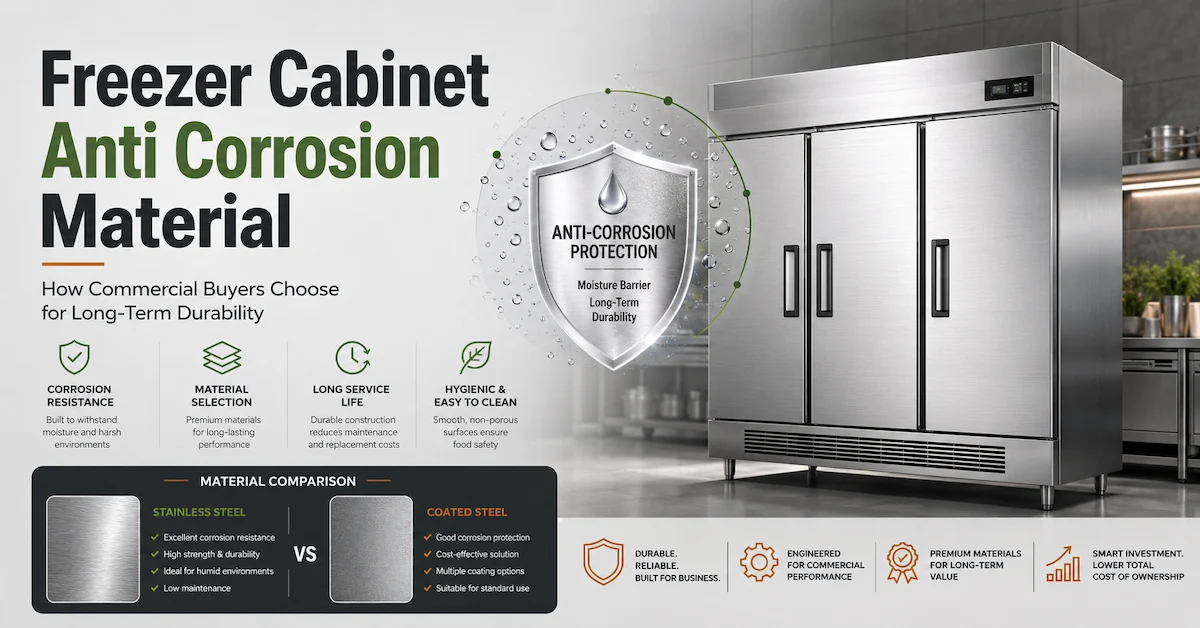
Freezer Cabinet Anti Corrosion Material Comparison
A practical Freezer Cabinet Anti Corrosion Material comparison should consider more than the purchase price of the raw material.
| Material | Corrosion Resistance | Appearance | Cost Level | Typical Use |
|---|---|---|---|---|
| Stainless steel | High in suitable environments | Premium | Higher | Food service, high-cleaning applications |
| Coated steel | Good when coating remains intact | Flexible | Medium | Retail and general commercial use |
| Galvanized steel | Good for many structural applications | Industrial | Medium | Frames, supports, internal structures |
| Pre-painted steel | Good for normal commercial environments | Highly customizable | Medium | Exterior cabinet panels |
No single material is automatically the best choice for every freezer.
The correct specification depends on:
- Installation environment
- Humidity
- Exposure to salt
- Cleaning frequency
- Cleaning chemicals
- Expected service life
- Target market price
- Appearance requirements
Stainless Steel Grade Matters
One common procurement mistake is specifying only "stainless steel."
Different grades have different compositions and corrosion behavior.
For commercial refrigeration buyers, important questions include:
- Which stainless steel grade is used?
- Is it used on the entire cabinet or only selected panels?
- What material is used for the inner liner?
- What material is used on the door frame?
- Are hinges and fasteners also corrosion resistant?
A freezer described as "stainless steel" may still contain other coated or galvanized components.
This is not necessarily a problem, but buyers should understand the complete material configuration before comparing quotations.
Corrosion Resistance Is More Than Cabinet Material
Material selection alone does not determine long-term performance.
Surface Coating Quality
A high-quality coating helps isolate the underlying metal from moisture.
Buyers should pay attention to:
- Coating consistency
- Surface adhesion
- Edge coverage
- Scratch resistance
- Color consistency
Panel Edges and Forming
Cutting and bending operations can create vulnerable edges if surface protection is damaged.
Manufacturing precision is therefore important.
Welding and Joint Areas
Welded or joined areas may require appropriate finishing and protection depending on the material and design.
Fasteners and Hinges
A corrosion-resistant cabinet can still experience problems if low-quality screws, hinges, brackets, or mounting hardware are used.
Buyers should evaluate the complete assembly rather than only the main panel.
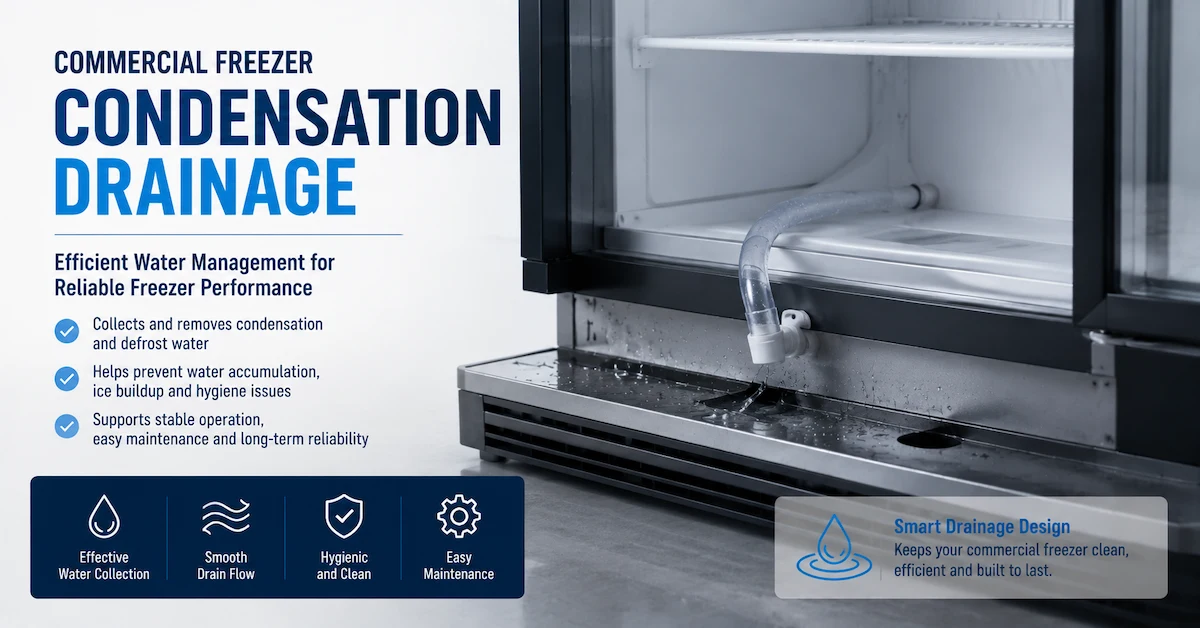
Drainage Design
Standing water increases corrosion risk.
Good drainage and cabinet geometry help prevent moisture from remaining in vulnerable areas.
Which Material Is Better for Different Applications?
Supermarkets and Convenience Stores
For general indoor retail environments, coated or pre-painted steel can provide a practical balance of:
- Appearance
- Corrosion resistance
- Cost
- Branding flexibility
The final choice depends on cleaning frequency and local climate.
Restaurants and Commercial Kitchens
Commercial kitchens may expose equipment to:
- High humidity
- Grease
- Water
- Frequent cleaning
Stainless steel surfaces can be valuable in these conditions because of their durability and cleanability.
Seafood and Frozen Food Applications
Seafood environments can involve additional moisture and salt exposure.
Buyers should consider stronger corrosion resistance and pay particular attention to:
- Inner cabinet materials
- Base panels
- Door frames
- Hinges
- Fasteners
Coastal Markets
Coastal environments may increase exposure to salt-containing air.
The procurement specification should therefore address not only cabinet panel material but also coating systems and exposed metal components.
Standard Dry Indoor Retail
Premium stainless construction may not always be economically necessary for a freezer used in a dry, controlled indoor location.
Selecting materials according to real operating conditions can provide better cost-performance than automatically choosing the most expensive option.
How Cabinet Materials Affect Total Ownership Cost
A lower initial cabinet cost does not always produce the lowest long-term cost.
Commercial buyers should consider:
Initial purchase price
Higher corrosion-resistant specifications may increase unit cost.
Maintenance
Surface deterioration can require refinishing, part replacement, or additional cleaning.
Appearance
Visible rust or coating damage can reduce the professional appearance of retail equipment.
Service life
Better material matching can help equipment maintain acceptable structural and cosmetic condition for longer.
Replacement risk
Poor material selection in aggressive environments may shorten the practical replacement cycle.
For B2B buyers ordering hundreds of units, these differences can become more important than a small change in factory price.
How Insulation and Cabinet Construction Relate to Material Selection
The exterior metal panel is only one part of the freezer cabinet.
A commercial freezer cabinet typically combines:
- Exterior panel
- Insulation layer
- Inner liner
- Structural components
- Door system
- Refrigeration components
Cabinet materials must work together with thermal insulation and structural design.
For buyers evaluating the complete cabinet rather than only surface material, Snowsea's freezer cabinet insulation performance comparison explains how insulation material, thickness, and construction influence thermal performance.
Door sealing also affects moisture and thermal conditions around the cabinet opening. See freezer door gasket sealing performance for related evaluation points.
How Manufacturers Control Corrosion Risk
Commercial freezer manufacturers should control corrosion resistance throughout production, not only during material purchasing.
Incoming Material Inspection
Material verification may include checking:
- Surface condition
- Material specification
- Coating quality
- Thickness consistency
- Visible defects
Cutting and Forming Control
Production should minimize unnecessary surface damage during:
- Cutting
- Bending
- Punching
- Assembly
Surface Inspection
Finished cabinet panels should be inspected for:
- Scratches
- Exposed metal
- Coating defects
- Discoloration
- Assembly damage
Moisture-Prone Area Inspection
Particular attention should be given to:
- Cabinet bottom
- Door frame
- Drain area
- Hinges
- Fasteners
- Joints and corners
Packaging Protection
Protective packaging is also important because cabinet panels can be scratched during handling and international transportation.
What B2B Buyers Should Confirm Before Ordering
Before approving a commercial freezer order, buyers should confirm the following:
| Procurement Question | Why It Matters |
| What is the outer cabinet material? | Determines exterior durability |
| What is the inner liner material? | Important for cleaning and moisture exposure |
| What stainless grade is used? | Different grades have different performance |
| What coating system is applied? | Influences coated-panel corrosion resistance |
| Are edges protected after forming? | Edge damage can expose base metal |
| What materials are used for hinges and fasteners? | Small components can become weak points |
| Is the cabinet suitable for coastal environments? | Important for salt exposure |
| Is the material suitable for frequent cleaning? | Cleaning may affect surface durability |
| Can cabinet materials be customized? | Important for OEM specifications |
| Can samples be evaluated before bulk orders? | Reduces procurement risk |
Importers should request a clear bill of materials or technical specification instead of relying only on broad marketing descriptions such as "premium metal cabinet."
Common Material Selection Mistakes
Choosing Only by Price
A cheaper panel specification may be reasonable for a dry indoor market but unsuitable for demanding environments.
Assuming All Stainless Steel Is the Same
Always confirm grade and where it is used.
Ignoring Small Components
Hinges, fasteners, brackets, and bottom structures can become corrosion weak points.
Ignoring Cleaning Practices
The material must tolerate the customer's real cleaning routine.
Ignoring Transportation Damage
A strong coating cannot protect the substrate if the surface is heavily scratched before installation.
FAQ
What is the best freezer cabinet anti corrosion material?
There is no universal best material. Stainless steel is commonly selected for demanding environments, while coated and pre-painted steel can provide good performance and better cost efficiency for normal indoor commercial applications.
Is stainless steel always better for commercial freezers?
Not necessarily. The ideal choice depends on environment, cleaning practices, budget, appearance requirements, and expected service life.
Why can stainless steel still develop corrosion marks?
Stainless steel is corrosion resistant, not completely immune. Salt, aggressive chemicals, surface contamination, or inappropriate maintenance can still affect its appearance and performance.
Is coated steel suitable for commercial freezers?
Yes. Properly manufactured coated steel is widely used for commercial freezer cabinets, particularly in normal indoor retail applications.
What is galvanized steel used for in freezers?
It can be used for structural components, frames, supports, bases, and other areas where zinc protection provides a practical corrosion-resistant solution.
Does cabinet corrosion affect freezer cooling performance?
Surface corrosion does not automatically cause cooling failure, but severe deterioration can affect structural components, seals, panels, and long-term equipment condition.
Which material is better for seafood applications?
Applications involving high moisture or salt exposure generally require stronger corrosion resistance. Buyers should evaluate the complete material specification rather than only the exterior panel.
What should buyers ask about stainless steel?
Confirm the grade, thickness, application area, surface finish, and whether associated hinges and fasteners use compatible corrosion-resistant materials.
Can OEM buyers customize freezer cabinet materials?
Yes. Depending on the freezer design and project volume, cabinet material, finish, color, inner liner, and other specifications may be customized.
How can buyers reduce corrosion problems after installation?
Use appropriate cleaning chemicals, remove standing water, avoid damaging protective coatings, maintain door seals, and follow the manufacturer's cleaning and maintenance instructions.
Conclusion
Selecting the right Freezer Cabinet Anti Corrosion Material requires balancing corrosion resistance, operating environment, cleaning conditions, appearance, service life, and procurement cost.
For importers, distributors, food-service equipment buyers, and private-label brands, the most important question is not simply whether a freezer uses stainless steel. Buyers should understand exactly which materials are used in the outer cabinet, inner liner, structural parts, hinges, fasteners, and moisture-prone areas.
A suitable material specification can reduce maintenance risk and help the cabinet retain its appearance and structural condition throughout commercial use.
Snowsea provides commercial refrigeration equipment and OEM/ODM solutions for global B2B projects. Explore Snowsea's commercial refrigeration products or contact Snowsea to discuss cabinet materials, corrosion-resistant configurations, branding, and customized freezer specifications.