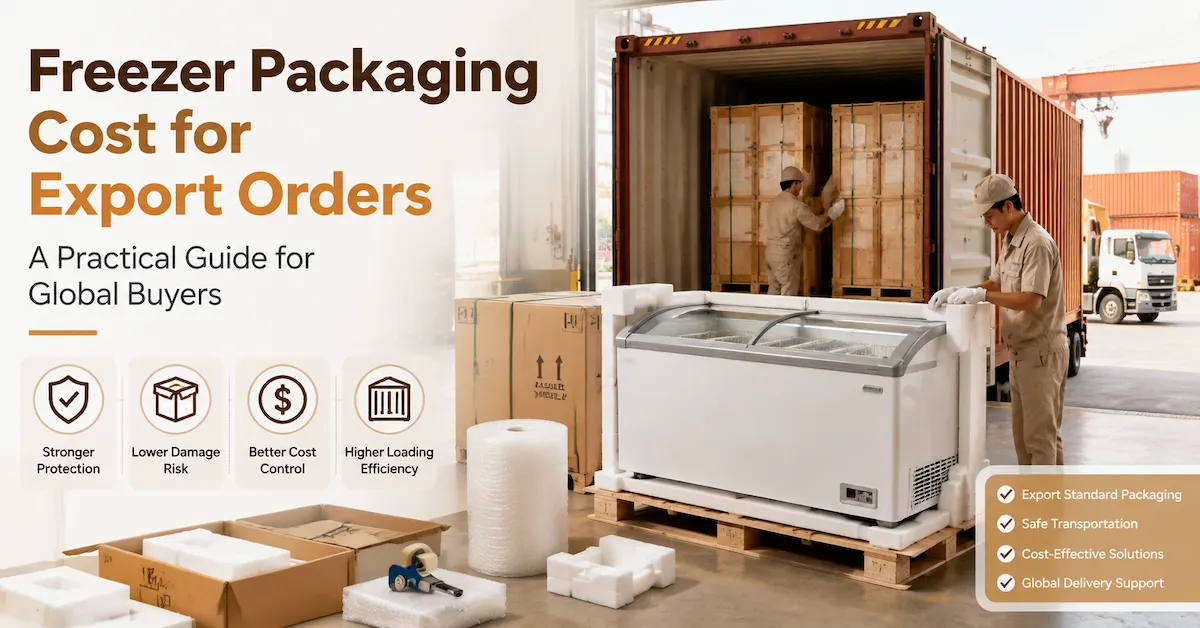
Understanding freezer packaging cost for export orders is essential when comparing quotations from commercial refrigeration suppliers.
A freezer is heavier, larger, and more structurally complex than many ordinary export products. It may contain glass doors, compressors, condensers, electrical controls, shelves, hinges, and sensitive refrigeration piping. Inadequate packaging can lead to cabinet dents, door misalignment, broken glass, displaced components, and delayed delivery.
At the same time, excessive packaging can increase:
- Packaging material costs
- Gross shipment weight
- Freight volume
- Container space consumption
- Unpacking labor
The best packaging solution is therefore not simply the strongest or cheapest option. It should provide an appropriate balance between product protection, loading efficiency, transportation risk, and total landed cost.
As a commercial refrigeration manufacturer, snowsea supports global buyers in evaluating product configuration, order quantity, shipping method, and export protection requirements. Buyers can learn more about the company through the snowsea manufacturing overview.
What Is Included in Freezer Packaging Cost for Export Orders?
Packaging cost includes more than an outer carton. A complete quotation may involve protective materials, supporting structures, labor, labeling, and container-loading preparation.
| Packaging component | Main purpose |
|---|---|
| Export carton | Protects the exterior from dust and light impact |
| Foam panels or blocks | Cushions vulnerable surfaces and components |
| Corner protectors | Reduces damage to cabinet edges |
| Plastic film or bags | Helps control dust and moisture exposure |
| Wooden pallet | Supports forklift handling and loading |
| Wooden frame | Reinforces larger or fragile freezer models |
| Full wooden crate | Provides higher protection for difficult transport |
| Metal or plastic straps | Secures the package during movement |
| Door and shelf fixing | Prevents internal movement during shipping |
| Labels and shipping marks | Supports identification and handling |
| Packaging labor | Covers assembly, inspection, and sealing |
Buyers should confirm whether these items are included in the product quotation or listed separately.
Product Preparation Before Packaging
Before the outer package is applied, the freezer may also require:
- Shelves and baskets to be fixed
- Doors or lids to be secured
- Power cables to be protected
- Casters to be locked or reinforced
- Accessories to be packed separately
- Exterior surfaces to receive protective film
These preparation steps influence labor cost but help prevent internal movement and cosmetic damage.
Main Factors Affecting Freezer Export Packaging Cost
There is no single packaging price suitable for every commercial freezer. Cost depends on the product, shipping route, handling conditions, and buyer’s acceptable risk level.
Freezer Size and Gross Weight
Larger and heavier freezers require:
- More carton material
- Thicker foam protection
- Stronger pallets
- Additional reinforcement
- More packaging labor
A large island freezer or multi-door display freezer generally requires a different packaging structure from a compact chest freezer.
Why Gross Dimensions Matter
Freight and container planning are affected by the packaged dimensions rather than only the freezer dimensions.
Additional reinforcement can increase:
- Package width
- Package height
- Gross weight
- Space required between units
Buyers should request both product dimensions and final packaging dimensions before calculating container capacity.
Freezer Structure and Fragility
Different freezer structures carry different transportation risks.
Glass-Door Freezers
Glass-door models may require:
- Extra corner protection
- Door restraints
- Glass-surface cushioning
- Reinforced frames
- Clear fragile-handling marks
Chest and Island Freezers
Chest and island freezers may need protection for:
- Sliding glass lids
- Curved glass
- Cabinet corners
- Compressor compartments
- Casters and lower ventilation panels
Upright Stainless-Steel Freezers
Upright models may require stronger bottom support because of their height and center of gravity.
Buyers can review the available commercial refrigeration products when evaluating how different cabinet structures may affect packaging requirements.
Shipping Method
Packaging requirements change according to how the order will be transported.
Full Container Load
Full container load, or FCL, usually provides more controlled handling because products remain in one container for most of the journey.
Appropriate packaging may include:
- Export carton
- Foam protection
- Bottom pallet or base
- Internal securing
- Container bracing where required
Less Than Container Load
Less than container load, or LCL, may involve more transfers, warehouse handling, and contact with other cargo.
LCL shipments may justify:
- Stronger wooden frames
- Full crates for fragile models
- Additional moisture protection
- Reinforced bottom structures
The packaging cost may be higher, but the additional protection can reduce damage risk during repeated handling.
Destination and Handling Conditions
Suppliers should understand:
- Destination country
- Port and inland transport route
- Number of handling stages
- Forklift availability
- Warehouse conditions
- Final unloading method
A product unloaded directly at a distributor’s warehouse may face different risks from equipment delivered to a remote project site.
Order Quantity
Sample orders often have higher packaging costs per unit because:
- Materials are purchased in smaller quantities
- Packaging setup is not distributed across many units
- Individual crates may be required
- Container-loading efficiency is lower
Bulk orders can provide better packaging efficiency through standardized production, material purchasing, and loading plans.
Common Commercial Freezer Packaging Methods
| Packaging method | Protection level | Relative cost | Suitable situations |
|---|---|---|---|
| Carton with foam protection | Basic | Low | Controlled FCL shipments |
| Carton with wooden pallet | Moderate | Medium | Common export orders |
| Reinforced wooden frame | High | Medium–High | Heavy or glass-door freezers |
| Full wooden crate | Very high | High | LCL, samples, or fragile products |
| Customized mixed packaging | Application-based | Variable | Multi-model or project orders |
Standard Export Carton
A standard carton solution can be efficient when:
- The order uses a full container
- Products are loaded directly at the factory
- Handling stages are limited
- Freezer structures are relatively robust
Its main advantages are lower cost, reduced package volume, and easier unpacking.
Carton With Wooden Pallet
Adding a pallet improves:
- Forklift handling
- Bottom protection
- Warehouse movement
- Loading stability
However, pallet dimensions should be optimized so they do not unnecessarily reduce container capacity.
Reinforced Wooden Frame
A wooden frame can protect critical structural areas without fully enclosing the product.
It may be appropriate for:
- Glass-door freezers
- Heavy cabinets
- Tall upright models
- Orders requiring extra corner protection
Full Wooden Crate
A complete wooden crate provides stronger impact protection but increases:
- Material cost
- Gross weight
- Package volume
- Unpacking time
It should be selected according to actual transport risk rather than used automatically for every order.
Standard Packaging vs Reinforced Export Packaging
| Evaluation factor | Standard packaging | Reinforced packaging |
|---|---|---|
| Material cost | Lower | Higher |
| Handling protection | Moderate | Higher |
| Package volume | More compact | Usually larger |
| Container utilization | Better | May be reduced |
| LCL suitability | Limited | Better |
| Unpacking | Easier | More labor required |
| Damage-risk control | Suitable for controlled routes | Better for complex routes |
A buyer should not choose packaging solely from a price list. The correct decision depends on the freezer model and logistics route.
How Packaging Influences Container Loading Cost
Packaging design can significantly affect the number of freezers loaded into a container.
Package Dimensions
Even a small increase in package width may reduce the number of units that fit in each row.
Suppliers should calculate:
- Units per row
- Number of loading layers
- Door clearance
- Ventilation or protection gaps
- Space for accessories and spare parts
Stackability
Not every commercial freezer can be stacked safely.
Stacking decisions depend on:
- Cabinet strength
- Package structure
- Product weight
- Center of gravity
- Glass components
- Transport vibration
Unsafe stacking can reduce product quality even when the outer packaging appears undamaged.
Container Utilization
The lowest packaging price is not always the lowest shipping cost.
For example, a full crate may add protection but reduce the number of units loaded. The buyer may then require an additional container or pay a higher freight cost per freezer.
The packaging decision should therefore consider:
Packaging cost + freight-volume impact + expected damage risk + unloading labor
Hidden Costs of Inadequate Freezer Packaging
Cheap packaging can create expenses that do not appear in the original quotation.
Cabinet and Surface Damage
Possible problems include:
- Dented side panels
- Scratched stainless steel
- Damaged paint
- Deformed ventilation covers
Cosmetic damage can make products difficult to sell, even when refrigeration performance remains functional.
Glass and Door Damage
Impact during transportation may cause:
- Broken glass
- Door-frame deformation
- Misaligned hinges
- Poor sealing after installation
These problems can affect both appearance and energy performance.
Refrigeration Component Movement
Severe vibration or impact may affect:
- Compressor mounting
- Refrigeration piping
- Condenser structures
- Electrical connections
Some transportation damage may only become visible after startup.
Claims, Delays, and Replacement Costs
A damaged freezer may create:
- Inspection expenses
- Replacement-parts shipments
- Customer complaints
- Project delays
- Local repair labor
- Inventory shortages
These hidden costs can exceed the savings from cheaper packaging.
How Buyers Can Control Freezer Packaging Cost
Confirm the Shipping Method Early
The supplier should know whether the order will use:
- FCL
- LCL
- Sea freight
- Inland trucking
- Warehouse consolidation
Packaging designed before the shipping method is confirmed may be either insufficient or unnecessarily expensive.
Provide Destination Information
Buyers should provide:
- Destination port
- Final delivery location
- Unloading facilities
- Expected warehouse conditions
- Special handling requirements
This helps the manufacturer recommend suitable protection.
Request Final Package Dimensions
Ask for:
- Net product dimensions
- Packaging dimensions
- Net weight
- Gross weight
- Estimated container quantity
These details are essential for comparing total landed cost.
Match Protection to Product Risk
Not every freezer requires a full wooden crate.
A practical packaging plan should consider:
- Glass content
- Cabinet height
- Freezer weight
- Shipment type
- Number of transfers
- Acceptable damage risk
Review Packaging Before Bulk Production
For OEM and private-label orders, buyers can request:
- Packaging drawings
- Packaging photographs
- Sample-package confirmation
- Drop or handling checks where applicable
- Container-loading plans
This allows packaging details to be confirmed before the full order is completed.
Packaging Considerations for Sample and Bulk Orders
Sample Freezer Orders
Sample units may require stronger packaging because they are often shipped separately or through LCL channels.
A sample package may include:
- Full wooden crate
- Additional internal fixing
- Stronger moisture protection
- More visible handling labels
Although the packaging cost per unit is higher, the sample usually has greater importance for testing and product approval.
Bulk Freezer Orders
Bulk orders allow packaging and loading to be standardized.
Potential advantages include:
- Lower material cost per unit
- Consistent packaging dimensions
- Better container utilization
- More efficient factory loading
- Reduced handling stages
The final packaging specification approved during the sample stage should be followed consistently during mass production.
How snowsea Supports Export Packaging Planning
A successful export order requires coordination between product design, packaging, production, and logistics.
For a snowsea project, packaging requirements can be discussed according to:
- Freezer model and structure
- Order quantity
- OEM or branding requirements
- Shipping method
- Destination
- Container-loading objective
- Required protection level
Export-Oriented Product Preparation
Project discussions may cover:
- Internal component fixing
- Door and lid protection
- Exterior surface protection
- Accessory packaging
- Shipping marks
- Loading sequence
OEM and Private-Label Packaging
For private-label projects, packaging may also involve:
- Brand names
- Product labels
- Model information
- Handling instructions
- Carton artwork
- Destination-specific shipping marks
Buyers can review additional commercial refrigeration and sourcing insights when preparing an OEM project.
How to Compare Packaging Quotations From Freezer Suppliers
Use the same specification when requesting quotations from different suppliers.
| Information to request | Why it matters |
|---|---|
| Packaging method | Shows the actual protection structure |
| Included materials | Prevents incomplete price comparisons |
| Package dimensions | Determines freight volume |
| Gross weight | Affects handling and shipping |
| Units per container | Helps calculate freight per unit |
| Glass protection method | Important for display freezers |
| Bottom support structure | Important for heavy equipment |
| Moisture protection | Relevant for long-distance shipping |
| Packaging photographs | Helps verify execution |
| Replacement responsibility | Clarifies risk management |
A slightly higher packaging quotation may provide better total value if it improves loading efficiency or reduces transport damage.
FAQ About Freezer Packaging Cost for Export Orders
What affects freezer packaging cost for export orders?
The main factors include freezer size, weight, cabinet structure, glass components, packaging materials, order quantity, shipping method, and destination handling conditions.
Is wooden packaging required for every commercial freezer?
No. Some FCL orders may use cartons, foam, and pallets, while fragile, sample, or LCL shipments may require stronger wooden protection.
Why are sample-order packaging costs higher?
Samples are packed individually, produced in small quantities, and may require reinforced protection for LCL or multi-stage transportation.
Does reinforced packaging increase freight cost?
It can. Reinforcement may increase weight and package dimensions, potentially reducing container utilization.
What packaging is suitable for glass-door freezers?
Glass-door freezers generally need stronger corner protection, door fixing, glass cushioning, and possibly a reinforced wooden frame.
How can buyers reduce freezer export packaging costs?
Buyers can confirm shipping methods early, optimize package dimensions, use bulk ordering, match protection to actual risk, and request container-loading plans.
What is the risk of choosing the cheapest packaging?
Insufficient packaging may lead to dents, broken glass, door misalignment, component movement, repair costs, and delivery delays.
Should packaging specifications be confirmed during sample approval?
Yes. Confirming packaging with the sample helps ensure the approved method is repeated during bulk production.
Can snowsea support private-label freezer packaging?
snowsea can discuss packaging and branding requirements according to the product model, order quantity, shipping route, and OEM project needs.
What information should buyers provide for an accurate packaging quotation?
Provide the freezer model, quantity, destination, shipping method, handling conditions, branding requirements, and preferred protection level.
Conclusion
Understanding freezer packaging cost for export orders helps buyers control both visible expenses and hidden transportation risks.
The most suitable solution depends on:
- Freezer dimensions and weight
- Cabinet and glass structure
- Shipment type
- Destination handling
- Order quantity
- Required protection level
- Container-loading efficiency
Standard packaging may be sufficient for controlled full-container shipments, while reinforced frames or wooden crates may be more appropriate for samples, LCL cargo, and fragile freezer models.
The goal is not to minimize packaging expenditure at any cost. It is to reduce total landed cost by balancing material expense, freight volume, unloading convenience, and damage prevention.
For an export packaging recommendation and commercial freezer quotation, contact snowsea with your required freezer model, quantity, destination, and shipping method.