Ice Cream Freezer Supplier: How to Improve Sell-Through Rate and Maximize Retail Profit per Unit
In ice cream retail, underperformance is often misattributed to weak demand. In reality, it is frequently caused by inefficient freezer configuration and poor product placement.
Retailers and distributors commonly observe:
- High-margin SKUs receiving limited exposure
- Slow-moving products occupying prime display positions
- Uneven product rotation leading to hidden inventory loss
- Inconsistent sales performance across similar locations
These issues are not purely operational. They are structural, driven by how freezers are selected, organized, and used in real retail environments.
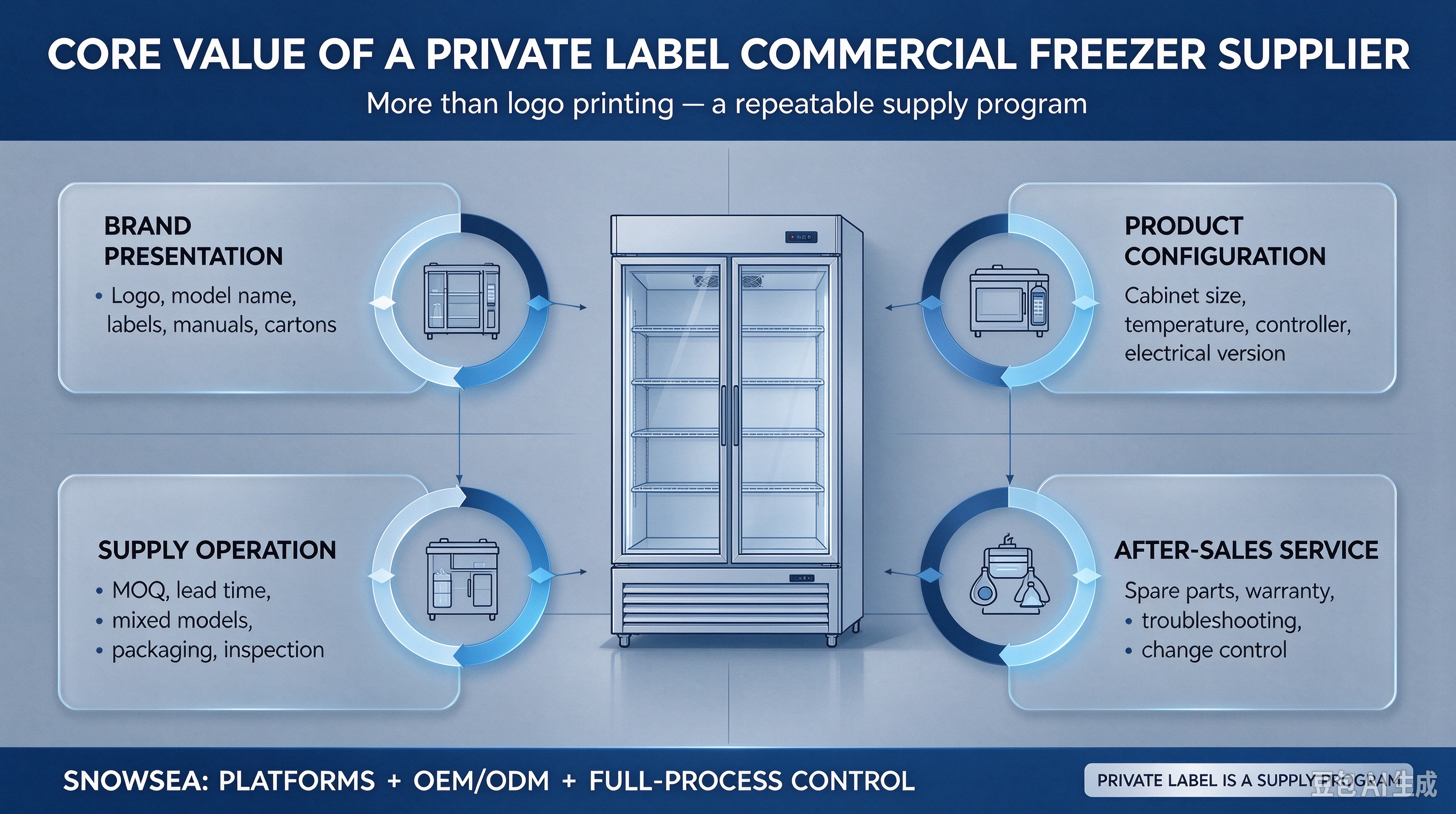
At Snowsea, as an ice cream freezer supplier, we focus on improving sell-through rate by aligning freezer configuration with product behavior, customer interaction, and retail channel dynamics. The goal is not simply to store products, but to accelerate movement and maximize profit per unit.
Why Sell-Through Rate Is Strongly Influenced by Freezer Design
Retail performance depends heavily on visibility, accessibility, and product positioning.
According to National Retail Federation, product visibility can influence purchase decisions by more than 60% in physical retail environments.
Key Structural Limitations
- Limited Visibility for High-Margin Products
Products placed outside primary sight zones receive significantly less attention - Unbalanced SKU Allocation
Slow-moving items occupy high-value display positions - Inefficient Use of Internal Volume
Storage capacity is not aligned with sales velocity - Customer Interaction Friction
Difficult access reduces impulse purchasing
These limitations reduce both conversion rate and overall revenue efficiency.
Sales-Oriented Freezer Configuration Strategy
Improving performance requires aligning freezer design with actual buying behavior.
Key Optimization Methods
- Primary Visibility Zoning
High-margin and fast-moving SKUs placed within the top 30–50% visual zone - Layered SKU Structuring
Upper layer: fast turnover products
Lower layer: bulk or slow-moving items - Access Optimization Design
Reduced opening resistance and improved reachability - Structured Product Rotation Layout
Prevents accumulation of low-visibility stock
This approach can be defined as sales-driven freezer configuration, where design directly supports retail conversion.
Why Choosing the Right Ice Cream Freezer Supplier Matters
Most suppliers focus on cooling performance and capacity. However, for retail operations, the ability to influence sales performance is equally critical.
A professional ice cream freezer supplier must:
- Understand SKU turnover dynamics
- Support display and layout optimization
- Provide configurations tailored to different retail formats
At Snowsea, we combine:
- Retail behavior analysis
- SKU-based configuration strategy
- Display-oriented engineering design
This ensures that each freezer contributes to higher product turnover rather than simply holding inventory.
Impact on Sales Performance and Profitability
Optimized freezer configuration leads to measurable improvements in retail performance.
Performance Comparison
| Parameter | Conventional Setup | Optimized Snowsea Configuration |
|---|---|---|
| Sell-Through Rate | Baseline | +12% to +20% |
| High-Margin SKU Exposure | Limited | Increased by 25%–40% |
| Inventory Turnover Cycle | 18–25 days | Reduced to 12–18 days |
| Dead Stock Ratio | 10%–18% | Reduced to 5%–8% |
| Revenue per Freezer | Baseline | +10% to +18% |
These improvements are driven by structural optimization rather than changes in product demand.
Real Retail Scenarios and Channel-Specific Optimization
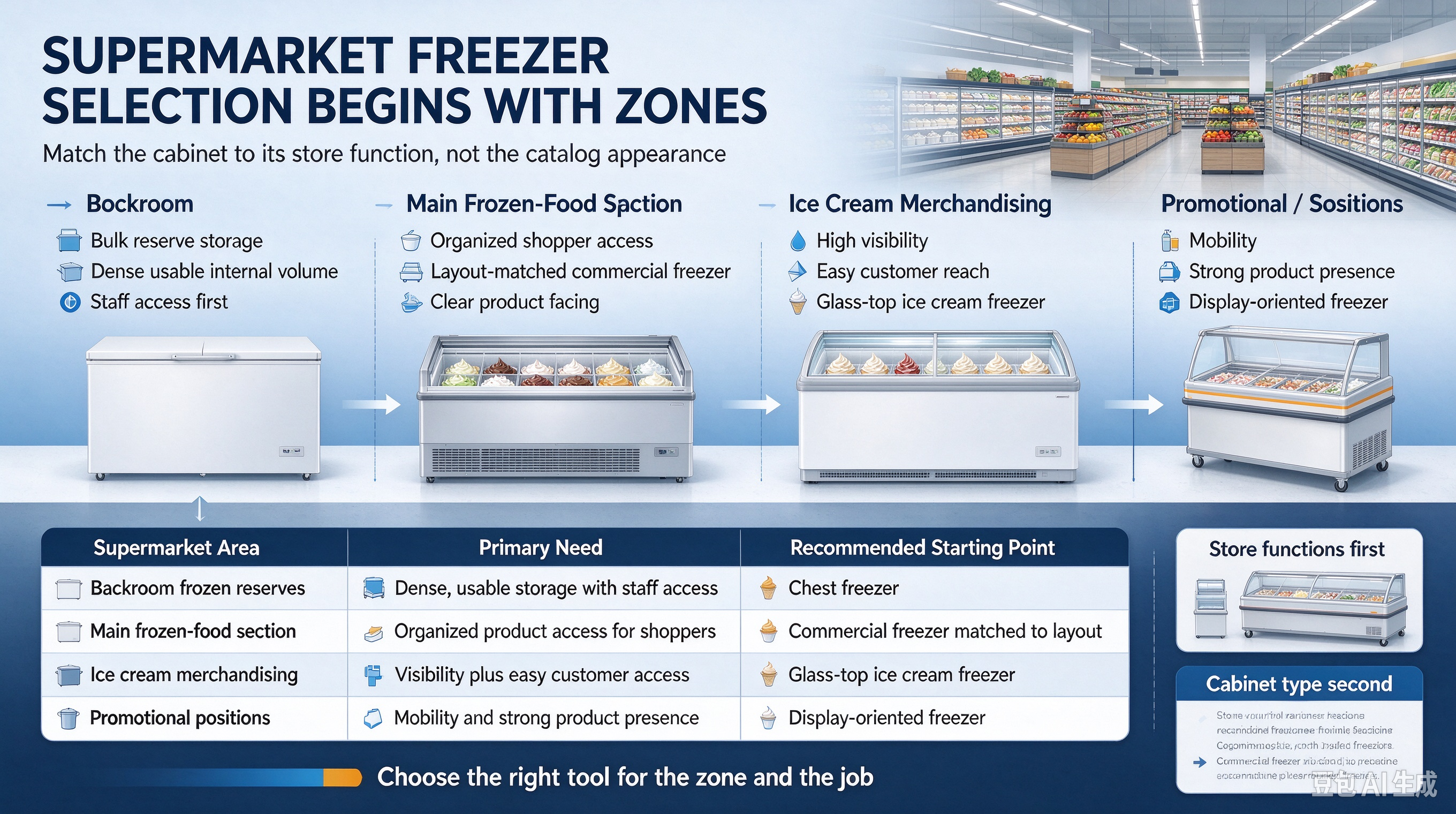
Different retail environments require fundamentally different freezer strategies.
Supermarkets (High SKU Density and Competitive Display)
Supermarkets typically display 20–50 SKUs within a single freezer.
Operational Reality:
- High product variety competing for attention
- Limited customer decision time
- Frequent restocking cycles
Core Issues:
- High-margin products buried among low-margin items
- Overstocking reduces visual clarity
- Product selection becomes overwhelming
Optimization Strategy:
- Reduce SKU count by 20–30% for clarity
- Prioritize top-selling SKUs in front-facing positions
- Group products by category or brand for faster recognition
Convenience Stores (Impulse Purchase Driven)
Convenience stores rely heavily on quick decision-making.
Operational Reality:
- Customer interaction time typically under 2 minutes
- Freezers located near checkout areas
- High opening frequency
Core Issues:
- Low visibility reduces impulse purchases
- Difficult access discourages engagement
Optimization Strategy:
- Concentrate top-selling SKUs in eye-level zones
- Simplify product layout
- Use easy-access freezer design
Ice Cream Brand Stores (Controlled Presentation)
Brand-owned stores prioritize visual consistency and product quality.
Operational Reality:
- Controlled SKU range
- Strong emphasis on brand identity
- High expectation for product appearance
Core Issues:
- Inconsistent display across locations
- Product presentation affecting perceived quality
Optimization Strategy:
- Standardized freezer layout across stores
- Controlled SKU hierarchy
- Consistent display structure
Multi-Channel Distributors (Mixed Demand Profiles)
Distributors supply multiple types of retail channels simultaneously.
Operational Reality:
- Diverse product requirements
- Varying turnover rates across channels
Core Issues:
- Single freezer configuration does not fit all channels
- SKU mismatch across markets
Optimization Strategy:
- Channel-specific freezer configurations
- Core SKU standardization with flexible extensions
At Snowsea, as an ice cream freezer supplier, we implement channel-adaptive display strategies, ensuring each configuration aligns with its specific sales environment.
Case Example: Improving Sell-Through Rate for a Distributor
A regional distributor supplying supermarkets and convenience stores experienced slow inventory movement.
Initial Situation
- Over 35 SKUs per freezer
- High stock pressure
- Low visibility for high-margin products
Optimization Measures
- Reduced SKU count by 25%
- Reorganized product placement
- Introduced display-focused freezer configuration
Results
- Sell-through rate increased by approximately 18%
- Inventory turnover improved significantly
- Profit per unit increased
This demonstrates that freezer configuration directly influences business performance.
What Buyers Should Evaluate When Choosing an Ice Cream Freezer Supplier
When selecting an ice cream freezer supplier, buyers should focus on three critical factors:
SKU Structure Support
Does the supplier help optimize product mix and placement?
Snowsea solution: SKU-based display configuration guidance
Channel Adaptability
Can freezer configurations match different retail environments?
Snowsea advantage: Channel-specific product design
Sales Efficiency Impact
Does the freezer improve product visibility and turnover?
Snowsea capability: Sales-driven engineering approach
Frequently Asked Questions
Q: Why do some ice cream products sell slower than others?
A: In many cases, the issue is visibility and placement rather than demand.
Q: Can freezer configuration affect sales performance?
A: Yes. Product positioning and accessibility directly influence conversion rates.
Q: Is increasing SKU count always beneficial?
A: No. A focused SKU structure typically leads to better turnover and higher profitability.
Improving Retail Profitability with the Right Freezer Strategy
Choosing the right ice cream freezer supplier is essential for improving sell-through rate and maximizing retail performance.
At Snowsea, we focus on:
- Sales-driven freezer configuration
- Channel-specific optimization
- Improved product visibility and turnover
Explore Our Product Range
https://www.snowseax.com/products