Why Defrost Method Matters in Commercial Freezers
Choosing between a Manual Defrost vs Automatic Defrost Freezer is not simply a question of convenience. The defrost system affects frost accumulation, maintenance frequency, refrigeration performance, temperature behavior, equipment complexity, and long-term operating costs.
For commercial buyers, the correct choice depends heavily on how the freezer will actually be used.
A low-traffic chest freezer storing packaged frozen food may have very different requirements from an upright freezer that is opened dozens of times throughout the day.
Importers and distributors should therefore consider:
- Door-opening frequency
- Ambient humidity
- Product loading
- Required temperature stability
- Maintenance availability
- Energy priorities
- Equipment downtime
- Target selling price
- End-user expectations
Snowsea provides a range of commercial refrigeration products for retail, food-service, frozen-food storage, and distribution applications where different defrost strategies may be appropriate.
What Is a Manual Defrost Freezer?
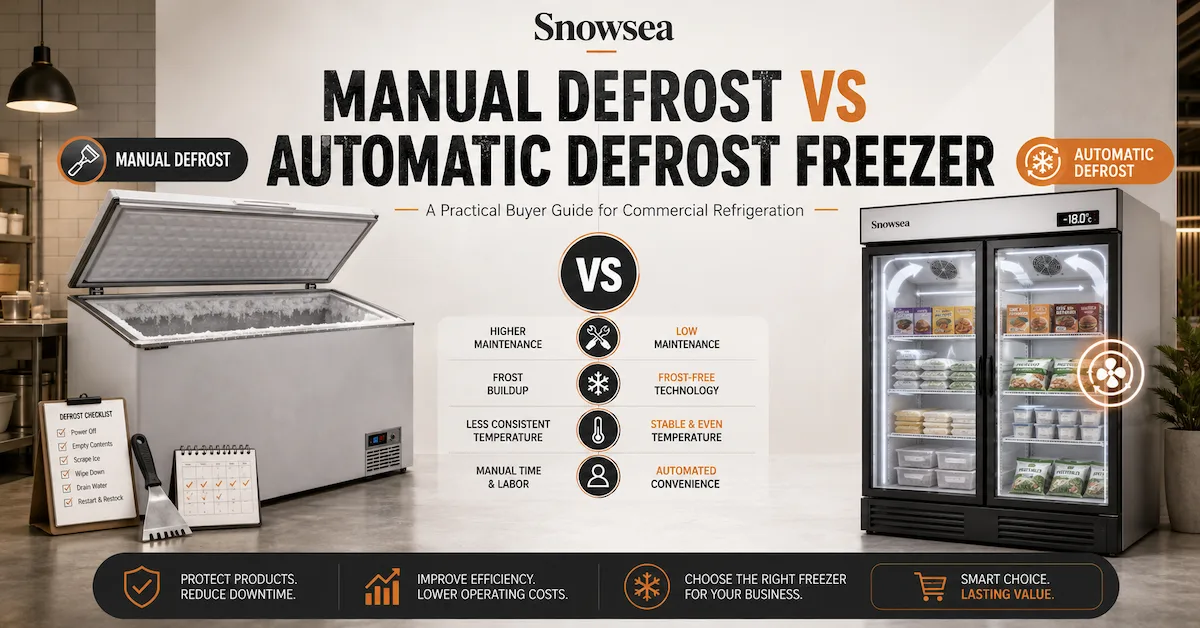
A manual defrost freezer normally allows frost to accumulate on cold internal surfaces or around the evaporator until the user intentionally stops operation and removes the frost.
The basic process usually involves:
- Removing or protecting stored products
- Turning off or isolating refrigeration
- Allowing accumulated ice to melt
- Removing water
- Cleaning and drying the cabinet
- Restarting the freezer
The exact procedure depends on the freezer design and manufacturer's instructions.
Advantages of Manual Defrost
Manual defrost systems are generally simpler because they require fewer components dedicated specifically to automatic defrost.
Potential advantages include:
- Simpler system architecture
- Fewer defrost-related electrical components
- Lower initial equipment cost in many designs
- Defrost performed only when required
- Good suitability for some chest freezer applications
Because the operator controls when defrost occurs, maintenance can also be scheduled around low-demand periods.
Limitations of Manual Defrost
The main disadvantage is labor.
If frost becomes excessive, staff must stop normal use and complete the defrost process.
Potential operational issues include:
- Manual maintenance requirements
- Temporary equipment downtime
- Product relocation during defrost
- Reduced cooling performance if frost is allowed to become excessive
- Dependence on staff following maintenance procedures
A low-maintenance design is only beneficial if the end user actually performs the required defrosting.
What Is an Automatic Defrost Freezer?
An automatic defrost freezer uses controls and system components to remove frost without requiring the operator to manually shut down and thaw the freezer every time frost builds up.
Depending on refrigeration system design, automatic defrost can involve:
- Electric heaters
- Hot-gas defrost
- Off-cycle defrost
- Timed controls
- Temperature-based termination
- More advanced demand or adaptive controls
For commercial refrigeration equipment, U.S. Department of Energy test procedures explicitly address automatic defrost and long-time automatic defrost operation, showing that defrost behavior is recognized as part of standardized commercial refrigeration energy testing.
Advantages of Automatic Defrost
Automatic defrost is particularly useful where equipment operates continuously and manual shutdown would disrupt commercial activity.
Advantages can include:
- Less routine manual defrost labor
- Better control of evaporator frost
- Reduced risk of operators delaying necessary defrost
- Suitable for frequent-use applications
- Better convenience in high-traffic commercial environments
Limitations of Automatic Defrost
Automatic defrost adds additional system complexity.
Depending on the design, additional elements may include:
- Defrost heaters
- Sensors
- Timers
- Controllers
- Drainage components
These components need to be properly engineered and matched with the refrigeration system.
Defrost cycles can also temporarily add heat to parts of the refrigeration system, which is why defrost timing and termination control matter.
Manual Defrost vs Automatic Defrost Freezer Comparison
A practical Manual Defrost vs Automatic Defrost Freezer comparison should focus on the buyer's operating environment rather than assuming one technology is always superior.
| Factor | Manual Defrost | Automatic Defrost |
|---|---|---|
| Defrost operation | User initiated | Automatically controlled |
| Maintenance labor | Higher | Lower |
| System complexity | Lower | Higher |
| Frost management | Depends on operator | Regularly controlled |
| Downtime for defrost | Planned manual shutdown | Usually integrated into operation |
| Initial cost | Often lower | Often higher |
| Temperature disturbance | Mainly during manual defrost | Short changes may occur during cycles |
| Best suited for | Lower-maintenance-frequency storage | Frequent-use commercial applications |
| Service requirements | Simpler | More control components to inspect |
The table should be used as a general purchasing framework. Actual performance depends on cabinet design, refrigeration capacity, insulation, controls, ambient conditions, and usage patterns.
Which System Uses Less Energy?
This question requires careful interpretation.
A manual defrost design does not use dedicated automatic defrost heaters or controls in the same way many automatic systems do. However, frost accumulation itself can reduce effective heat transfer if maintenance is delayed.
ENERGY STAR notes for residential freezers that manual-defrost models can use substantially less energy than automatic-defrost models, while also requiring periodic frost removal. That residential guidance should not be directly used to predict the energy consumption of a commercial freezer because commercial cabinet size, usage, doors, loading, compressors, fans, and test conditions differ.
For commercial procurement, buyers should request actual energy-consumption data for the specific model rather than choosing a defrost type based on a generic energy claim.
How Frost Affects Freezer Cooling Performance
Frost commonly forms when moisture reaches surfaces below freezing.
Moisture can enter through:
- Door openings
- Warm product loading
- Humid ambient air
- Poor door sealing
- Moisture inside stored products or packaging
When frost becomes excessive around an evaporator, airflow and heat transfer can be restricted.
This is particularly important in forced-air systems because airflow must pass effectively through or around the evaporator.
Buyers interested in the relationship between air movement and cabinet temperature can also review Snowsea's guide to commercial freezer airflow circulation design.
How Defrost Method Affects Temperature Stability
Temperature stability is important for frozen-food storage.
Manual Defrost Temperature Behavior
During normal refrigeration operation, a manual-defrost freezer does not need scheduled heater-driven defrost cycles.
However, when a full manual defrost becomes necessary, the freezer may be unavailable for a longer period and products may need to be moved.
Automatic Defrost Temperature Behavior
Automatic systems perform shorter, controlled defrost events according to their operating logic.
During defrost, temperatures around the evaporator can temporarily rise. Proper controls are designed to terminate defrost and return the refrigeration system to normal operation.
For commercial buyers, the important question is therefore not:
“Does automatic defrost cause temperature change?”
A more useful question is:
“How effectively does the complete freezer recover after defrost under normal product load?”
Snowsea's article on commercial freezer temperature recovery explains why recovery performance should be evaluated together with refrigeration capacity, insulation, airflow, and product loading.
How Defrost Affects Compressor and Evaporator Performance
The compressor, evaporator, airflow system, and defrost system operate as one refrigeration system.
If heavy frost restricts evaporator airflow, the system may not distribute cooling effectively.
On the other hand, an automatic defrost system that operates more often or longer than necessary can introduce unnecessary heat and energy consumption.
Good system design therefore aims to balance:
- Frost prevention
- Defrost frequency
- Defrost duration
- Temperature recovery
- Compressor operation
- Fan operation
- Energy consumption
For buyers evaluating refrigeration-system durability, Snowsea's commercial freezer compressor reliability test provides additional supplier evaluation points.
Which Defrost Type Is Better for Different Commercial Applications?
Chest Freezers and Bulk Frozen Storage
Manual defrost is commonly suitable when:
- Doors remain closed for long periods
- Product turnover is relatively low
- Energy efficiency is important
- Staff can schedule periodic maintenance
- Simple construction is preferred
This can make manual defrost practical for some bulk-storage and ice cream freezer applications.
Supermarkets and Convenience Stores
Automatic defrost may offer greater operational convenience when:
- Doors are opened frequently
- Equipment operates continuously
- Staff cannot regularly perform manual defrost
- Product accessibility is important
- Downtime needs to be minimized
Restaurants and Commercial Kitchens
The best choice depends on operating patterns.
A restaurant with limited frozen storage and trained maintenance staff may accept manual defrost.
A high-volume kitchen with frequent access may value automatic frost management more highly.
High-Humidity Markets
Humidity increases the amount of moisture that can enter a freezer during door openings.
In these markets, buyers should pay particular attention to:
- Defrost capacity
- Door sealing
- Drainage
- Evaporator design
- Airflow
- Temperature recovery
Ice Cream Retail
Ice cream storage often demands stable low temperatures.
Buyers should evaluate not only defrost method but also:
- Cabinet temperature range
- Recovery after door opening
- Insulation
- Door sealing
- Refrigeration capacity
Manual vs Automatic Defrost: Total Cost Considerations
Purchase price should not be the only decision factor.
Initial Equipment Cost
Manual systems may have fewer defrost-related components, which can support a lower initial cost in some product designs.
Automatic systems require additional control and defrost components.
Labor Cost
Manual defrost requires staff time.
For a buyer operating hundreds of units, even occasional manual maintenance can create significant cumulative labor requirements.
Downtime Cost
Commercial users should consider what happens to stored products while equipment is being manually defrosted.
Service Cost
Automatic systems reduce manual defrost labor but introduce additional components that may eventually require diagnosis or replacement.
Energy Cost
Actual energy consumption should be evaluated using model-specific test data rather than assumptions based solely on the words “manual” or “automatic.”
What Should B2B Buyers Ask a Freezer Manufacturer?
Before purchasing, importers and distributors should confirm:
| Buyer Question | Why It Matters |
| Is the freezer manual or automatic defrost? | Defines maintenance strategy |
| How is automatic defrost initiated? | Reveals control method |
| How is defrost terminated? | Affects temperature recovery |
| What components perform the defrost? | Important for service and spare parts |
| How often does defrost normally occur? | Helps estimate operational impact |
| How is frost handled under high humidity? | Important for tropical markets |
| How is defrost water drained? | Poor drainage can create maintenance issues |
| Is loaded-cabinet performance tested? | Better represents actual operation |
| What happens after a defrost cycle? | Shows recovery capability |
| Can defrost configuration be customized? | Relevant for OEM projects |
For private-label projects, Snowsea's OEM/ODM commercial refrigeration solutions can support discussions around cabinet configuration, controls, refrigeration systems, appearance, and target-market requirements.
How to Choose Between Manual and Automatic Defrost
A simple purchasing framework is:
Choose manual defrost when:
- Simplicity is a priority
- Door opening is relatively limited
- Periodic manual maintenance is acceptable
- Long continuous storage periods are common
- The target market accepts manual defrost
Choose automatic defrost when:
- Equipment is opened frequently
- Manual maintenance needs to be reduced
- Continuous commercial accessibility is important
- Frost management should require less operator intervention
- The application can justify additional system complexity
The correct decision should ultimately be based on total operating requirements rather than one specification.
FAQ
What is the main difference between manual and automatic defrost freezers?
Manual defrost requires the operator to remove frost periodically, while automatic defrost uses system controls and components to manage frost during normal operation.
Is a manual defrost freezer more energy efficient?
It can be in some designs because there is no regular automatic defrost heating cycle, but commercial energy consumption depends on the complete cabinet and operating conditions. Buyers should compare model-specific test data.
Does automatic defrost increase freezer temperature?
Temperature around the evaporator can temporarily rise during defrost. A properly controlled system then resumes refrigeration and restores normal operating conditions.
Which freezer is easier to maintain?
Automatic defrost reduces routine manual frost removal, while manual systems are generally mechanically simpler. “Easier” depends on whether the buyer prioritizes reduced labor or simpler components.
Does frost increase freezer energy consumption?
Heavy frost can restrict heat transfer and airflow around the evaporator, making proper frost management important for refrigeration performance.
Which defrost system is better for a chest freezer?
Manual defrost is often practical for chest freezers with relatively infrequent access, but the correct choice depends on the application and product specification.
Which is better for supermarkets?
Automatic defrost is often more convenient where equipment is accessed frequently and manual shutdown would disrupt operations.
Is automatic defrost the same as frost-free?
The terms are often used together in product marketing, but system designs vary. Buyers should confirm exactly how frost is removed and how air circulates inside the specific freezer.
Can OEM buyers specify a defrost system?
Yes. Depending on cabinet and refrigeration design, OEM projects may specify different controls, evaporator configurations, defrost methods, and operating requirements.
What should importers compare besides defrost type?
Compare refrigeration capacity, temperature range, recovery performance, insulation, airflow, door sealing, energy consumption, components, testing, and after-sales support.
Conclusion
The Manual Defrost vs Automatic Defrost Freezer decision should be based on the real operating environment rather than the assumption that one system is universally better.
Manual defrost can provide simpler construction and controlled maintenance for applications with limited door opening and manageable frost accumulation. Automatic defrost reduces routine operator intervention and can be better suited to high-frequency commercial use where equipment availability matters.
For importers, distributors, supermarket buyers, and private-label brands, the most reliable approach is to compare frost conditions, maintenance labor, temperature recovery, energy data, system complexity, serviceability, and total operating cost together.
Snowsea manufactures commercial refrigeration equipment for different B2B applications. Explore Snowsea's commercial refrigeration products or contact Snowsea to discuss defrost systems, freezer configurations, performance requirements, and OEM/ODM projects.