What Does OEM Freezer Custom Caster Option Mean?
An OEM freezer custom caster option project means selecting or configuring the freezer's wheel system according to cabinet weight, loaded condition, mobility requirements, wheel diameter, brake function, mounting structure, floor environment, stability, packaging, and after-sales requirements.
For commercial refrigeration buyers, casters should not be treated as accessories added at the end of product development.
They can influence:
- Overall freezer height
- Ground clearance
- Mobility
- Parking stability
- Load distribution
- Floor interaction
- Cleaning access
- Packaging dimensions
- Shipping protection
- Replacement and spare parts
The key principle is:
A freezer caster should be selected as part of the cabinet structure and mobility system—not simply as a wheel added after production.
Snowsea can evaluate caster requirements together with the complete freezer configuration through its OEM/ODM solutions.
What Caster Specifications Should B2B Buyers Confirm?
A useful OEM RFQ should define the following points.
| Specification | Buyer Should Confirm | Why It Matters |
|---|---|---|
| Caster type | Fixed,swivel or locking requirement | Determines mobility |
| Wheel diameter | Required or target size | Affects movement and height |
| Loaded weight | Expected maximum operating weight | Influences load selection |
| Wheel material | Floor/application requirement | Affects rolling and floor contact |
| Brake | Parking/locking requirement | Supports stationary stability |
| Mounting | Plate,stem or project-specific structure | Must match cabinet base |
| Installed height | Overall caster height | Changes freezer dimensions |
| Quantity | Number of casters per unit | Affects load distribution |
| Floor type | Tile, concrete, kitchen floor, etc. | Influences wheel selection |
| Spare parts | Replacement requirement | Supports after-sales service |
A photo alone is rarely enough to define a commercial freezer caster specification.
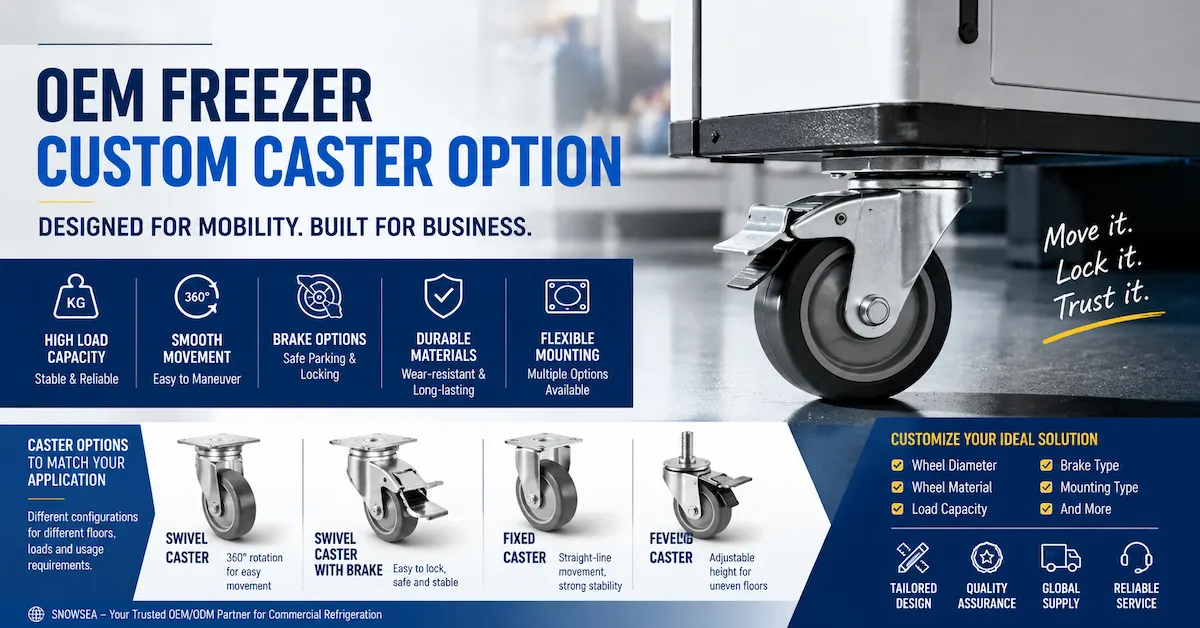
Fixed vs Swivel vs Locking Casters
Fixed Casters
Fixed casters roll in one primary direction.
They may provide:
- More predictable directional movement
- Simple construction
- Better directional control in some applications
Their limitation is reduced maneuverability.
Swivel Casters
Swivel casters rotate around their mounting axis, making it easier to reposition equipment.
They can be useful where freezers need to move for:
- Cleaning
- Store layout changes
- Maintenance
- Installation
Casters With Brakes
A brake can help keep the freezer stationary after positioning.
However, requesting a “caster with brake” is not yet a complete specification.
Depending on the caster design, buyers may need to distinguish between:
- Wheel locking
- Swivel locking
- Combined locking functions
The correct configuration depends on how the equipment will actually be moved and parked.
Casters vs Leveling Feet
Not every commercial freezer should automatically use wheels.
| Base Configuration | Main Advantage | Main Limitation | Typical Consideration |
|---|---|---|---|
| Fixed feet | Stable installation | Difficult to reposition | Permanent location |
| Adjustable feet | Helps cabinet leveling | Limited mobility | Uneven flooring |
| Casters | Easy repositioning | Stability must be reviewed | Mobile equipment |
| Mobility + leveling solution | Combines two functions | Greater complexity | Project-specific needs |
The better procurement question is:
How often will this freezer need to move after installation?
If the answer is “almost never,” mobility may be less important than leveling and stability.
How Should Freezer Caster Load Be Evaluated?
Caster selection should consider the freezer in its expected operating condition—not only the empty cabinet.
Buyers should consider:
- Empty freezer weight
- Frozen product load
- Shelves or baskets
- Door components
- Accessories
- Other installed equipment
A simple division of total weight by the number of casters may not represent real operating conditions.
Actual loading can also be affected by:
- Uneven floors
- Uneven product distribution
- Dynamic movement
- Thresholds or floor joints
- Temporary load concentration
For this reason, the final caster rating and mounting structure should be evaluated by the manufacturer against the complete cabinet design.
Why Wheel Diameter Matters
Wheel diameter affects more than how easily the freezer rolls.
It can influence:
- Rolling resistance
- Ability to pass small floor irregularities
- Ground clearance
- Overall cabinet height
- User working height
- Center of gravity
- Packaging height
A larger wheel may improve mobility in some conditions, but it can also raise the cabinet.
Therefore:
A larger caster is not automatically a better caster for a commercial freezer.
Wheel diameter should be considered together with cabinet dimensions and stability.
How Casters Affect Overall Freezer Height
OEM buyers should distinguish between:
Cabinet body height
and:
Overall height including casters
This becomes especially important when the freezer must fit:
- Under a counter
- Inside a planned supermarket layout
- Through a doorway
- Below a height restriction
- Into export packaging
A change in caster height can make an otherwise unchanged freezer specification unsuitable for the intended project.
For related dimensional planning, see Snowsea's OEM freezer custom cabinet size guide.
How Should Wheel Material Be Selected?
Different wheel materials can offer different characteristics.The correct choice depends on the actual operating environment.
Buyers should consider:
- Equipment load
- Floor material
- Frequency of movement
- Noise expectations
- Floor marking
- Moisture
- Cleaning conditions
- Wear
- Cost
Commercially available caster designs may use materials such as polyurethane-type, rubber/TPR-type, nylon-type, or other engineered wheel materials.
However, no single material is automatically best.
Caster material should be selected according to the application, not simply by material name.
Specific options should be confirmed for the selected Snowsea freezer platform.
Why Floor Type Belongs in the RFQ
OEM buyers often specify the freezer but forget to describe the floor.
Useful information includes whether the equipment will mainly operate on:
- Smooth retail tile
- Concrete
- Commercial kitchen flooring
- Warehouse flooring
- Other project-specific surfaces
Floor conditions can influence:
- Rolling behavior
- Noise
- Vibration
- Wear
- Floor marking
- Ease of repositioning
Including floor type can improve the quality of caster evaluation.
Why Brake Configuration Matters
A freezer that moves easily must also remain stable when parked.
The buyer should consider:
- How frequently the freezer moves
- Whether users open doors aggressively
- Whether the floor is level
- Which wheels need locking
- How accessible the brake pedal must be
The key principle is:
The correct brake configuration depends on how the freezer is moved, positioned, loaded, and operated.
Avoid choosing a brake arrangement only because it appears on another freezer model.
How Casters Affect Cabinet Stability
Adding casters raises the cabinet above the floor.
This can change the relationship between:
- Cabinet height
- Cabinet width and depth
- Center of gravity
- Door movement
- Product loading
- Floor condition
This is particularly important for taller upright equipment.
Caster selection should never be separated from cabinet geometry.
A mobility system should be evaluated with the assembled freezer rather than only testing an individual wheel.
Caster Mounting Is a Structural Requirement
Even a suitable wheel can create problems if the cabinet base is not designed for its mounting load.
Important points can include:
- Mounting plate dimensions
- Hole pattern
- Fasteners
- Base reinforcement
- Brackets
- Installation access
- Replacement access
The core engineering principle is:
A high-load caster cannot perform correctly if the freezer base is not designed to transfer that load.
If a buyer specifies a different caster from the existing freezer design, the base structure may also require review.
Can Buyers Specify Their Own Caster Brand or Model?
Yes.Buyers can submit a preferred:
- Caster model
- Drawing
- Technical datasheet
- Sample
- Supplier reference
for evaluation.
The manufacturer should then review:
- Rated load
- Wheel diameter
- Installed height
- Mounting
- Brake function
- Wheel material
- Cabinet compatibility
- Sourcing availability
- Order volume
Buyer-specified components should not be assumed compatible until the assembled system has been reviewed.
Three Levels of OEM Caster Customization
Level 1: Existing Validated Caster
An existing caster configuration is retained.
Potential advantages include:
- Lower engineering risk
- Faster sampling
- Easier repeat production
- Less structural modification
Level 2: Alternative Caster Configuration
The buyer may request a different:
- Wheel diameter
- Material
- Brake arrangement
- Wheel type
The manufacturer should recheck load, height, mounting, and stability.
Level 3: New Caster and Base Configuration
A major change may require:
- New mounting plate
- New brackets
- Cabinet-base reinforcement
- Different ground clearance
- Packaging revisions
This can increase engineering work, testing, cost, MOQ, and lead time.
How Does Caster Customization Affect OEM Cost?
Buyers should not compare caster unit price alone.
Total project cost can include:
- Caster price
- Brake mechanism
- Wheel material
- Wheel diameter
- Load rating
- Fasteners
- Base reinforcement
- New brackets
- Assembly labor
- Testing
- Packaging changes
- Spare parts
The practical purchasing principle is:
The lowest-priced caster is not necessarily the lowest-cost OEM solution if it creates structural, mobility, stability, or packaging problems.
Does Custom Caster Selection Affect MOQ and Lead Time?
It can.
MOQ may be influenced by:
- Special caster specifications
- Dedicated wheel materials
- Custom colors
- Supplier purchasing minimums
- New mounting hardware
- Cabinet structural changes
Lead time may also increase when the project requires:
- Engineering review
- Component sourcing
- Structural modification
- Sample assembly
- Mobility and stability testing
- Packaging validation
- Final approval
Providing both initial order quantity and annual forecast helps the supplier evaluate the commercially practical route.
How Casters Affect Export Packaging
Casters can influence:
- Overall packed height
- Bottom protection
- Foam structure
- Pallet support
- Transport impact risk
- Container loading
- Final assembly
Depending on the wheel projection, freezer weight, and packaging structure, the manufacturer should evaluate whether the casters are best shipped installed or separately.
For related risk management, see Snowsea's freezer export packaging protection guide.
Spare Casters and After-Sales Planning
Distributors and private-label brands should consider replacement before mass production.
Useful questions include:
- Can one caster be replaced independently?
- Are mounting dimensions standardized?
- What tools are required?
- Can spare sets be included with bulk orders?
- Will future repeat orders use the same specification?
A small spare-parts decision made during procurement can simplify future servicing.
What Should Be Tested Before Mass Production?
A customized caster configuration should be validated on the assembled freezer.
Useful checks may include:
- Caster model verification
- Wheel diameter
- Installed height
- Mounting-hole alignment
- Fastener security
- Loaded cabinet support
- Rolling behavior
- Turning behavior
- Brake operation
- Cabinet stability
- Door-opening stability
- Surface condition
- Packaging protection
- Replacement procedure
For wider product validation, see Snowsea's commercial freezer quality testing procedure.
OEM Caster Production QC Checklist
Mass-production inspection should verify consistency in:
- Caster model
- Caster quantity
- Wheel diameter
- Wheel material
- Brake configuration
- Mounting
- Fasteners
- Base reinforcement
- Installed cabinet height
- Rolling function
- Brake function
- Cabinet stability
- Surface condition
- Packaging
These checks are more useful to a B2B buyer than a general “strict QC” claim because they identify what must remain consistent between the approved sample and repeat production.
How to Compare OEM Freezer Suppliers for Caster Projects
| Evaluation Area | What Buyers Should Verify |
|---|---|
| Caster selection | Are mobility requirements understood? |
| Load matching | Is loaded freezer weight considered? |
| Wheel size | Is cabinet-height impact reviewed? |
| Material | Are floor conditions considered? |
| Mounting | Is the cabinet base evaluated? |
| Brake | Is parking behavior checked? |
| Stability | Is the assembled freezer validated? |
| Packaging | Are caster shipping risks considered? |
| QC | Is the approved caster specification controlled? |
| MOQ | Does the option suit purchasing volume? |
| Spare parts | Is replacement planning available? |
A capable OEM supplier should explain the consequences of changing caster specifications rather than simply agreeing to install a different wheel.
What Should Buyers Send Snowsea for a Quote?
For an efficient OEM freezer custom caster option evaluation, provide:
- Freezer type
- Reference model
- Cabinet dimensions
- Empty cabinet weight, if available
- Expected maximum loaded weight
- Number of casters required
- Fixed or swivel requirement
- Brake requirement
- Preferred wheel diameter
- Required ground clearance
- Maximum acceptable freezer height
- Preferred wheel material,if specified
- Main floor type
- Expected movement frequency
- Preferred caster brand/model, if mandatory
- Datasheet or drawing, if available
- Spare-parts requirement
- Packaging requirement
- Destination market
- Initial order quantity
- Annual purchasing forecast
- Target project schedule
Browse Snowsea commercial refrigeration products or send your project specification through the Snowsea contact page.
FAQ
Can I customize the casters on an OEM freezer?
Yes.Buyers can submit caster type, wheel diameter, brake, material, mounting, height, and mobility requirements for technical and commercial evaluation.
What is the difference between fixed and swivel casters?
Fixed casters mainly roll in one direction, while swivel casters can rotate to support easier repositioning.
Should commercial freezer casters have brakes?
It depends on the application. The need for brakes and the locking arrangement should be evaluated according to movement frequency, floor conditions, cabinet stability, and use.
How is freezer caster load capacity selected?
Selection should consider the freezer's expected loaded weight, load distribution, cabinet structure, movement, floor condition, and mounting—not only empty cabinet weight.
Does caster diameter affect freezer height?
Yes. Installed caster height contributes directly to the freezer's overall height and can also affect ground clearance and stability.
Which caster material is best for a commercial freezer?
There is no universal best material.Selection depends on load, flooring, noise, movement frequency, cleaning environment, wear, and cost.
Can I specify my own caster brand or model?
Yes. Provide the model, datasheet, drawing, or sample for compatibility and sourcing evaluation.
Does caster customization affect MOQ?
It can, particularly where special components, supplier purchasing minimums, new brackets, or structural modifications are required.
Can casters affect export packaging?
Yes. Casters may affect packed height, base protection, foam design, impact risk, and whether the wheel system is shipped installed or separately.
What information is needed for a caster quotation?
Provide the freezer model, dimensions, loaded weight, caster type, wheel diameter, brake, floor condition, mounting requirements, overall-height limit, quantity, and any reference datasheet.
Conclusion
An OEM freezer custom caster option should be treated as part of the complete cabinet and mobility design rather than a simple wheel selection.
Private-label brands, distributors, and OEM buyers should define:
- Loaded freezer weight
- Caster type
- Wheel diameter
- Brake requirements
- Wheel material
- Mounting
- Overall height
- Ground clearance
- Floor conditions
- Stability requirements
- Packaging
- Spare-parts needs
- Order volume
The manufacturer can then evaluate load compatibility, cabinet-base structure, mobility, stability, MOQ, testing, packaging, sourcing, and project cost.
A clear specification before sampling reduces redesign risk and makes competing OEM quotations easier to compare.
Send Snowsea your freezer type, cabinet dimensions, loaded weight, preferred caster type, wheel diameter, brake requirements, ground clearance, floor conditions, preferred caster model or drawing, destination market, packaging requirements, and estimated order quantity through the contact page to request an OEM technical evaluation and commercial quotation.