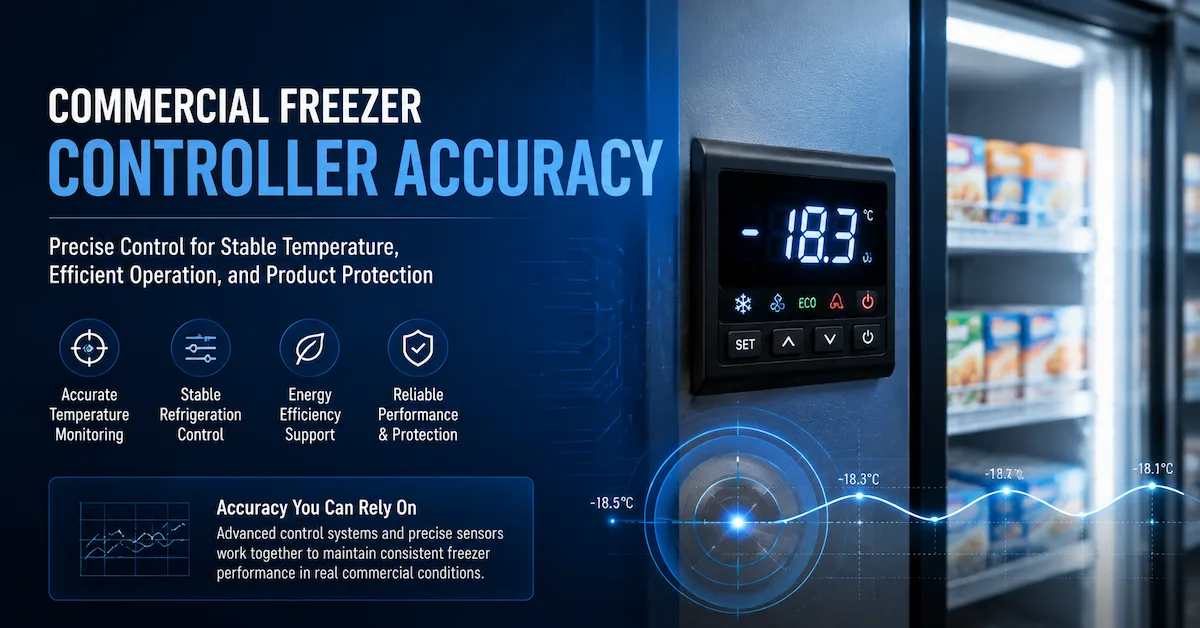
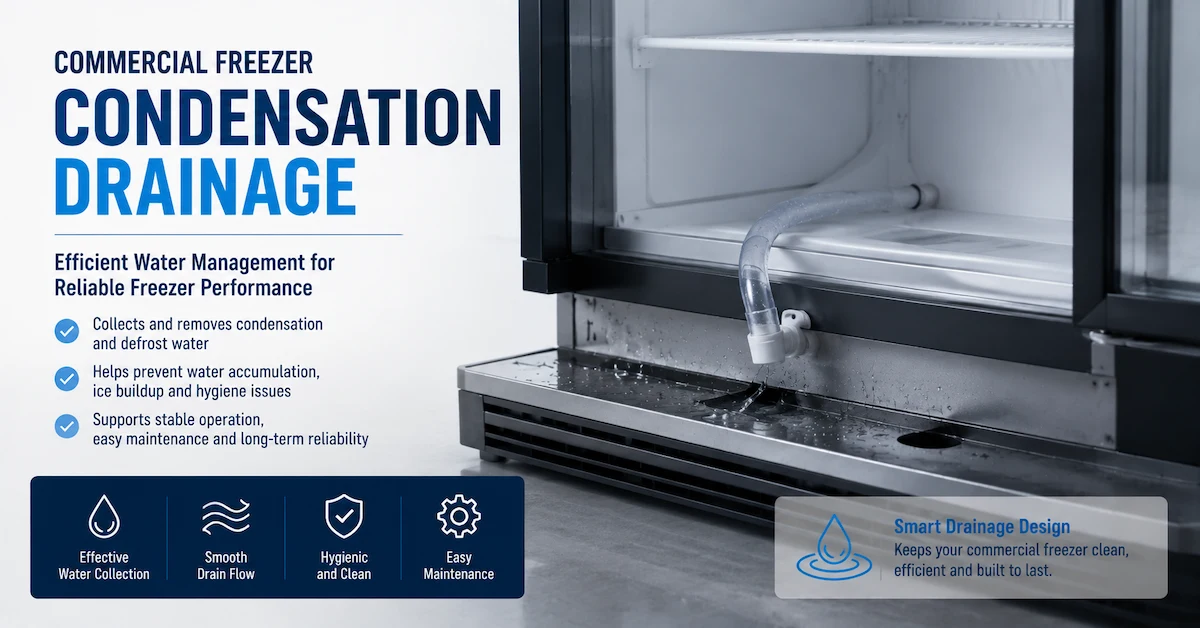
What Does OEM Freezer Custom Controller Mean?
An OEM freezer custom controller project means configuring or evaluating a freezer control system around the operational requirements of a commercial refrigeration product.
A controller may manage much more than the temperature setpoint.Depending on the freezer platform and controller architecture, it can coordinate:
- Temperature regulation
- Compressor start and stop
- Compressor restart delay
- Sensor inputs
- Fan operation
- Defrost functions
- Temperature alarms
- Display information
- Button functions
- Parameter access
- Lighting outputs
- Other electrical functions where applicable
The most important principle for OEM buyers is:
A custom freezer controller should be specified by functions, control logic, inputs, outputs, and operating requirements—not by display appearance alone.
Snowsea can evaluate controller requirements together with the complete freezer configuration through its OEM/ODM solutions.
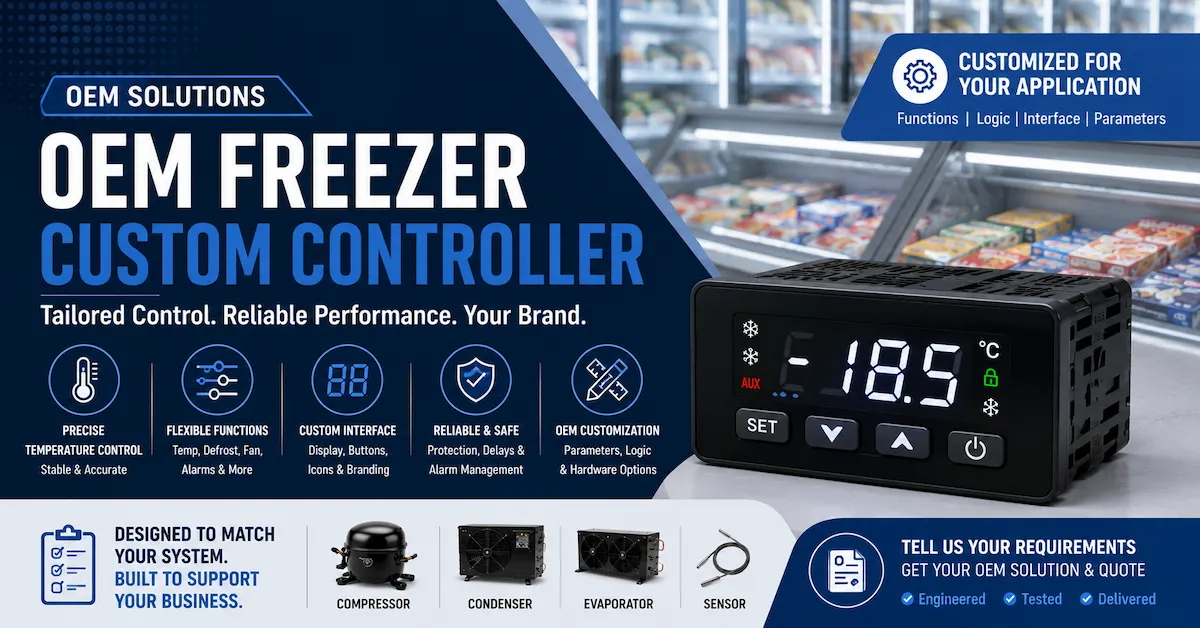
What Can Be Customized in a Freezer Controller?
The actual customization scope depends on the selected freezer platform and engineering feasibility.
| Controller Area | Possible OEM Requirement | Why It Matters |
|---|---|---|
| Temperature setting | Setpoint and adjustment range | Defines operating control |
| Differential | Compressor cut-in/cut-out logic | Influences cycling |
| Sensor input | Type and quantity | Determines monitoring |
| Compressor control | Start/stop and protection delay | Supports system operation |
| Defrost | Timing and termination logic | Manages frost where applicable |
| Fan control | Start/stop timing | Affects airflow |
| Alarm | High/low temperature, sensor fault | Helps detect abnormal operation |
| Display | Temperature, icons,units | User interface |
| Buttons | Key functions and layout | Operator convenience |
| Parameter lock | User/service access levels | Reduces incorrect adjustment |
| Lighting output | Switching function | Integrates cabinet lighting |
| Communication | Interface where supported | System integration |
Instead of sending only a photo of a preferred display, buyers should provide a functional specification.
Basic Controller vs Advanced Controller
Different freezer applications require different levels of control.
| Controller Type | Typical Functions | Suitable For | OEM Complexity |
|---|---|---|---|
| Basic thermostat control | Temperature switching | Simple freezer systems | Low |
| Digital controller | Setpoint, sensor, display, delay | Standard commercial freezers | Medium |
| Multi-function controller | Temperature, defrost, fan,alarm | More complex refrigeration systems | Medium–High |
| Project-specific control | Customized logic/interface | Private-label OEM projects | High |
Not every freezer needs the most complex controller.
More functions can also mean:
- More components
- More configuration
- More testing
- Higher development cost
- More service requirements
The correct solution is the one that matches the application.
Freezer Controller vs Thermostat: What Is the Difference?
A thermostat mainly focuses on temperature-based switching.
A freezer controller can potentially coordinate multiple system functions such as temperature, compressor delay, sensors, fans, defrost, alarms, display, and parameter access.
Therefore:
Custom thermostat settings are only one part of a custom freezer controller project.
For projects focused primarily on temperature switching and thermostat parameters, see Snowsea's OEM freezer custom thermostat guide.
What Temperature Parameters Should Buyers Specify?
A high-quality OEM inquiry should define more than the desired freezer temperature.
Important parameters may include:
- Target operating temperature range
- Default temperature setpoint
- User-adjustable range
- Temperature differential
- Calibration offset
- High-temperature alarm threshold
- Low-temperature alarm threshold
- Compressor restart delay
- Sensor-failure behavior
For example, two buyers may both request a freezer operating around the same temperature but require very different user adjustment limits and alarm strategies.
That difference affects controller configuration.
How Controller Logic Affects Compressor Operation
The controller determines when the compressor is allowed to start and stop.
Depending on the system, relevant parameters may include:
- Cut-in temperature
- Cut-out temperature
- Differential
- Minimum off time
- Restart delay
- Alarm response
A compressor with suitable capacity can still perform poorly if the control logic is incorrectly matched to the freezer.
This is why controller selection should be reviewed together with compressor sizing and refrigeration-system requirements.
Related guides:
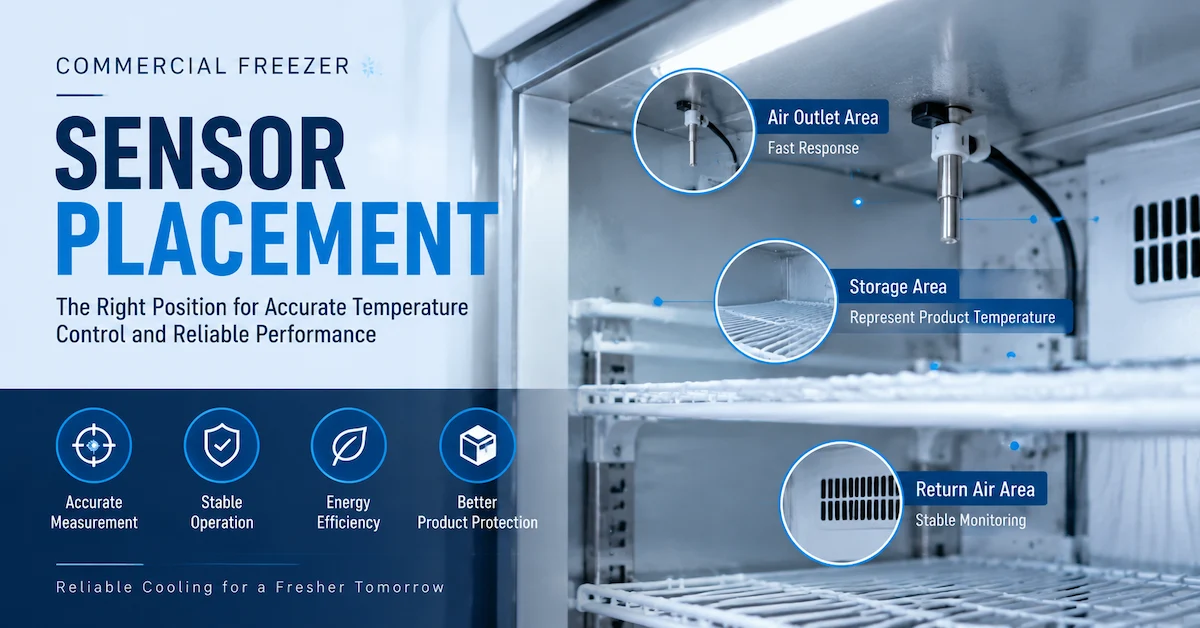
Sensor Configuration Is Part of Controller Design
Sensors provide the controller with the information needed to make operating decisions.
Depending on the freezer design, buyers may need to confirm:
- Sensor quantity
- Sensor type
- Sensor location
- Calibration requirement
- Failure response
Cabinet Temperature Sensor
This commonly provides the main temperature reference used by the controller.
Its installation position can influence the temperature reading and control response.
Evaporator Sensor
Where the system architecture requires it, an evaporator sensor may support functions such as:
- Defrost termination
- Fan control
- Evaporator monitoring
Not every freezer uses the same sensor configuration, so the buyer should not assume that one controller setup can be copied directly to every cabinet.
How Defrost Requirements Affect Controller Selection
For freezer platforms that use controlled defrost functions, the controller may need to manage:
- Defrost interval
- Defrost duration
- Defrost termination
- Compressor operation
- Fan delay
- Post-defrost recovery
The correct strategy depends on the refrigeration system and product design.
A controller developed for a simple manually defrosted freezer may therefore not be suitable for a system requiring automatic defrost control.
For more background, see Manual Defrost vs Automatic Defrost Freezer.
What Alarm Functions Should B2B Buyers Consider?
Alarm requirements are particularly important for commercial equipment used in stores, kitchens, supermarkets, and food-service environments.
Possible functions may include, where supported:
- High-temperature alarm
- Low-temperature alarm
- Sensor fault alarm
- Door-open alarm
- Other system alarms
Specific functions depend on the controller and freezer electrical architecture.
Buyers should specify:
- What condition should trigger the alarm?
- How long should the delay be?
- Should the alarm be visual, audible, or both?
- Who can change the alarm settings?
These details are much more useful than simply requesting an “alarm controller.”
Display and User Interface Customization
Some OEM projects also require a customized user interface.
Possible requirements include:
- LED or LCD display
- °C or °F
- Display icons
- Button layout
- Key functions
- Parameter lock
- Branding or panel appearance
- User/service access levels
However, the correct sequence is:
Define the functions first, then define the appearance.
Changing the front panel without confirming the underlying controller logic can create unnecessary redesign work later.
Why Parameter Lock and Service Access Matter
Commercial freezer brands often need to control which parameters can be changed by the end user.
End-User Access
The user may only need access to:
- Temperature adjustment
- Lighting
- Basic operating functions
Service Access
Authorized technicians may need access to:
- Temperature differential
- Calibration
- Compressor delay
- Defrost parameters
- Alarm limits
- Other technical settings
Separating these access levels can reduce incorrect adjustment in the field.
How Voltage and Electrical Design Affect Controller Selection
Controller selection must also match the electrical architecture of the freezer.
Important considerations can include:
- Supply voltage
- Controller input requirements
- Relay output capacity
- Compressor control
- Fan load
- Lighting load
- Wiring arrangement
The buyer should therefore provide both the freezer electrical specification and the functions the controller is expected to operate.
For export projects, destination-market voltage and frequency requirements should be confirmed early.
Can Buyers Specify Their Own Controller Brand or Model?
A buyer can submit a preferred controller brand, model, or datasheet for technical evaluation.
However, a specified controller should not automatically be assumed compatible.
The manufacturer may need to review:
- Supply voltage
- Sensor compatibility
- Relay/output capacity
- Control logic
- Physical dimensions
- Mounting
- Wiring
- Refrigeration-system requirements
- Availability
- Certification implications
A controller that works in another refrigeration product may still require changes before it can be used in the selected freezer.
Standard Controller vs Buyer-Specified Controller
| Option | Main Advantage | Main Consideration |
|---|---|---|
| Existing validated controller | Faster development | Limited customization |
| Existing controller with custom parameters | Good balance of flexibility and risk | Hardware functions remain fixed |
| Approved alternative controller | More sourcing flexibility | Requires validation |
| Buyer-specified controller | Matches buyer standard | Compatibility must be checked |
| New control solution | Greater customization | Higher development complexity |
This comparison is important for private-label buyers because the highest level of customization is not always the most commercially efficient option.
Three Levels of OEM Freezer Controller Customization
Level 1: Parameter Customization
This may include:
- Default temperature
- Adjustment limits
- Differential
- Delay
- Alarm parameters
- Defrost settings where applicable
Because the existing controller hardware remains unchanged, this type of project may require less development work.
Level 2: Function and Interface Configuration
This can involve:
- Sensor configuration
- Display changes
- Buttons
- Icons
- User-access logic
- Function mapping
- Wiring adjustments
More engineering confirmation and testing may be required.
Level 3: New Controller or Control Logic Development
A more extensive project may involve, where technically and commercially feasible:
- New controller hardware
- New PCB architecture
- Project-specific control logic
- New display
- New wiring
- New panel structure
This can affect:
- Development cost
- Tooling
- MOQ
- Sample lead time
- Validation time
- Production lead time
Buyers should therefore define which functions are genuinely required before requesting full controller redevelopment.
How Does Custom Controller Design Affect OEM Cost?
The controller unit price is only one part of the total customization cost.
Other factors can include:
- Existing or new controller platform
- Number of sensors
- Output requirements
- Display customization
- Software or parameter changes
- Control-panel modifications
- Wiring harness changes
- Tooling
- Testing
- Component purchasing quantity
- Certification impact
The key procurement principle is:
Controller cost should be evaluated together with engineering, validation, sourcing, tooling, and mass-production risk—not only the controller unit price.
Does Custom Controller Design Affect MOQ and Lead Time?
It can.
MOQ may increase when a project requires:
- Customized controller purchasing
- Dedicated display components
- Custom faceplates
- New PCB hardware
- Special wiring
- Project-specific components
Lead time can also increase when the project requires:
- Engineering review
- Controller sourcing
- Sample preparation
- Programming or parameter setup
- Functional testing
- Revision
- Final approval
To receive a more realistic proposal, buyers should provide both the initial order quantity and estimated annual volume.
What Should Be Tested Before Mass Production?
A customized controller configuration should be validated with the actual freezer system rather than only checking the controller on a workbench.
Useful checks may include:
- Controller model verification
- Parameter version verification
- Sensor input accuracy
- Temperature adjustment range
- Compressor switching logic
- Compressor restart delay
- Fan control where applicable
- Defrost operation where applicable
- Alarm functions
- Display and button response
- Parameter lock
- Temperature stability
- Temperature recovery
- Power-cycle behavior
- Wiring and electrical operation
See Snowsea's commercial freezer quality testing procedure for related system-level testing considerations.
OEM Controller Production QC Checklist
After a customized configuration is approved, mass-production control should verify consistency.
Important checks may include:
- Correct controller model
- Correct parameter or software version
- Correct sensors
- Correct sensor positions
- Correct wiring
- Correct voltage
- Correct display
- Correct button functions
- Correct temperature range
- Correct compressor switching
- Correct alarms
- Correct defrost logic where applicable
- Correct fan control where applicable
- Specification and manual consistency
Version control is especially important for repeat OEM orders.
How to Compare OEM Freezer Suppliers for Controller Projects
| Evaluation Area | What Buyers Should Verify |
|---|---|
| Controller flexibility | Can functions and parameters be customized? |
| Engineering review | Is control logic matched to the freezer? |
| Sensor integration | Are sensors correctly selected and tested? |
| Compressor control | Are cycling and delay settings validated? |
| Defrost control | Is the strategy suitable for the platform? |
| Interface | Can display and keys meet project needs? |
| Testing | Is the complete configuration validated? |
| Production QC | Are parameters and versions controlled? |
| MOQ | Does customization fit purchasing volume? |
| Lead time | Are engineering and testing stages clear? |
The supplier should be able to explain the technical and commercial consequences of each requested customization instead of simply agreeing to every function.
What Should Buyers Send Snowsea for a Controller Quote?
For an efficient OEM freezer custom controller evaluation, provide:
- Freezer type
- Reference freezer model
- Preferred controller brand/model, if required
- Controller datasheet,if available
- Target temperature range
- Default temperature setting
- User-adjustable temperature range
- Temperature differential requirement
- Sensor quantity and type
- Compressor control requirements
- Restart-delay requirements
- Defrost requirements
- Fan-control requirements
- Alarm requirements
- Display requirements
- °C/°F requirement
- Button/function requirements
- Parameter-lock requirements
- Voltage and frequency
- Destination market
- Certification requirements
- Initial order quantity
- Annual purchasing forecast
- Reference drawing or photo
You can also review Snowsea's commercial refrigeration products before submitting your project specification.
FAQ
Can I customize the controller on an OEM freezer?
Yes, controller requirements can be submitted for OEM evaluation. The feasible customization scope depends on the controller platform, freezer design, electrical system, required functions, quantity, and engineering feasibility.
What is the difference between a thermostat and a freezer controller?
A thermostat mainly manages temperature switching, while a controller may also manage sensors, compressor delays, fans, defrost, alarms, display, and other functions.
Can I specify a controller brand or exact model?
Yes. Buyers can provide a preferred brand, exact model, or technical datasheet for compatibility evaluation.
Can controller parameters be customized?
Depending on the controller platform, parameters such as temperature range, differential, delay, alarms, and defrost settings may be configurable.
Can the display and buttons be customized?
Some projects may support display, icons, button functions, or panel customization. The scope should be confirmed after the required controller functions are defined.
Can a freezer controller manage defrost?
Where the freezer system and controller support automatic defrost functions, the controller may manage defrost timing, termination, compressor operation, and related logic.
Does the controller affect compressor performance?
Yes. Compressor start/stop temperatures, differential, and restart delays can influence system cycling and operating behavior.
Does custom controller development affect MOQ?
It may, particularly when custom hardware, displays, wiring, faceplates, or dedicated controller purchasing quantities are required.
Does controller customization increase lead time?
More complex customization can add engineering, component sourcing, sample development, testing, and revision stages.
What information is needed for an OEM controller quotation?
Provide the freezer type, controller requirement, target temperature, sensors, compressor/defrost/fan logic, display functions, voltage, destination market, quantity, and any reference datasheets or drawings.
Conclusion
An OEM freezer custom controller project should begin with the required operating functions—not with the appearance of the display panel.
B2B buyers should define:
- Temperature parameters
- Sensor requirements
- Compressor control logic
- Defrost strategy
- Fan functions
- Alarm requirements
- Display and buttons
- User/service access
- Electrical specification
- Required customization level
- Order quantity
The manufacturer can then evaluate technical compatibility, engineering workload, testing, component sourcing, MOQ, lead time, and mass-production risk.
For private-label brands, distributors, and OEM buyers, a detailed controller specification reduces misunderstanding during sampling and makes competing quotations easier to evaluate.
Send Snowsea your freezer type, target temperature range, preferred controller or datasheet, sensor requirements, compressor/defrost/fan control logic, display and button requirements, voltage, destination market, certification requirements, and estimated order quantity through the contact page to request an OEM technical evaluation and commercial quotation.