What Does OEM Freezer Custom Door Type Mean?
An OEM freezer custom door type project means adapting the freezer door configuration to match a private-label brand, commercial application, store layout, or project specification.
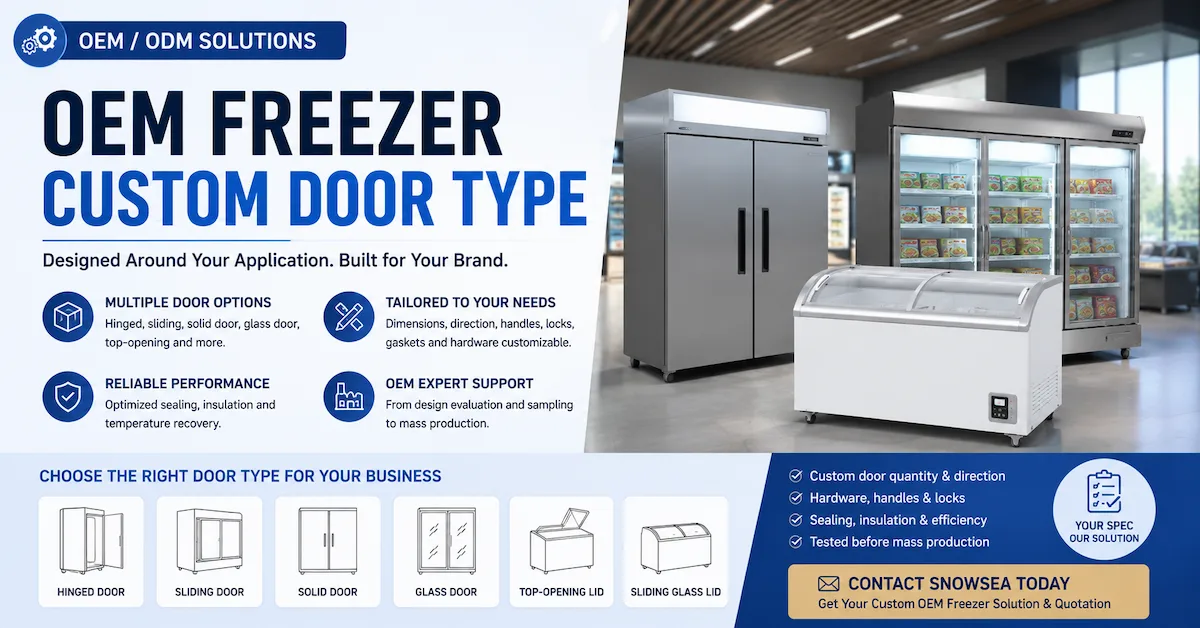
Depending on the freezer platform and technical feasibility, customization may involve:
- Hinged doors
- Sliding doors
- Solid insulated doors
- Glass doors
- Top-opening lids
- Sliding glass lids
- Single-door layouts
- Double-door layouts
- Multi-door configurations
- Door opening direction
- Handles, hinges, locks, and gaskets
For OEM buyers, door customization should not be treated as a cosmetic change only.
Changing the door structure can influence cabinet dimensions, insulation, sealing, accessibility, temperature recovery, energy consumption, packaging, and production complexity.
Snowsea supports commercial refrigeration customization through its OEM/ODM solutions.
Which Freezer Door Type Should B2B Buyers Choose?
The best configuration depends on how the freezer will actually be used.
| Door Type | Main Advantage | Typical Application | Main Buyer Concern |
|---|---|---|---|
| Hinged door | Wide opening and direct access | Upright storage freezers | Required opening clearance |
| Sliding door | Saves operating space | Retail and display freezers | Track quality and sealing |
| Solid door | Strong insulation and privacy | Kitchens and back-of-house storage | Insulation and durability |
| Glass door | Product visibility | Supermarkets and convenience stores | Condensation and heat transfer |
| Top-opening lid | Good cold retention | Chest freezers | Product access and organization |
| Sliding glass lid | Visibility with compact opening | Island/display chest freezers | Glass, frame, track and sealing |
There is no universal “best freezer door.”
A retail buyer may prioritize visibility, while a central kitchen may prioritize insulation and frequent staff access.
Hinged Door vs Sliding Door for OEM Freezers
Hinged Door
A hinged door opens outward from one side.
It is commonly used on upright commercial freezers because staff can access the full cabinet opening quickly.
Potential advantages include:
- Wide access
- Simple operation
- Easy shelf access
- Familiar commercial kitchen design
However, buyers must account for opening clearance.
A freezer installed in a narrow aisle may not have enough space for a large hinged door.
Sliding Door
Sliding doors move horizontally and usually require less external clearance.
They can be suitable for:
- Supermarket displays
- Convenience stores
- Frozen food retail
- Island freezers
Buyers should evaluate more than the space-saving benefit.
Track structure, door overlap, gasket or sealing arrangement, ease of cleaning, and repeated opening performance also matter.
Solid Door vs Glass Door
Another major OEM freezer custom door type decision is whether the cabinet should use solid or transparent doors.
Solid Door Freezer
Solid insulated doors are commonly used where product display is not required.
Typical applications include:
- Hotel kitchens
- Central kitchens
- Catering storage
- Institutional kitchens
- Frozen food preparation areas
Key purchasing considerations include:
- Insulation
- Surface material
- Door strength
- Gasket sealing
- Cleaning convenience
Glass Door Freezer
Glass doors are useful when customers or staff need to see products without opening the cabinet first.
Typical applications include:
- Supermarkets
- Mini markets
- Convenience stores
- Frozen snack displays
- Ice cream aisles
Important considerations include:
- Glass construction
- Thermal performance
- Anti-condensation strategy
- Frame design
- Door sealing
For related technical considerations, see Snowsea's commercial freezer glass door thickness guide.
What Door Specifications Should Buyers Include in an RFQ?
A request such as “We need a custom freezer door” is not detailed enough for accurate engineering evaluation.
Buyers should define:
- Freezer type
- Door type
- Solid or glass construction
- Number of doors
- Opening direction
- Door dimensions
- Handle type
- Hinge requirements
- Lock requirements
- Gasket requirements
- Self-closing requirement if applicable
- Target application
Providing these details reduces repeated quotation revisions.
A reference drawing, existing product image, or dimension sketch can also help the manufacturer understand the requested configuration.
Why Door Type Can Affect Temperature Performance
Every time a freezer door opens, warmer surrounding air can enter the cabinet.
The amount of heat entering the freezer depends on factors such as:
- Opening area
- Opening duration
- Door-opening frequency
- Gasket sealing
- Ambient conditions
- Product load
- Airflow design
This means a door configuration should be evaluated together with refrigeration performance.
For example, a high-traffic retail freezer may experience much more frequent opening than a backup chest freezer in a warehouse.
Buyers comparing configurations should consider both access convenience and recovery performance.
Snowsea's commercial freezer temperature recovery guide explains why recovery behavior matters in commercial operation.
Door Gasket Design Is a Critical OEM Detail
A customized freezer door still needs reliable sealing.
The gasket needs to maintain appropriate contact around the door perimeter.
Potential problems from poor alignment or sealing can include:
- Air leakage
- Frost formation
- Increased compressor operation
- Temperature instability
- Higher energy consumption
During OEM development, buyers should pay attention to:
- Gasket dimensions
- Installation consistency
- Door alignment
- Closing pressure
- Replaceability
For more detail, see Snowsea's freezer door gasket sealing performance guide.
How Door Type Relates to Cabinet Insulation
A freezer is a complete thermal enclosure.
Changing the door structure can alter the insulation and heat-transfer characteristics of the cabinet.
A solid insulated door, for example, has different thermal characteristics from a transparent glass door assembly.
OEM buyers should therefore avoid changing:
- Door material
- Door thickness
- Opening dimensions
- Frame structure
without reviewing the complete cabinet design.
For projects where thermal performance is important, insulation configuration should be evaluated alongside door design rather than independently.
Three Levels of OEM Freezer Door Customization
Not all customization projects require the same engineering effort.
Level 1: Existing Door Configuration Selection
The buyer selects from door configurations already compatible with an existing freezer platform.
This can reduce:
- Development complexity
- Sample time
- Engineering risk
It may be suitable for distributors who need differentiation without major structural changes.
Level 2: Door Hardware Customization
The core door structure remains similar, but selected hardware is changed.
Possible items include:
- Handle
- Lock
- Hinge
- Gasket
- Opening direction
- Decorative trim
This provides greater differentiation without necessarily redesigning the complete cabinet.
Level 3: Structural Door Redesign
A more advanced OEM freezer custom door type project may require:
- Different opening dimensions
- Additional doors
- New door frame
- New panel structure
- Changed cabinet opening
- Special glass or hardware
These changes may require additional engineering, samples, validation, tooling, or component sourcing.
How Does Custom Door Type Affect OEM Price?
Door customization can influence cost through several areas.
Potential cost drivers include:
- Door material
- Glass versus solid construction
- Insulation
- Frame design
- Hinges
- Handles
- Locks
- Gaskets
- Special hardware
- Structural cabinet changes
- Tooling
- Testing
- Packaging
For this reason, comparing only the price of the door component can be misleading.
The more important comparison is the cost of the complete approved freezer configuration.
Does Custom Door Type Affect MOQ?
It may.
An existing door configuration can generally be easier to source and manufacture than a completely new structural design.
MOQ may be influenced by:
- Special glass quantity
- Hardware purchasing quantity
- Custom extrusion or frame requirements
- Tooling
- Custom panels
- Packaging
- Production setup
OEM buyers should provide both initial order quantity and estimated repeat demand when requesting a quotation.
That allows the manufacturer to propose a customization level that makes commercial sense.
Can Door Opening Direction Be Customized?
In some projects, opening direction may be an important requirement.
For example, the buyer may need a door to open from a particular side because of:
- Wall position
- Kitchen workflow
- Store aisle layout
- Adjacent equipment
Whether the opening direction can be changed depends on the selected cabinet and hinge structure.
Buyers should provide installation drawings or layout information when this requirement is important.
What About Self-Closing Doors?
Self-closing behavior can be useful in commercial environments where staff frequently access the freezer.
It may help reduce the chance of doors being left partially open.
However, buyers should confirm:
- Hinge type
- Closing force
- Door weight
- Gasket compression
- User experience
A stronger closing force is not automatically better if it makes the door difficult to operate.
The door system needs to balance reliable closing with practical daily use.
How Door Type Affects Energy Efficiency
A freezer door can affect energy performance through:
- Heat transfer
- Air leakage
- Opening frequency
- Opening duration
- Glass surface area
- Gasket condition
This means energy efficiency cannot be evaluated from compressor specifications alone.
For retail projects, buyers should consider the trade-off between high visibility and thermal performance.
For back-of-house storage, stronger insulation may be more valuable than transparency.
The correct choice depends on application and lifecycle operating priorities.
What Should Be Tested Before Mass Production?
Door customization should be verified on an approved sample before batch production when the project involves meaningful structural changes.
Useful checks can include:
- Door dimensions
- Opening direction
- Opening and closing movement
- Hinge alignment
- Handle installation
- Lock function
- Gasket contact
- Door sealing
- Surface appearance
- Temperature recovery
- Condensation performance where applicable
- Repeated operation
The exact test plan depends on the model and requested configuration.
For broader quality evaluation, see Snowsea's commercial freezer quality testing procedure.
OEM Freezer Door QC Checklist
Once the sample has been approved, production should reproduce the confirmed specification consistently.
A practical inspection checklist may include:
- Door model confirmation
- Door dimension check
- Frame alignment
- Hinge inspection
- Handle inspection
- Lock inspection
- Gasket installation
- Opening and closing test
- Sealing inspection
- Surface inspection
- Functional temperature test
- Final inspection
For private-label projects, approved drawings and specifications should be documented clearly before mass production.
How Door Customization Affects Export Packaging
A customized door can change the way the finished freezer needs to be protected during transportation.
Relevant factors may include:
- Overall dimensions
- Handle projection
- Glass protection
- Door fixation
- Corner protection
- Foam protection
- Carton or crate dimensions
Glass door configurations may require additional protection compared with standard solid cabinet surfaces.
For export buyers, packaging should be confirmed together with the final product configuration rather than after production is complete.
See Snowsea's freezer export packaging protection guide for related considerations.
How to Compare OEM Freezer Door Suppliers
B2B buyers should compare more than whether a supplier answers “yes” to customization.
| Evaluation Area | Buyer Should Check |
|---|---|
| Door options | Are suitable configurations available? |
| Structural capability | Can cabinet changes be evaluated? |
| Sealing | Is gasket and alignment considered? |
| Thermal performance | Is insulation impact reviewed? |
| Hardware | Are hinges,handles and locks suitable? |
| Testing | Is the approved sample validated? |
| QC | Can production reproduce the specification? |
| MOQ | Does it match the project? |
| Lead time | Is development time realistic? |
| Packaging | Is the customized door protected for export? |
A reliable OEM partner should help determine whether the requested door type is technically and commercially suitable—not simply accept every requested change without evaluation.
What Should Buyers Send Snowsea for a Door Customization Quote?
For a faster technical review,send Snowsea:
- Freezer type or reference model
- Required door type
- Solid or glass construction
- Number of doors
- Door dimensions
- Opening direction
- Handle requirement
- Hinge requirement
- Lock requirement
- Target application
- Destination country
- Voltage and frequency
- Required quantity
- Certification requirements
- Reference photo or drawing
- Target delivery schedule
A high-quality RFQ gives Snowsea enough information to evaluate both the door configuration and its impact on the complete freezer.
Explore Snowsea commercial refrigeration products to select a base product, or visit OEM/ODM Solutions to discuss customization.
FAQ
What is OEM freezer custom door type?
It refers to customizing the door structure or configuration of a commercial freezer for a private-label or project-specific requirement.
What freezer door types can be considered for OEM projects?
Depending on the freezer platform, options may include hinged doors, sliding doors, solid doors, glass doors, top lids, and different door quantities.
Is a sliding door better than a hinged door?
Not universally. Sliding doors save external space, while hinged doors can provide wider direct access. The correct choice depends on the application.
Can a solid freezer door be changed to glass?
This requires technical evaluation because glass can affect structure, insulation, condensation behavior, and thermal performance.
Can door opening direction be customized?
It may be possible depending on cabinet and hinge design. Buyers should specify the required opening direction before development.
Can freezer handles and locks be customized?
Depending on the model and project, hardware such as handles, hinges, locks, and related components may be evaluated for customization.
Does a custom freezer door affect energy consumption?
It can. Door insulation, glass area, sealing, and opening behavior all influence heat gain and refrigeration workload.
Does custom door design increase MOQ?
It may, especially if new glass, tooling, frames, hardware, or structural components are required.
Should a custom freezer door be tested before production?
Yes.Structural function, sealing, alignment, temperature performance, and other project-specific requirements should be verified before mass production where appropriate.
Can Snowsea support private-label freezer door customization?
Snowsea supports commercial refrigeration OEM/ODM projects and can evaluate door configuration together with the complete freezer specification.
Conclusion
An OEM freezer custom door type project should be treated as a structural, thermal, operational, and commercial decision—not simply an appearance change.
B2B buyers should define:
- Door type
- Door quantity
- Material
- Dimensions
- Opening direction
- Hardware
- Gasket
- Application
- Quantity
- Destination market
The supplier should then evaluate how the requested configuration affects cabinet structure, insulation, sealing, temperature recovery, QC, production, and export packaging.
For private-label brands, distributors, and OEM buyers, defining these requirements before sampling reduces specification changes and makes quotations easier to compare.
Send Snowsea your freezer type, preferred door configuration, door quantity, dimensions, target application, destination market, reference drawing and estimated order quantity through the contact page to request an OEM technical review and commercial quotation.