What Does OEM Freezer Custom Glass Door Mean?
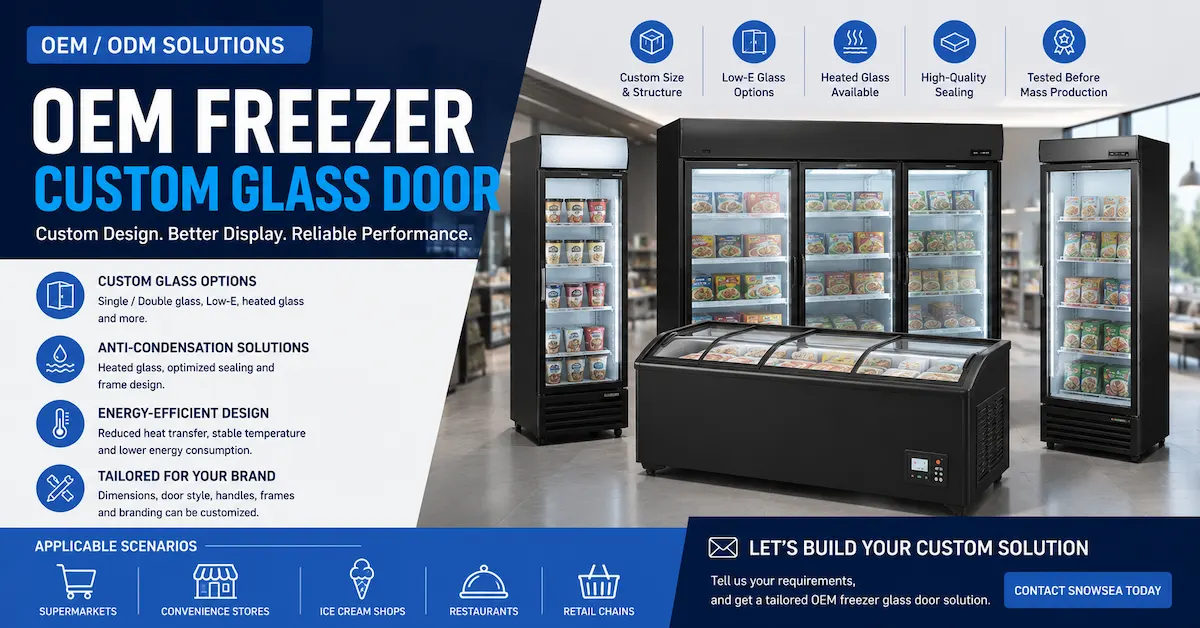
An OEM freezer custom glass door project means adapting the glass door system of a commercial freezer to meet a buyer's private-label, retail display, thermal-performance, or market-specific requirements.
Depending on the base freezer platform and technical feasibility, the project may involve:
- Glass dimensions
- Glass construction
- Door thickness
- Hinged or sliding operation
- Frame structure
- Handle design
- Gasket configuration
- Low-emissivity options where applicable
- Anti-condensation strategy
- Heated glass where required
- Decorative trim or branding
For B2B buyers, the key point is that a glass door is part of the freezer's thermal enclosure.
Changing it can affect not only appearance, but also heat transfer, sealing, temperature recovery, electrical load, refrigeration workload, packaging, and final cost.
Snowsea can evaluate door requirements together with the complete commercial freezer specification through its OEM/ODM solutions.
What Glass Door Specifications Should Buyers Confirm?
A request such as “We need a custom glass door freezer” is usually not enough for accurate quotation.
A better RFQ should define the actual door requirement.
| Specification | What to Confirm | Why It Matters |
|---|---|---|
| Door dimensions | Width and height | Must match cabinet structure |
| Door style | Hinged or sliding | Affects access and layout |
| Glass configuration | Project requirement | Influences thermal performance |
| Frame | Material and finish | Affects structure and appearance |
| Gasket | Sealing requirement | Controls air leakage |
| Handle | Type and position | Affects daily operation |
| Condensation control | Required or not | Depends on environment |
| Heating requirement | If applicable | Adds electrical considerations |
| Branding | Logo,trim or panel | Supports private-label positioning |
Exact available options should be confirmed against the selected Snowsea freezer platform rather than assumed to be available on every model.
Standard Glass vs Low-E Glass: What Should OEM Buyers Consider?
Glass selection should begin with the application rather than with a feature checklist.
Standard transparent glass may be suitable when the main requirement is straightforward product visibility.
Low-emissivity glass may be considered when a project needs additional control of radiant heat transfer, but whether it is appropriate depends on the freezer design, ambient environment, operating hours, and energy target.
Buyers should therefore compare:
- Product visibility
- Thermal requirement
- Store environment
- Operating schedule
- Energy objective
- Project budget
The best specification is the one that works with the complete freezer system—not simply the glass option with the most features.
For related design considerations, see Snowsea's commercial freezer glass door thickness guide.
When Should Heated Glass Be Considered?
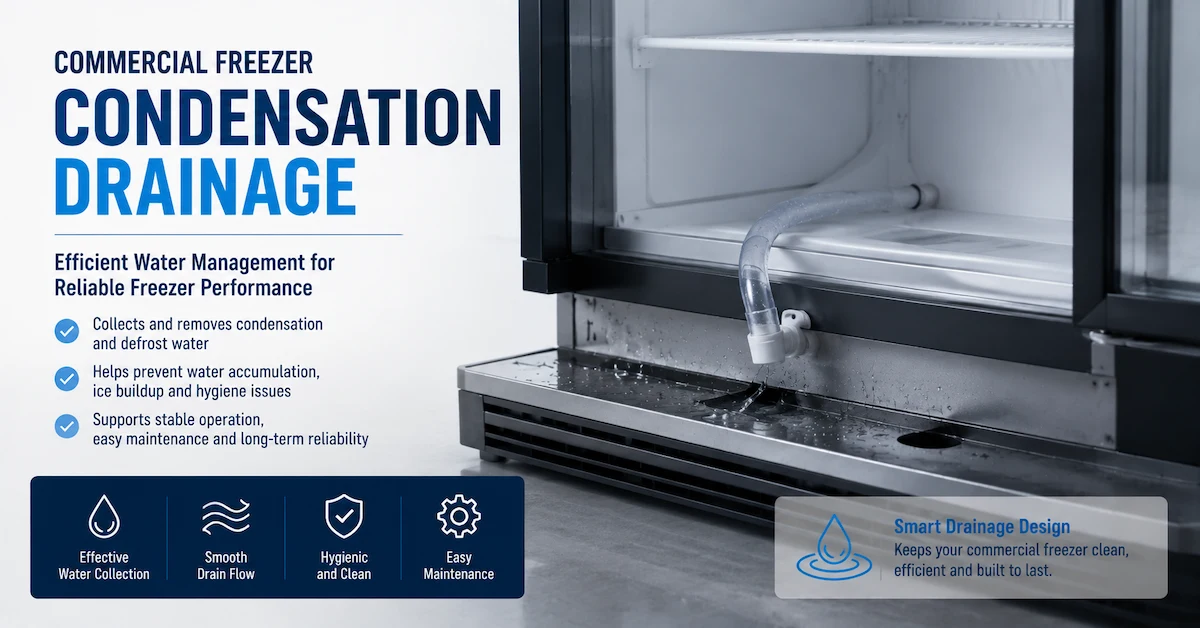
Condensation is a common concern for commercial glass-door freezer projects, especially where cold glass surfaces are exposed to warm or humid air.
A heated glass solution may be considered for certain applications, but it should not automatically be specified for every OEM freezer custom glass door project.
Adding glass heating can affect:
- Electrical load
- Wiring
- Controller configuration
- Energy consumption
- Component selection
- Compliance review
Before specifying it, buyers should provide the expected ambient temperature and humidity conditions so the manufacturer can evaluate the application.
What Causes Condensation on Freezer Glass Doors?
Condensation control is not determined by glass thickness alone.
Several factors can influence visible moisture or fogging:
- Ambient humidity
- Ambient temperature
- Glass surface temperature
- Glass construction
- Air infiltration
- Gasket sealing
- Door-opening frequency
- Anti-condensation strategy
- Store ventilation
This is why the statement “use thicker glass and condensation will disappear” is too simplistic for an OEM project.
The full operating environment should be evaluated.
Hinged Glass Door vs Sliding Glass Door
The opening method can significantly affect how the freezer is used.
| Option | Main Advantage | Typical Fit | Key Concern |
|---|---|---|---|
| Hinged glass door | Wide direct access | Upright display freezer | Opening clearance |
| Sliding glass door | Saves aisle space | Chest/island display freezer | Track and sealing |
Hinged glass doors can provide convenient full-height access, while sliding designs can be useful where available aisle space is limited.
Neither option is universally better.
Buyers should compare store layout, access frequency, sealing, cleaning, merchandising requirements, and customer interaction.
For broader door configuration selection, see Snowsea's OEM freezer custom door type guide.
Why Glass Door Sealing Matters
The glass itself is only one part of the door system.
The frame, gasket, alignment, track or hinge, and closing structure all contribute to sealing performance.
Poor sealing may increase:
- Warm-air infiltration
- Frost formation
- Temperature fluctuation
- Compressor workload
- Energy consumption
OEM buyers should therefore ask suppliers how door alignment and gasket contact are verified during sample approval and production.
For more detail, see Snowsea's freezer door gasket sealing performance guide.
How Glass Door Design Affects Temperature Recovery
Opening a commercial freezer introduces heat and surrounding air into the refrigerated cabinet.
The impact depends on:
- Door size
- Opening frequency
- Opening duration
- Store ambient conditions
- Product load
- Refrigeration capacity
- Airflow
- Door sealing
A retail freezer opened repeatedly throughout the day has different operating conditions from a back-of-house freezer accessed only occasionally.
For this reason, a custom glass door should be validated as part of the complete freezer.
Snowsea's commercial freezer temperature recovery guide explains the importance of recovery performance in commercial applications.
Three Levels of OEM Glass Door Customization
Level 1: Existing Glass Door Configuration
The buyer selects an existing door configuration already compatible with a freezer platform.
This can usually reduce:
- Engineering complexity
- Sample development
- Structural risk
- Project lead time
This level is often suitable for distributors or private-label brands that want differentiation without redesigning the cabinet.
Level 2: Glass and Hardware Customization
The basic door structure remains similar while selected details are changed.
Possible items include:
- Glass specification
- Handle
- Frame finish
- Gasket
- Trim
- Branding
This creates more product differentiation while limiting structural changes.
Level 3: Structural Glass Door Development
More advanced projects may involve:
- New glass dimensions
- Different opening structure
- New frame
- Heated glass system
- Additional wiring
- Cabinet opening redesign
These projects may require more engineering evaluation, sample testing, tooling, component sourcing, and production preparation.
How Does Custom Glass Door Design Affect OEM Cost?
A custom freezer glass door quotation should not be evaluated from the glass component price alone.
Possible cost drivers include:
- Glass specification
- Number of glass panels
- Door dimensions
- Frame construction
- Gasket
- Handle and hardware
- Heating system if required
- Wiring changes
- Tooling
- Cabinet modifications
- Testing
- Export packaging
- Order quantity
Two apparently similar glass-door freezers can therefore have different costs because their complete specifications are different.
For accurate comparison, buyers should request quotations against the same approved requirement.
Does an OEM Freezer Custom Glass Door Affect MOQ?
It can.
A project based on an existing validated configuration is usually commercially simpler than a completely new glass-door system.
MOQ may be influenced by:
- Custom glass purchasing quantities
- Special frame components
- Hardware quantities
- Heating components
- Tooling
- Packaging
- Production setup
B2B buyers should provide both the expected first order and estimated repeat volume when available.
This helps the manufacturer propose a customization route that is technically and commercially realistic.
What Should Be Tested Before Mass Production?
A custom glass-door sample should be evaluated before mass production when the project involves meaningful changes.
Useful checks can include:
- Door dimensions
- Glass installation
- Frame alignment
- Opening and closing function
- Gasket contact
- Sealing performance
- Handle and hardware operation
- Condensation behavior under the agreed test condition
- Temperature recovery
- Heating function if specified
- Electrical function if applicable
- Final appearance
The test requirements should be agreed according to the selected model and project specification.
For broader freezer inspection, see Snowsea's commercial freezer quality testing procedure.
OEM Glass Door Production QC Checklist
After sample approval, mass production should reproduce the confirmed specification consistently.
A practical QC checklist may include:
- Correct glass specification
- Door dimensions
- Frame installation
- Glass positioning
- Hinge or sliding-track function
- Handle installation
- Gasket alignment
- Door sealing
- Electrical connection where applicable
- Surface inspection
- Functional temperature test
- Final inspection
For private-label programs, approved drawings and specifications should be documented before production.
Why Export Packaging Matters More for Glass Door Freezers
Glass-door equipment requires careful transportation protection.
An OEM freezer custom glass door can also change overall dimensions and the location of vulnerable components, which may require different packaging.
Buyers should confirm:
- Glass surface protection
- Door fixation
- Foam cushioning
- Corner protection
- Handle protection
- Carton or crate structure
- Container loading method
Packaging should therefore be reviewed during product development rather than only after the freezer is finished.
See Snowsea's freezer export packaging protection guide.
How to Compare OEM Glass Door Freezer Suppliers
A strong supplier comparison should go beyond “Can you make this glass door?”
| Evaluation Area | Buyer Should Verify |
|---|---|
| Customization capability | Can the requested configuration be evaluated? |
| Thermal design | Is heat transfer considered? |
| Condensation strategy | Does it match the environment? |
| Sealing | Are gasket and alignment controlled? |
| System integration | Is refrigeration performance reviewed? |
| Sample testing | Is the design validated before production? |
| QC | Can approved specifications be reproduced? |
| MOQ | Does it fit the purchasing plan? |
| Packaging | Is glass protected for export? |
| Communication | Are technical requirements documented clearly? |
A reliable OEM partner should identify technical risks before mass production instead of simply agreeing to every requested feature.
What Should Buyers Send Snowsea for a Glass Door Quote?
For an efficient technical evaluation,send Snowsea:
- Freezer type or reference model
- Required glass door style
- Door dimensions
- Hinged or sliding operation
- Required glass specification
- Low-E requirement if applicable
- Heated glass requirement if applicable
- Condensation-control requirement
- Frame and handle requirement
- Target application
- Expected ambient conditions
- Voltage and frequency
- Destination country
- Estimated order quantity
- Certification requirements
- Reference drawing or product photo
A detailed RFQ allows Snowsea to evaluate the glass door together with the complete cabinet and refrigeration configuration.
Explore Snowsea commercial refrigeration products, review OEM/ODM Solutions, or contact Snowsea with your specifications.
FAQ
What is an OEM freezer custom glass door?
It is a glass-door configuration developed or adapted for a private-label or project-specific commercial freezer requirement.
Can the glass door dimensions be customized?
Dimensions may be evaluated depending on the base cabinet structure, door frame, production feasibility, and project quantity.
Can Snowsea provide Low-E glass options?
Project-specific glass requirements can be evaluated against the selected freezer platform. Buyers should include the required glass specification in the RFQ.
Does a freezer always need heated glass?
No. Whether heated glass is appropriate depends on condensation-control requirements, environmental conditions, product design, and energy considerations.
Can heated glass increase electricity consumption?
A heating system adds electrical load, so it should be considered as part of the freezer's overall energy and electrical design.
Is sliding glass better than hinged glass?
Neither is universally better. Sliding glass can save aisle space, while hinged doors can provide wider direct access.
Can glass door design affect freezer temperature performance?
Yes. Glass thermal performance, door size, sealing, ambient conditions, and opening frequency can affect refrigeration load and recovery.
Does custom glass door design affect MOQ?
It may, particularly when special glass, frames, heating components, tooling, or structural changes are required.
Should glass doors be tested before mass production?
Yes.Relevant projects should verify dimensions, sealing, operation, condensation behavior, temperature performance, and specified electrical functions before mass production.
What information does Snowsea need for an OEM glass door quotation?
Provide the freezer type, door dimensions, opening method, glass requirement, ambient conditions, voltage, destination market, quantity, certification needs, and reference drawing where available.
Conclusion
An OEM freezer custom glass door project should be treated as a combination of display design, thermal performance, sealing, condensation control, structural engineering, and commercial planning.
B2B buyers should define:
- Glass door type
- Dimensions
- Opening method
- Glass requirements
- Condensation-control needs
- Frame and hardware
- Ambient environment
- Quantity
- Target market
The manufacturer should then evaluate how those requirements affect the complete freezer configuration, testing, MOQ, cost, production, and export packaging.
For private-label brands, distributors, and OEM buyers, confirming these details before sampling reduces design revisions and makes supplier quotations easier to compare.
Send Snowsea your freezer type, glass door dimensions, opening method, target market, ambient conditions, anti-condensation requirements, reference drawing, and estimated order quantity through the contact page to request an OEM technical evaluation and commercial quotation.