What Does OEM Freezer Custom Interior Layout Mean?
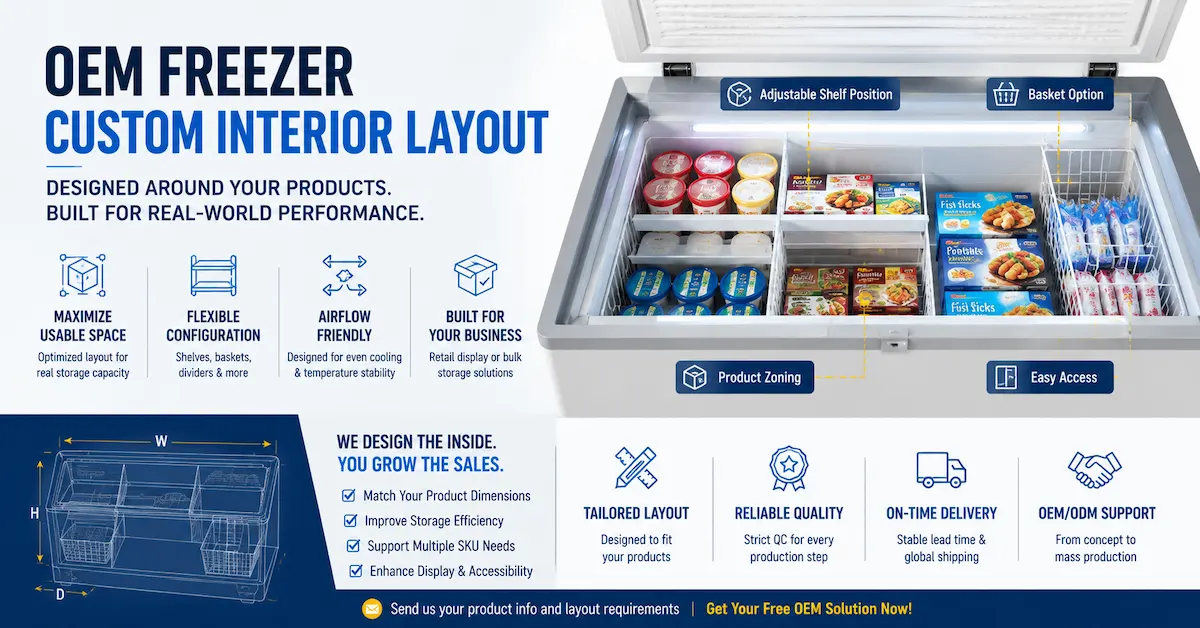
An OEM freezer custom interior layout project means configuring the usable storage space inside a commercial freezer according to the products being stored, package dimensions, target loading quantity, shelves or baskets, airflow requirements, access, cleaning, and operational needs.
It is different from simply changing the freezer's external dimensions.
A freezer's internal space can be influenced by:
- Insulation thickness
- Cabinet structure
- Refrigeration components
- Air ducts
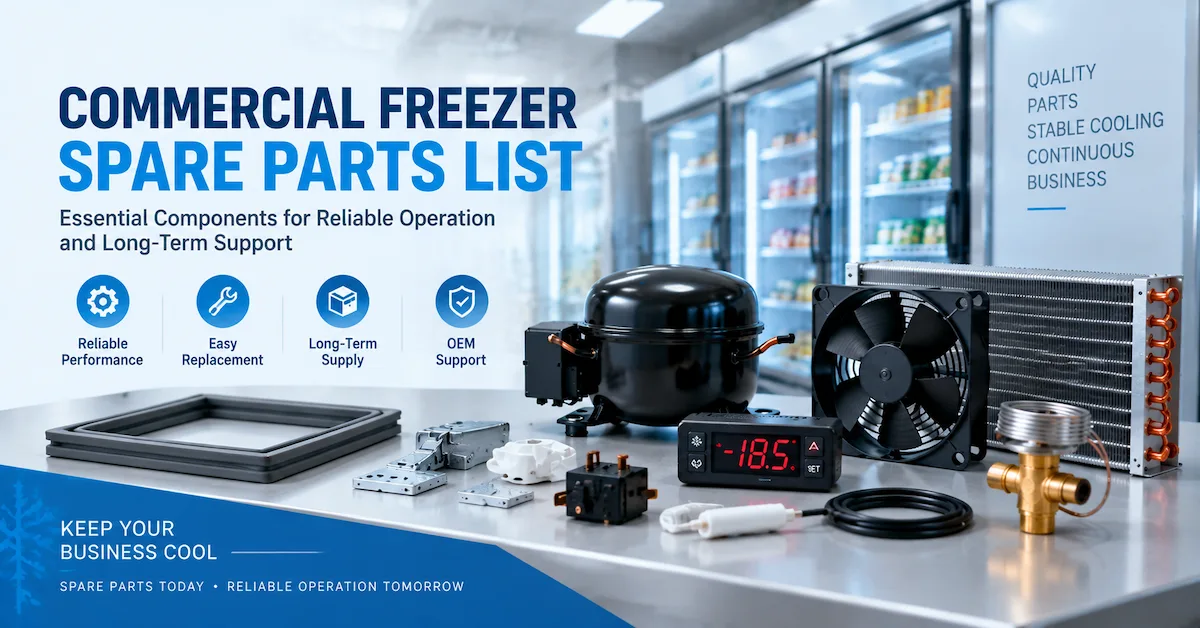
- Shelves and baskets
- Door configuration
- Internal supports
- Lighting and accessories
- Drainage or service requirements
The key principle is simple:
A freezer interior layout should be designed around the products being stored—not simply around the cabinet's external dimensions.
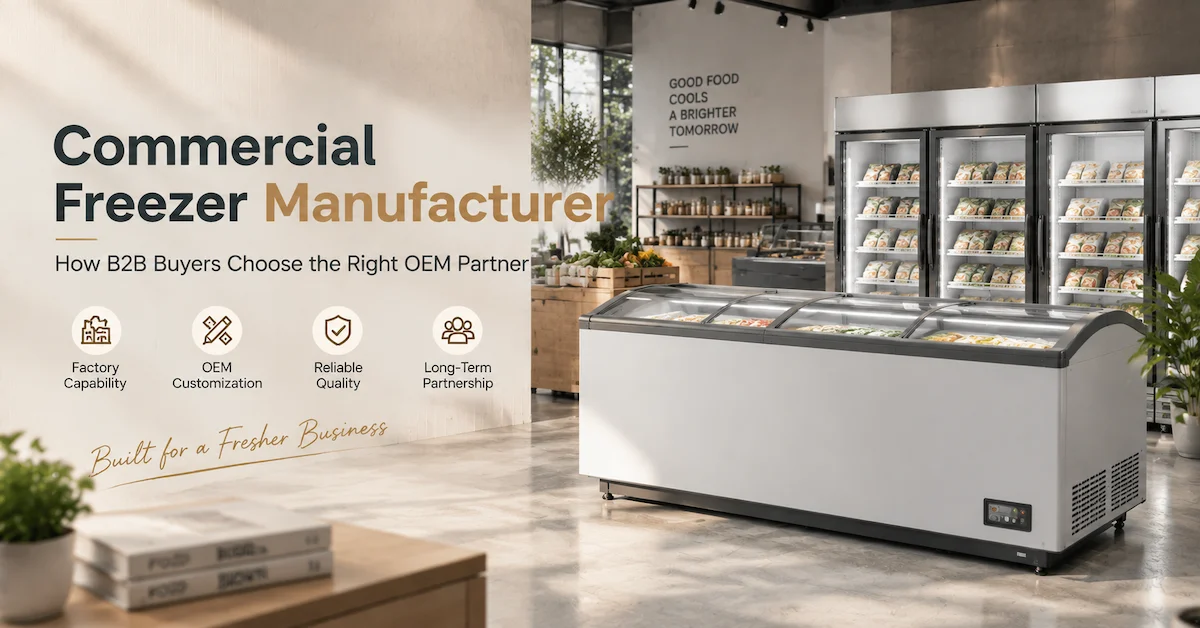
Snowsea can evaluate requested configurations according to the selected freezer platform, product requirements, and engineering feasibility through its OEM and ODM solutions.
What Information Should Buyers Provide First?
The most useful starting point is not “I need four shelves.”
It is the product itself.
| Interior Requirement | Buyer Should Provide | Why It Matters |
|---|---|---|
| Product dimensions | Length × width × height | Determines actual fit |
| Package type | Carton, bag, tray, tub, etc. | Affects stacking |
| Product weight | Per package or loading unit | Affects shelf/load design |
| Target quantity | Units per freezer | Defines storage target |
| Number of SKUs | Single or mixed products | Affects organization |
| Shelf/basket need | Quantity and preferred position | Defines storage structure |
| Vertical spacing | Required product clearance | Avoids wasted space |
| Access method | Front or top loading | Influences arrangement |
| Storage purpose | Retail display or bulk storage | Changes layout priority |
| Cleaning needs | Removable components/access | Affects maintenance |
For OEM interior planning, product package dimensions are often more useful than a requested shelf count.
External Cabinet Size Is Not Usable Storage Space
Two commercial freezers with similar external dimensions can offer very different usable internal layouts.
The external cabinet dimensions include space required for:
- Insulation
- Structural panels
- Refrigeration system components
- Air circulation
- Door construction
- Internal fittings
That means a buyer should distinguish between:
External cabinet dimensions
and
Usable internal dimensions
If overall size is also being customized, review Snowsea's OEM freezer custom cabinet size guide.
For many B2B projects, the better question is not:
“How many liters is this freezer?”
It is:
“How many units of my actual product can this freezer store while maintaining the required operating layout?”
Gross Capacity vs Usable Storage Capacity
Nominal cabinet volume does not automatically equal usable product storage capacity.
Part of the interior must accommodate:
- Cooling components
- Airflow passages
- Shelf structures
- Clearance around products
- Door movement
- Internal supports
For example, maximizing theoretical cubic volume can be less useful if cartons cannot be loaded efficiently or shelves cannot be spaced around the actual package height.
OEM buyers should therefore evaluate both:
Volume capacity + real product loading capacity
This is especially important when comparing quotations from different commercial freezer suppliers.
Design the Interior Around Product Package Dimensions
Suppose a buyer stores frozen-food cartons.
The most useful data may include:
- Carton length
- Carton width
- Carton height
- Carton weight
- Preferred loading direction
- Units per row
- Rows per shelf
- Total target quantity
Changing carton orientation can change the number of products that fit on each shelf.
A technically efficient custom freezer interior layout should therefore evaluate the product's real geometry rather than relying only on liters or shelf count.
Whenever possible, buyers should send:
- Product drawings
- Package drawings
- Photos
- Physical samples
- CAD dimensions
during the OEM evaluation stage.
Shelf, Basket, Divider or Open Storage?
Different storage structures solve different problems.
| Interior Option | Main Advantage | Main Limitation | Typical Consideration |
|---|---|---|---|
| Fixed shelves | Simple organized levels | Less flexibility | Standard product sizes |
| Adjustable shelves | Supports multiple product heights | More components | Mixed SKUs |
| Baskets | Easy grouping and access | Uses some internal space | Chest freezer organization |
| Dividers | Separates different products | Less flexible open space | Multi-SKU storage |
| Open cavity | Maximum continuous space | Less organization | Bulk products |
These are general commercial refrigeration layout approaches. Final options depend on the freezer platform and engineering feasibility.
For detailed shelf configuration, see the OEM freezer custom shelf system guide.
Custom Shelf System vs Custom Interior Layout
These two OEM requirements are related but not identical.
A custom shelf system focuses mainly on:
- Shelf quantity
- Shelf dimensions
- Shelf material
- Spacing
- Load capacity
- Rails
- Supports
- Adjustability
An OEM freezer custom interior layout covers the complete usable interior,including:
- Shelves
- Baskets
- Storage zones
- Internal dimensions
- Product orientation
- Access
- Airflow space
- Component clearances
- Product loading efficiency
In other words:
A custom shelf system is one component of the complete freezer interior layout.
Fixed vs Adjustable Interior Layout
Fixed Layout
A fixed arrangement can work well when the buyer has standardized product sizes.
Potential advantages include:
- Simpler structure
- Consistent production
- Easier loading instructions
- Fewer adjustable components
However, it provides less flexibility when the product mix changes.
Adjustable Layout
An adjustable layout may suit distributors or retailers handling multiple package heights and SKUs.
Potential benefits include:
- Flexible shelf spacing
- Easier product-mix changes
- Better use of vertical space
However, additional rails, supports, or shelf positions can affect component cost and QC requirements.
A practical rule is:
The more frequently product dimensions change, the more valuable interior adjustability may become.
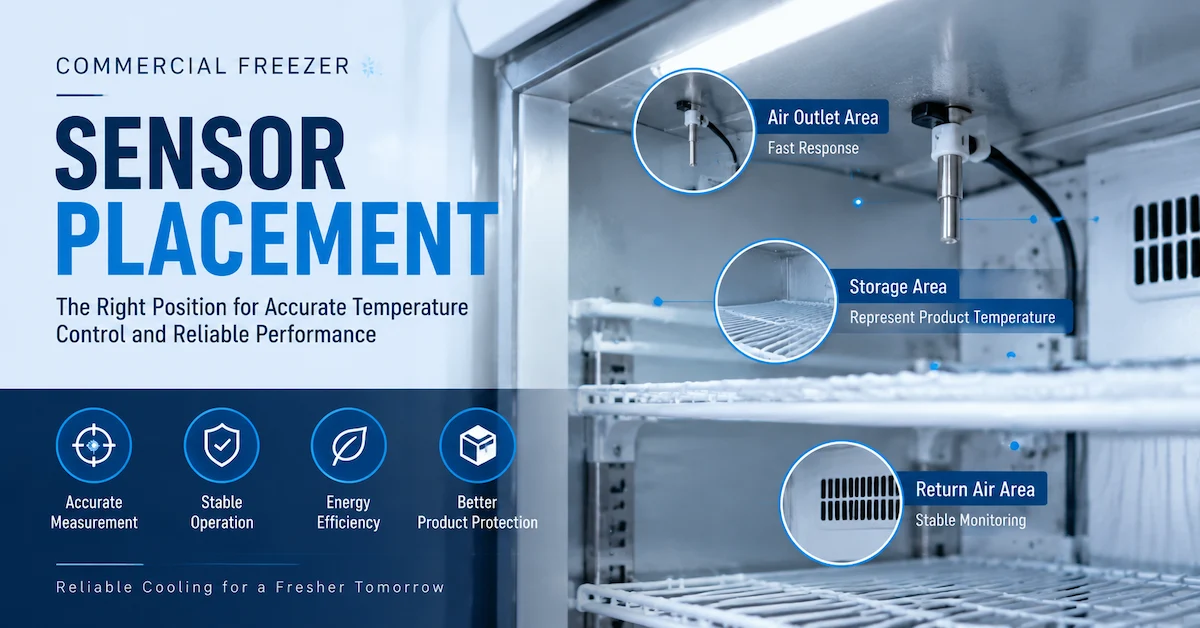
Interior Layout and Airflow Must Be Planned Together
Maximum storage density does not always produce the best refrigeration performance.
Products packed too closely may interfere with:
- Air outlets
- Return airflow
- Circulation paths
- Temperature distribution
- Recovery after door opening
The layout therefore needs to balance:
Storage density ↔ Air circulation ↔ Temperature performance
For more technical background, see Snowsea's commercial freezer airflow circulation design guide.
OEM buyers should avoid defining an interior layout solely by asking for the maximum possible number of shelves or baskets.
Does Product Weight Matter?
Yes.
Storage capacity should be evaluated by both volume and load, not volume alone.
If products are heavy, the supplier should also consider:
- Weight per shelf
- Loading distribution
- Shelf support
- Rails or brackets
- Cabinet structure
For a more detailed discussion, see Snowsea's commercial freezer shelf capacity guide.
A large internal volume has limited commercial value if the storage system does not suit the expected product load.
Interior Layout for Retail Display vs Bulk Storage
Different applications require different priorities.
Retail Display
Retail applications may focus more on:
- Product visibility
- SKU separation
- Facing quantity
- Easy customer access
- Fast restocking
Back-of-House Storage
Storage applications may prioritize:
- Storage density
- Bulk loading
- Inventory handling
- Efficient use of internal space
Therefore:
The best interior layout for merchandising is not always the best layout for maximum storage capacity.
Before requesting customization, buyers should tell the supplier how the freezer will actually be used.
How Door Type Changes the Interior Layout
Door configuration affects how users reach products.
A freezer may use different access concepts such as:
- Top opening
- Front opening
- Hinged access
- Sliding access
The door arrangement can influence:
- Shelf position
- Basket removal
- Product reach
- Restocking
- Loading direction
- Usable access area
If the project also requires a different opening structure, see the OEM freezer custom door type guide.
Door configuration and internal layout should be evaluated together rather than as independent design decisions.
Three Levels of OEM Interior Layout Customization
| Level | Typical Scope | Cost/MOQ Impact | Engineering Risk |
|---|---|---|---|
| Existing layout | Existing shelves/baskets | Lowest | Lowest |
| Modified layout | Quantity, spacing, baskets,dividers | Low–Medium | Moderate |
| Project-specific layout | Significant internal structural changes | Medium–High | Higher |
Level 1: Existing Validated Layout
This is usually the lowest-risk route when the existing configuration already matches the buyer's products.
It may support:
- Faster sampling
- Simpler production
- Easier repeat orders
Level 2: Modified Storage Arrangement
Changes may include:
- Shelf quantity
- Shelf spacing
- Basket configuration
- Divider position
- Product zoning
The manufacturer should still verify fit, load, access, and airflow.
Level 3: Project-Specific Interior Design
A more extensive project may involve modifications to:
- Internal dimensions
- Support structure
- Storage zones
- Component positioning
- Shelf mounting
- Cabinet interfaces
This level may require greater engineering evaluation, prototyping, and validation before mass production.
How Does Custom Interior Layout Affect Cost?
There is no single fixed price for interior customization.
Potential cost drivers include:
- Custom shelves
- Baskets
- Dividers
- Rails
- Support brackets
- Special dimensions
- New components
- Tooling where necessary
- Engineering work
- Assembly labor
- Sample validation
- Packaging changes
A useful commercial principle is:
The cheapest interior configuration is not necessarily the lowest-cost solution if poor space utilization forces the buyer to purchase a larger freezer to store the same quantity of product.
OEM cost should be evaluated together with usable capacity and operational efficiency.
Can Interior Customization Affect MOQ and Lead Time?
Yes, depending on the scope.
Potential MOQ drivers include:
- Special shelf dimensions
- Custom baskets
- Dedicated dividers
- New rails or supports
- Customized structural components
- Supplier purchasing minimums
A simple modification using existing components may have a very different commercial impact from a completely new interior structure.
Snowsea should therefore evaluate MOQ and lead time after the requested layout, components, and sample requirements are defined.
Buyers can improve quotation accuracy by providing both:
- Initial order quantity
- Estimated annual demand
Why Sample Validation Matters
A CAD layout can look efficient while still creating practical loading problems.
Before mass production, the buyer should ideally verify:
- Product fit
- Quantity per shelf
- Total loading quantity
- Shelf spacing
- Product removal
- Restocking
- Door clearance
- Basket removal
- Airflow clearance
- Cleaning access
Whenever practical:
The final interior arrangement should be validated using the buyer's real product dimensions or equivalent sample packaging.
This can reduce the risk of discovering layout problems after bulk production.
What Should Be Checked During Production QC?
Once a customized layout is approved, production should consistently follow the approved specification.
Useful QC checkpoints can include:
- Internal dimensions
- Shelf quantity
- Basket quantity
- Shelf spacing
- Rail position
- Divider position
- Support alignment
- Component mounting
- Door clearance
- Removable-part fit
- Surface condition
- Assembly consistency
- Approved sample conformity
For broader product inspection considerations, see Snowsea's commercial freezer quality testing procedure.
How to Compare OEM Freezer Suppliers for Interior Layout Projects
| Evaluation Area | What Buyers Should Check |
|---|---|
| Product analysis | Does the supplier ask for package dimensions? |
| Capacity planning | Is usable capacity evaluated? |
| Layout design | Are shelves,baskets and zones considered? |
| Airflow | Is product clearance reviewed? |
| Shelf load | Is product weight considered? |
| Accessibility | Can products be loaded and removed easily? |
| Sample validation | Is the actual arrangement checked? |
| MOQ | Are customization implications explained? |
| QC | Is the approved layout controlled? |
| Commercial logic | Is cost compared with usable storage value? |
A capable OEM supplier should do more than ask how many shelves the buyer wants. It should understand what products need to fit inside the cabinet and what performance constraints the layout must respect.
What Should Buyers Send Snowsea for an OEM Quote?
To evaluate an OEM freezer custom interior layout, provide as much of the following information as possible:
- Freezer type or reference model
- Maximum external dimensions
- Product being stored
- Package length,width and height
- Product/package weight
- Target quantity per freezer
- Number of SKUs
- Shelf or basket requirements
- Preferred shelf quantity
- Required vertical spacing
- Fixed or adjustable layout
- Retail display or storage application
- Preferred loading direction
- Product/package photos
- Drawings or CAD files, if available
- Cleaning or accessibility requirements
- Destination market
- Initial order quantity
- Annual purchasing forecast
- Target project schedule
You can review Snowsea commercial refrigeration products before sending your specification.
For a more efficient evaluation, include your product/package dimensions and target units per freezer when contacting Snowsea through the contact page.
FAQ
Can the interior layout of an OEM freezer be customized?
Buyers can submit specific interior-layout requirements for evaluation. Feasibility depends on the selected freezer platform, components, cabinet structure, cooling requirements, and customization scope.
What information is most important for designing the layout?
Product dimensions, package type, product weight, target quantity, number of SKUs, and intended use are among the most useful starting points.
Can shelf quantity and spacing be customized?
They can be evaluated according to product height, usable internal dimensions, shelf structure, airflow requirements, and the selected freezer platform.
Can baskets or dividers be added?
Buyers can request baskets, dividers, or other organizational features for evaluation. Availability depends on dimensions, structure, and project requirements.
How do I calculate usable freezer storage capacity?
Do not rely only on nominal liters. Compare actual internal dimensions with product dimensions, loading orientation, shelves, airflow clearance, and component space.
Does interior layout affect cooling performance?
It can. Product placement and storage density can influence airflow and temperature distribution, so the layout should not block required circulation paths.
Can the interior be designed around my carton size?
Yes. Providing carton dimensions and target quantities gives the manufacturer much more useful information for layout evaluation.
Does a custom interior layout affect MOQ?
It may. Custom baskets, shelves, rails, dividers, structural parts, or tooling can create component purchasing or manufacturing minimums.
Does interior customization increase freezer cost?
It can, depending on the level of modification. Buyers should evaluate customization cost against usable capacity, loading efficiency, and the operational value of the final layout.
Should the layout be tested before mass production?
Yes. Sample validation can help confirm product fit, loading quantity, accessibility, shelf spacing, airflow clearance, and assembly consistency before bulk production.
Conclusion
An OEM freezer custom interior layout is not simply a choice of how many shelves or baskets to install.
For B2B procurement, the layout should be developed around:
- Real product dimensions
- Package orientation
- Target storage quantity
- Product weight
- Shelf or basket arrangement
- Usable internal dimensions
- Airflow clearance
- Accessibility
- Cleaning
- Door configuration
- MOQ
- Cost
- Sample validation
- Production QC
The most effective OEM projects begin with actual product data.
Instead of asking only for a “500-liter freezer with four shelves,” buyers can provide product dimensions and a target such as “X cartons per freezer.” This gives the supplier a clearer basis for evaluating usable capacity, cabinet compatibility, internal organization, and engineering feasibility.
Send Snowsea your freezer type, product/package dimensions, product weight, target storage quantity, number of SKUs, shelf or basket requirements, preferred layout, cabinet-size limitations, product photos or drawings, destination market, and estimated order quantity through the Snowsea contact page.
Snowsea can then evaluate the requested interior arrangement, usable storage space, airflow clearance, shelf or basket configuration, customization scope, sample requirements, MOQ, and project feasibility before preparing an OEM technical proposal and quotation.