What Does OEM Freezer Custom Refrigerant Mean?
An OEM freezer custom refrigerant project means selecting or adapting the refrigerant and corresponding refrigeration system according to the freezer type, required temperature, destination market, ambient conditions, electrical specification, safety requirements, and OEM project needs.
For B2B buyers, the most important point is:
Changing the refrigerant is not the same as simply replacing the gas inside an existing freezer.
A different refrigerant may require the manufacturer to review:
- Compressor compatibility
- Lubricant compatibility
- Expansion device or capillary configuration
- Evaporator performance
- Condenser performance
- Refrigerant charge
- Refrigeration piping
- Safety design
- Electrical arrangement
- Factory charging process
- Labels and documentation
- Product testing
For this reason, refrigerant selection should be evaluated as part of the complete refrigeration system.
Snowsea can review project-specific requirements through its OEM/ODM solutions.
What Should Buyers Specify Before Choosing a Refrigerant?
A request such as “Please use R290” is usually not enough for an accurate OEM evaluation.
The supplier also needs to understand how and where the freezer will operate.
| Project Factor | Buyer Should Provide | Why It Matters |
|---|---|---|
| Destination market | Country or region | Market requirements can differ |
| Freezer type | Chest, upright, display, etc. | System configuration differs |
| Temperature range | Required operating temperature | Defines cooling requirement |
| Ambient condition | Expected operating temperature | Influences refrigeration load |
| Stored product | Ice cream, frozen food, meat, etc. | Defines performance target |
| Cabinet size | Dimensions or capacity | Affects required cooling capacity |
| Voltage/frequency | Market electrical specification | Determines component compatibility |
| Order quantity | Initial and projected volume | Affects OEM feasibility |
A complete RFQ allows refrigerant selection to be evaluated together with freezer performance rather than as an isolated component request.
Refrigerant Selection Is a System Decision
Different refrigerants can have different operating characteristics.
These may influence:
- System pressure
- Refrigerant mass charge
- Compressor selection
- Lubricant requirements
- Heat exchanger design
- Expansion-device selection
- Safety requirements
- Manufacturing procedures
Therefore, a refrigerant configuration already validated for one freezer platform should not automatically be assumed suitable for a different cabinet or temperature requirement.
OEM buyers should evaluate the complete combination of:
Refrigerant + compressor + evaporator + condenser + expansion device + operating condition.
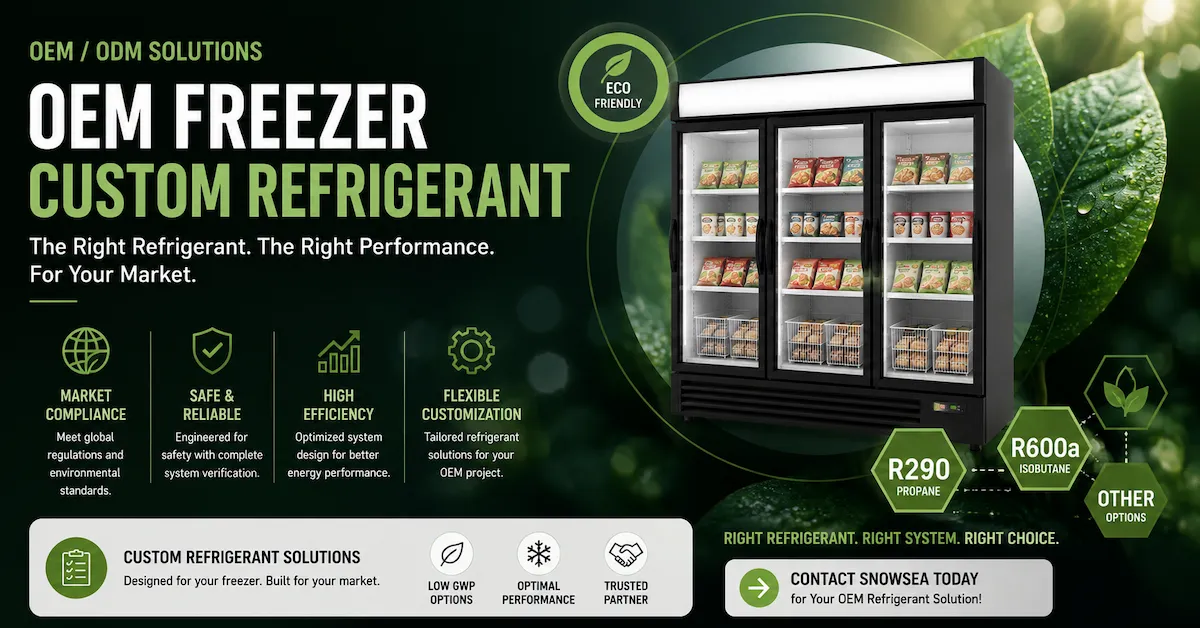
Can OEM Buyers Request R290, R600a, or Other Refrigerants?
Commercial refrigeration equipment may use different refrigerants depending on the product design and target market.
Industry applications can include refrigerants such as:
- R290
- R600a
- Other system-specific refrigerant options
However, this should not be interpreted as a universal Snowsea availability list for every freezer model.
The appropriate configuration needs to be confirmed according to:
- Selected freezer platform
- Cooling requirement
- Cabinet size
- Operating temperature
- Destination country
- Required compliance
- Engineering feasibility
The better procurement question is not simply:
“Do you have this refrigerant?”
It is:
“Can this freezer platform be engineered and validated for my required refrigerant and destination market?”
Why R290 Requires More Than a Refrigerant Change
R290 is an important refrigerant in commercial refrigeration discussions, but an OEM project involving R290 should not be treated as a simple gas substitution.
Because refrigerant characteristics can affect safety and system design, the manufacturer may need to evaluate:
- Refrigerant charge
- Refrigeration circuit
- Compressor compatibility
- Electrical arrangement
- Component positioning
- Leak control
- Factory charging procedures
- Warning labels
- Relevant safety requirements
The key procurement principle is:
Refrigerant choice can change the safety requirements of the complete freezer, not only the cooling circuit.
OEM buyers should therefore compare suppliers on system-engineering capability rather than refrigerant availability alone.
Does Changing Refrigerant Require a Different Compressor?
It may.
A compressor must be matched with the required:
- Refrigerant
- Cooling capacity
- Evaporating condition
- Condensing condition
- Voltage and frequency
- Lubricant
- Freezer application
For this reason, changing refrigerant may require compressor re-selection or system verification.
Snowsea's commercial freezer compressor sizing guide explains why compressor selection should be based on cooling demand rather than physical size alone.
How Refrigerant and Other Components Work Together
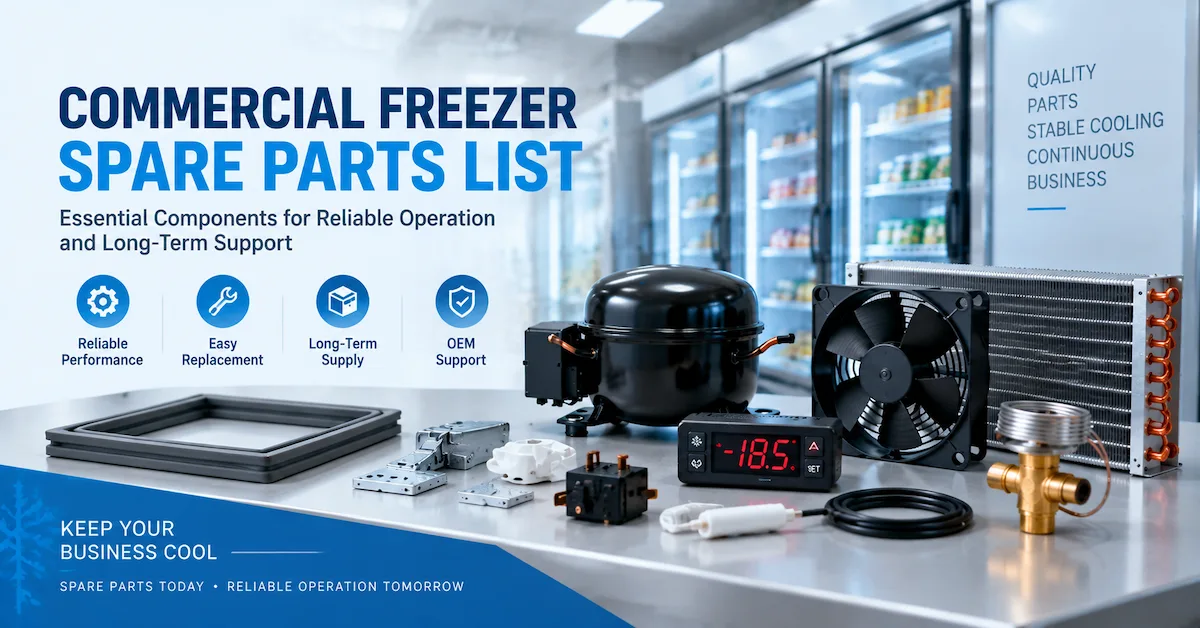
A commercial freezer refrigeration system should be evaluated as a matched system.
| Component | Why It Matters |
|---|---|
| Refrigerant | Determines system operating characteristics |
| Compressor | Must match refrigerant and cooling load |
| Lubricant | Must be compatible with the compressor/system |
| Condenser | Rejects heat from the refrigeration system |
| Evaporator | Absorbs heat from the cabinet |
| Expansion device | Controls refrigerant flow |
| Refrigerant charge | Must suit the validated circuit |
Changing one part without reviewing the others can create unnecessary performance and reliability risk.
Related technical guides include Snowsea's commercial freezer evaporator design and commercial freezer condenser design.
Does Refrigerant Determine the Freezer Temperature Range?
Not by itself.
The actual operating temperature depends on the complete freezer system, including:
- Compressor capacity
- Evaporator design
- Condenser performance
- Cabinet insulation
- Ambient temperature
- Product loading
- Airflow
- Temperature control
For example, requesting a particular refrigerant does not automatically guarantee a particular cabinet temperature.
This is especially important for OEM buyers requesting non-standard low-temperature operation.
For a broader specification process, see Snowsea's OEM freezer custom temperature range guide.
Why Ambient Conditions Matter
An upright display freezer operating in an air-conditioned supermarket and a commercial freezer operating in a high-temperature environment can have very different refrigeration loads.
Buyers should therefore provide the expected operating environment when discussing OEM freezer custom refrigerant requirements.
Useful information includes:
- Maximum expected ambient temperature
- Typical operating environment
- Indoor or commercial kitchen use
- Door-opening frequency
- Product loading
- Required cabinet temperature
Instead of sending only:
“We need R290.”
A stronger RFQ would include:
“We need a commercial freezer for our target market, operating under these ambient conditions, with this temperature range and this refrigerant preference.”
Refrigerant and Destination-Market Requirements
Refrigerant decisions for export projects should also consider the destination market.
Requirements can differ by:
- Country
- Region
- Product category
- Refrigerant type
- Product design
- Applicable safety standards
- Energy-efficiency rules
- Labeling requirements
These requirements can also change over time.
For that reason, Snowsea and the buyer should confirm the current requirements applicable to the intended market before finalizing mass-production specifications.
Buyers should include the destination country in the first RFQ instead of waiting until after sample development.
Three Levels of OEM Refrigerant Customization
Level 1: Existing Validated Refrigerant Configuration
The buyer selects a freezer platform using an existing validated refrigeration configuration.
Possible advantages include:
- Lower engineering complexity
- Faster project evaluation
- Lower development risk
- Easier production planning
For many OEM projects, this is the most efficient starting point.
Level 2: Alternative Validated Configuration
A freezer platform may be evaluated with another existing refrigeration configuration where technically available.
This can involve changes to:
- Refrigerant
- Compressor
- Refrigerant charge
- Expansion device
- Controller parameters
The exact available configuration needs to be confirmed for the selected product.
Level 3: Refrigeration System Redesign
If the requested refrigerant has not been validated on the selected platform, broader development may be necessary.
Possible work can include:
- Compressor re-selection
- Expansion-device adjustment
- Condenser evaluation
- Evaporator evaluation
- Refrigerant charge development
- Safety review
- Performance testing
- Compliance evaluation
This can have a greater impact on development cost, MOQ, sampling, and lead time.
How Does Custom Refrigerant Affect OEM Cost?
The cost of a refrigerant customization project should not be judged from the price of the refrigerant alone.
Potential cost factors include:
- Compressor specification
- Refrigeration components
- Refrigeration circuit changes
- Safety-related components
- Charging process
- Engineering work
- Sample testing
- Certification or compliance work
- Labels
- Documentation
- Order quantity
The important commercial principle is:
The cost of changing refrigerant should be evaluated as a refrigeration-system project, not as the price difference between two refrigerant gases.
That makes supplier quotations easier to compare accurately.
Does Refrigerant Customization Affect MOQ?
It can.
If the required refrigerant is already part of an existing validated freezer configuration, the project may be easier to implement commercially.
MOQ may increase when the project requires:
- Different compressor
- New refrigeration components
- Special component purchasing
- New production processes
- Additional testing
- New documentation
- New labels or packaging
B2B buyers should therefore provide both:
- Expected first order
- Estimated repeat or annual volume
This helps the manufacturer evaluate whether the requested customization is practical.
Does Refrigerant Customization Affect Lead Time?
Yes, depending on the level of change.
Possible lead-time factors include:
- Compressor sourcing
- Component availability
- Engineering validation
- Sample development
- Performance testing
- Compliance work
- Production preparation
An existing validated system can generally be evaluated more efficiently than a new refrigeration configuration requiring redesign.
For RFQ comparison, buyers should ask suppliers to separate:
Engineering/sample stage → approval stage → mass-production stage.
This provides a clearer project timeline than asking only for one overall lead-time number.
What Should Be Tested Before Mass Production?
A refrigerant customization project should be validated before volume production.
Relevant checks can include:
- Refrigeration-system leakage
- System evacuation
- Correct refrigerant charging
- Cooling performance
- Temperature stability
- Temperature recovery
- Compressor operation
- Condenser performance
- Evaporator performance
- Electrical functions
- High-ambient performance where required
- Safety functions and final labeling
Testing should be defined according to the selected freezer platform and project specification rather than using one universal procedure.
For broader factory validation, see Snowsea's commercial freezer quality testing procedure and commercial freezer compressor reliability test.
OEM Refrigerant Production QC Checklist
After sample approval, production consistency becomes essential.
A practical inspection process may verify:
- Correct refrigerant specification
- Correct compressor
- Correct refrigeration components
- Refrigerant-circuit workmanship
- Evacuation process
- Refrigerant charging
- Leak inspection
- Cooling performance
- Temperature test
- Electrical inspection
- Nameplate information
- Warning labels where required
- Final documentation
For OEM buyers, the approved specification should identify the refrigerant clearly so production, testing, labels, and documents remain consistent.
How to Compare OEM Freezer Suppliers for Refrigerant Projects
| Evaluation Area | Buyer Should Verify |
|---|---|
| Refrigeration engineering | Can the complete system be evaluated? |
| Compressor matching | Is refrigerant compatibility considered? |
| System components | Are condenser,evaporator and flow control reviewed? |
| Safety | Are refrigerant-specific risks evaluated? |
| Destination market | Are market requirements considered? |
| Sample testing | Is performance validated before production? |
| QC | Is refrigerant charging controlled? |
| Documentation | Do nameplate and specifications match? |
| MOQ | Is the project commercially practical? |
| Lead time | Are development stages clearly explained? |
A reliable OEM supplier should explain when a requested refrigerant is unsuitable for a particular platform rather than simply accepting every requested specification.
What Should Buyers Send Snowsea for a Refrigerant Quote?
To receive a more useful technical evaluation and quotation, send Snowsea:
- Freezer type or reference model
- Preferred refrigerant, if specified
- Destination country
- Required temperature range
- Stored product
- Cabinet dimensions or capacity
- Expected ambient conditions
- Door configuration
- Voltage and frequency
- Compressor preference,if any
- Certification requirements
- Energy-efficiency requirements
- Estimated first-order quantity
- Estimated annual purchasing volume
- Existing technical specification or drawing
- Target delivery schedule
A complete RFQ enables Snowsea to review refrigerant choice together with the compressor, refrigeration circuit, freezer performance, production requirements, and commercial feasibility.
Browse Snowsea commercial refrigeration products, review OEM/ODM solutions, or contact Snowsea with your project specifications.
FAQ
What is an OEM freezer custom refrigerant project?
It is a project in which the refrigerant and corresponding refrigeration-system configuration are evaluated according to the freezer, target market, operating conditions, and OEM requirements.
Can I request R290 for an OEM freezer?
A requested R290 configuration can be evaluated depending on the selected freezer platform, system design, destination market, safety requirements, and project feasibility.
Can an OEM freezer use R600a?
The appropriate refrigerant depends on the specific freezer platform and technical requirements. Buyers should confirm availability and compatibility before specifying it for production.
Can I simply change refrigerant without changing other components?
Not necessarily. A refrigerant change may require review of the compressor, lubricant, expansion device, heat exchangers, charge, safety design, and other components.
Does the refrigerant determine freezer temperature?
No.Temperature performance depends on the complete refrigeration system, insulation, airflow, ambient conditions, product load, and controller.
Does changing refrigerant require changing the compressor?
It may. Compressor compatibility and operating conditions must be evaluated for the requested refrigerant.
Can refrigerant choice affect energy consumption?
Yes. Refrigerant and system configuration can influence operating efficiency, but overall energy performance depends on the complete freezer design.
Does refrigerant customization affect MOQ?
It may, especially if new compressors, components, production processes, tests, labels, or compliance work are required.
Will refrigerant customization increase lead time?
A new system configuration may require component sourcing, engineering, sample development, testing, and compliance review, which can extend project lead time.
What information does Snowsea need for a refrigerant quotation?
Provide the freezer type, preferred refrigerant, destination country, required temperature, ambient conditions, voltage, certification needs, quantity, and technical specification where available.
Conclusion
An OEM freezer custom refrigerant project should be treated as a complete refrigeration-system and market-requirement decision, not simply as a request to replace one refrigerant with another.
B2B buyers should define:
- Destination market
- Preferred refrigerant
- Freezer type
- Required temperature range
- Ambient conditions
- Cabinet capacity
- Voltage and frequency
- Compliance requirements
- Order quantity
The manufacturer should then evaluate the refrigerant together with the compressor, evaporator, condenser, expansion device, refrigeration charge, safety requirements, performance testing, MOQ, and lead time.
For private-label brands, distributors, and OEM buyers, confirming these requirements before sampling can reduce system redesign, compliance risks, and quotation differences later in the project.
Send Snowsea your freezer type, destination market, required temperature range, ambient conditions, preferred refrigerant, voltage, certification requirements, reference specification, and estimated order quantity through the contact page to request an OEM technical evaluation and commercial quotation.