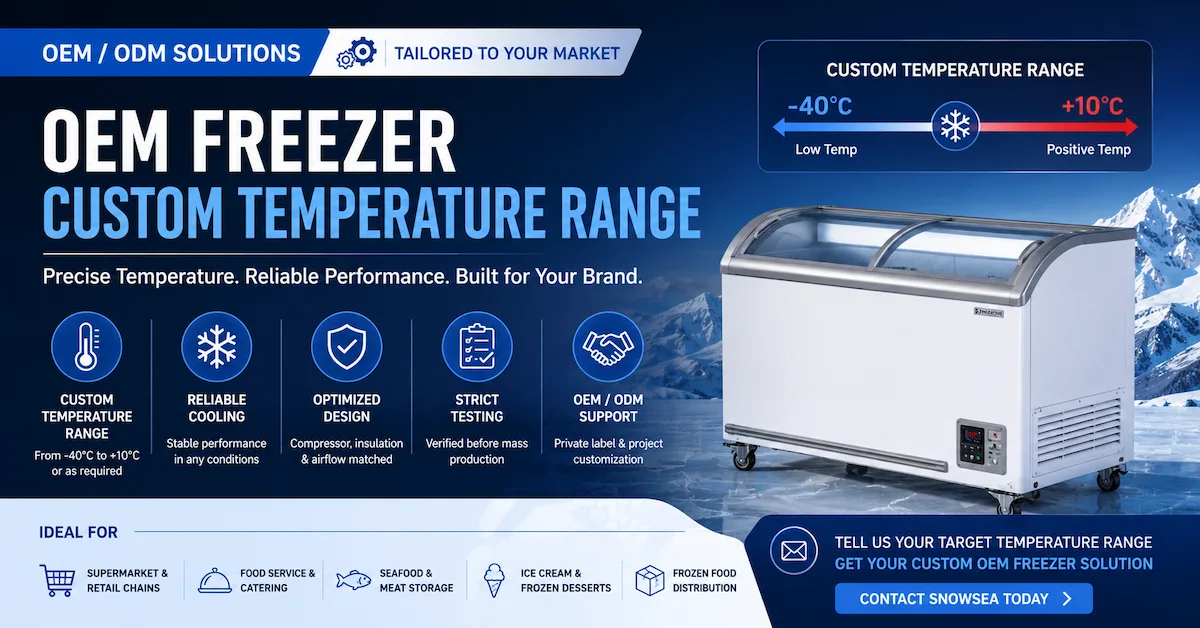
What Does OEM Freezer Custom Temperature Range Mean?
An OEM freezer custom temperature range project means configuring a commercial freezer so its refrigeration system can achieve and maintain the operating temperatures required by a buyer's application and target market.
This is different from simply changing a thermostat parameter.
A complete temperature-range requirement may involve:
- Target cabinet temperature
- Minimum and maximum operating range
- Temperature tolerance
- Ambient operating conditions
- Stored product type
- Product loading volume
- Cooling recovery requirements
- Defrost strategy
- Refrigeration component selection
For private-label brands and distributors, these specifications should be confirmed before sample production because the requested temperature can influence several parts of the freezer design.
Snowsea supports commercial freezer customization through its OEM/ODM solutions.
Temperature Setting vs Actual Freezer Operating Range
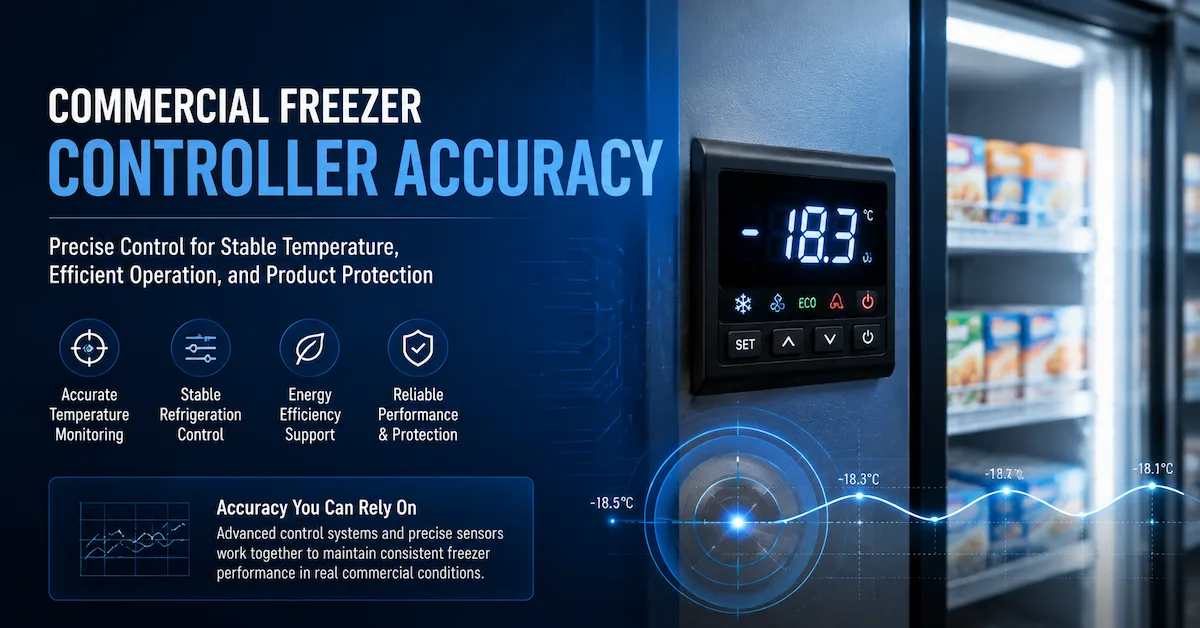
One of the most common OEM misunderstandings is treating thermostat settings and refrigeration performance as the same thing.
They are not.
| Item | What It Means | What the Buyer Should Confirm |
|---|---|---|
| Set Point | Controller target | Required setting |
| Operating Range | Actual cabinet temperature range | Minimum and maximum |
| Differential | Control variation around target | Acceptable tolerance |
| Ambient Condition | Temperature around the freezer | Intended market/environment |
| Product Load | Food placed inside | Product type and volume |
| Recovery | Return after opening or loading | Required performance |
| Uniformity | Temperature variation within cabinet | Acceptable distribution |
An OEM freezer custom temperature range therefore needs to be defined as a complete performance requirement rather than a single controller number.
For controller-specific customization, see Snowsea's OEM freezer custom thermostat guide.
Why Can't the Temperature Range Be Customized by Thermostat Alone?
Changing a controller from one set point to another does not automatically increase refrigeration capacity.
Actual freezer performance depends on the complete system, including:
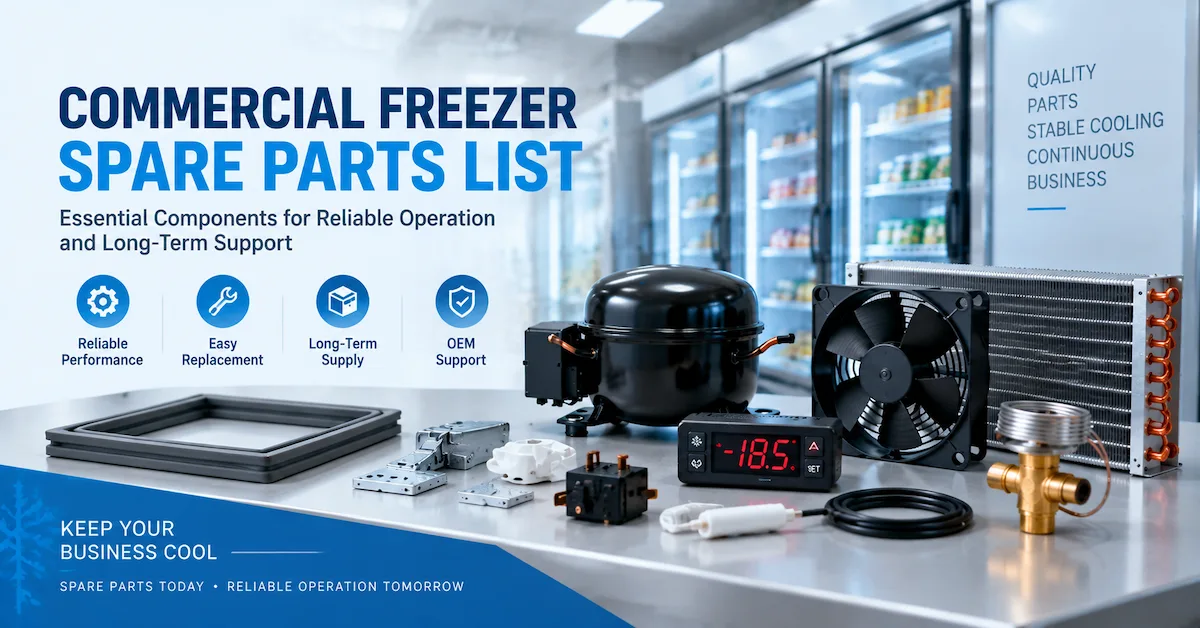
- Compressor
- Condenser
- Evaporator
- Refrigerant
- Expansion device
- Insulation
- Door gasket
- Air circulation
- Thermostat or controller
- Ambient temperature
For example, if an OEM buyer requests a lower operating temperature than a standard model was designed for, Snowsea would need to evaluate whether the refrigeration system can support that target under the intended operating conditions.
This is why buyers should avoid specifications such as:
“Use the same freezer but change the controller to a lower temperature.”
A stronger requirement is:
“We need this freezer to operate within our specified range under the intended ambient condition and product load.”
Related technical guides include commercial freezer compressor sizing, commercial freezer condenser design, and commercial freezer evaporator design.
What Temperature Requirements Should an OEM Buyer Provide?
The manufacturer needs more than a target number.
Buyers should define:
Target Operating Temperature
State the temperature the stored product needs during normal operation.
Required Operating Range
Specify acceptable minimum and maximum cabinet temperatures.
Ambient Temperature
The same freezer can face different refrigeration loads in an air-conditioned shop, commercial kitchen, warehouse, or high-temperature export market.
Stored Product
Applications may include:
- Frozen meat
- Seafood
- Ice cream
- Frozen vegetables
- Frozen meals
- Retail frozen foods
Different products and usage patterns create different operating requirements.
Loading Conditions
Buyers should explain:
- Approximate loading volume
- Loading frequency
- Product temperature when loaded
- Expected door-opening frequency
These details make the OEM quotation more technically meaningful.
Three Levels of Custom Temperature Range Projects
Not every project requires a complete redesign.
Level 1: Select an Existing Validated Range
The buyer selects a temperature specification already available on a suitable freezer platform.
Advantages may include:
- Lower engineering complexity
- Faster sample approval
- Lower development risk
- Easier quotation comparison
Level 2: Adjust the Existing Refrigeration Configuration
Some projects may require changes to selected parameters or components.
Possible areas include:
- Controller settings
- Refrigerant configuration
- Expansion parameters
- Compressor selection
Testing is still necessary to verify the final result.
Level 3: Re-Evaluate the Complete Refrigeration System
A significantly different operating requirement may require broader engineering review involving:
- Compressor capacity
- Condenser capacity
- Evaporator design
- Insulation
- Airflow
- Controller
- Defrost system
This type of project may require more sample development, testing, and production preparation.
How Does Compressor Selection Affect Temperature Range?
The compressor is a major part of the refrigeration system, but selecting a larger compressor does not automatically create a better freezer.
Compressor capacity should match:
- Target temperature
- Refrigeration load
- Evaporator
- Condenser
- Ambient conditions
- Cabinet volume
An incorrectly matched system can create efficiency or reliability problems even if the compressor itself appears powerful.
For a deeper explanation, see Snowsea's commercial freezer compressor sizing guide.
Why Insulation Matters in Low-Temperature OEM Projects
As the temperature difference between the freezer interior and surrounding environment increases, heat transfer becomes more important.
Buyers should evaluate:
- Insulation thickness
- Foam quality and consistency
- Cabinet construction
- Door sealing
- Thermal bridging
Better insulation can help reduce refrigeration load and support more stable operating conditions.
Related Snowsea technical resources include:
- Commercial Freezer Insulation Thickness
- Commercial Freezer Foam Density
- Freezer Door Gasket Sealing Performance
How Ambient Conditions Affect Custom Freezer Performance
A freezer specification should always be evaluated in the environment where the equipment will actually operate.
Important conditions include:
- Room temperature
- Humidity
- Ventilation
- Distance around condenser airflow
- Frequency of customer or staff access
A model intended for a moderate indoor retail environment may face a different refrigeration load when installed in a hot commercial kitchen or higher-temperature market.
For export projects, tell the supplier the destination country and expected operating environment during the RFQ stage.
Product Load Can Change Temperature Recovery
An empty-cabinet test does not represent every real operating condition.
OEM buyers should consider how the freezer behaves when:
- Products are added
- Doors are opened repeatedly
- The cabinet is heavily loaded
- Air circulation paths are partially restricted
This is particularly important for supermarkets, food distributors, commercial kitchens, and other high-use applications.
A useful sample validation plan should therefore include both temperature stability and recovery performance.
Does a Lower Temperature Range Increase Energy Consumption?
A different operating target can change refrigeration demand.
Instead of asking only:
“How low can this freezer go?”
B2B buyers should also ask:
- What configuration is required?
- How will the target affect power consumption?
- How does the unit perform under the intended ambient condition?
- Is the insulation appropriate?
- Is the compressor operating within a suitable design range?
For commercial projects, operating cost matters alongside purchase price.
Snowsea's Energy Efficiency Solutions provides additional related guidance.
How Does Custom Temperature Range Affect OEM Price?
The final OEM price can be influenced by more than the controller.
Possible cost drivers include:
- Compressor specification
- Condenser or evaporator changes
- Refrigeration components
- Insulation configuration
- Temperature controller
- Additional testing
- Sample development
- Order quantity
- Packaging or branding requirements
Because of these variables, a supplier cannot prepare a meaningful custom temperature quotation from the requested temperature alone.
The more complete the RFQ, the more comparable the quotation.
Does Temperature Customization Affect MOQ?
It can.
If a buyer selects an existing validated configuration, customization complexity may be relatively limited.
If the project requires unique:
- Components
- Refrigeration design
- Electrical configuration
- Control parameters
- Testing procedures
then component purchasing quantities and engineering requirements can affect MOQ and commercial terms.
Buyers should provide both the initial order quantity and expected annual demand when available.
What Should Be Tested Before Mass Production?
Sample testing is one of the most important stages of an OEM freezer custom temperature range project.
Relevant checks can include:
- Pull-down performance
- Temperature stability
- Cabinet temperature uniformity
- Loaded performance
- Door-opening recovery
- High-ambient performance where required
- Compressor cycling
- Defrost operation
- Controller performance
- Energy consumption
The exact test plan should match the selected model and project requirements.
For related quality procedures, see Snowsea's commercial freezer quality testing guide.
Custom Temperature Range QC Checklist
Once the sample configuration is approved, production consistency becomes critical.
A practical QC checklist may include:
- Controller parameter verification
- Compressor model verification
- Refrigeration component inspection
- Refrigerant configuration check
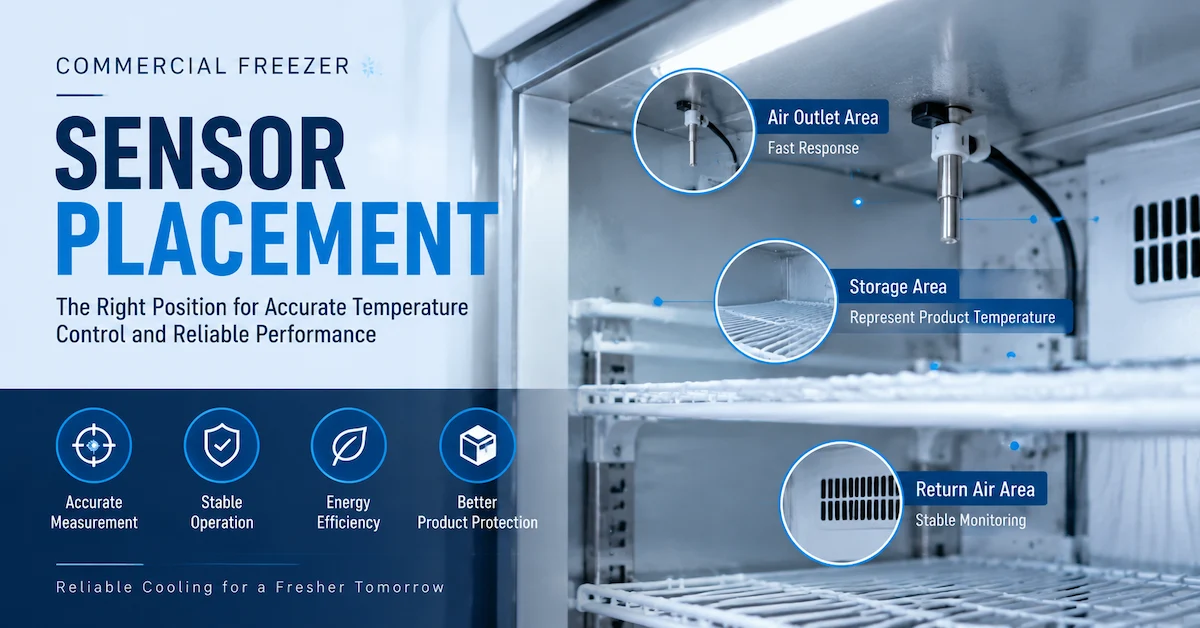
- Sensor position inspection
- Electrical inspection
- Temperature performance test
- Final functional inspection
For OEM buyers, the approved configuration should be documented clearly before mass production.
How to Compare OEM Freezer Suppliers
Do not compare only unit price.
| Evaluation Area | What Buyers Should Check |
|---|---|
| Temperature capability | Can the freezer actually maintain the target? |
| System design | Are components matched to the load? |
| Ambient performance | Is the target market considered? |
| Insulation | Is thermal performance appropriate? |
| Sample testing | Is performance verified before production? |
| QC | Can approved settings be reproduced consistently? |
| OEM capability | Can related specifications be coordinated? |
| MOQ | Is it realistic for the project? |
| Lead time | Does it fit the launch schedule? |
| Support | Are technical communication and spare parts available? |
The best supplier is not necessarily the one claiming the lowest possible temperature. It is the supplier that can provide a technically suitable, testable, repeatable commercial freezer configuration.
What Should Buyers Send Snowsea for an OEM Quote?
To receive a more accurate recommendation,provide:
- Freezer type
- Intended application
- Target temperature
- Required operating range
- Ambient temperature
- Stored product
- Approximate loading volume
- Voltage and frequency
- Destination country
- Required quantity
- Certification requirements
- Branding requirements
- Sample requirement
- Target delivery schedule
A stronger inquiry looks like this:
We need a private-label commercial freezer for frozen food storage.Please evaluate our required operating range, ambient condition, voltage, quantity, and target market and recommend a suitable refrigeration configuration.
This gives the manufacturer enough information to move directly toward technical evaluation and quotation.
FAQ
What is OEM freezer custom temperature range?
It means configuring a commercial freezer to meet a buyer-defined operating temperature requirement through appropriate refrigeration, insulation, control, and system design.
Can I change the freezer temperature range by changing the thermostat?
Not necessarily. The complete refrigeration system must be capable of achieving and maintaining the requested operating conditions.
Can Snowsea customize lower freezer temperatures?
Project-specific temperature requirements can be evaluated against the freezer platform, components, ambient conditions, and application before a configuration is confirmed.
Does compressor size determine freezer temperature?
Compressor capacity is important, but it must work correctly with the evaporator, condenser, refrigerant, insulation, and refrigeration load.
Does ambient temperature affect freezer performance?
Yes. Higher surrounding temperatures can increase refrigeration load, so the intended operating environment should be provided during OEM evaluation.
Should OEM samples be tested under load?
Where relevant, loaded testing provides additional information about temperature recovery and real operating performance.
Does custom temperature range increase the freezer price?
It may. Component changes, insulation, engineering, sample development, and testing can affect cost.
Can custom temperature range affect MOQ?
Yes, particularly if the project requires non-standard components or a new refrigeration configuration.
What information is required for an OEM temperature-range quotation?
Provide the freezer type, target range, ambient condition, product, voltage, destination market, quantity, certifications, and project requirements.
Can Snowsea support private-label temperature customization?
Snowsea can evaluate OEM/ODM commercial freezer requirements and discuss suitable configurations based on the buyer's technical and commercial specifications.
Conclusion
An OEM freezer custom temperature range project is not simply a controller adjustment. It requires the buyer and manufacturer to define the actual operating requirement and verify whether the entire refrigeration system can support it.
The strongest OEM specification should consider:
- Target temperature
- Operating range
- Ambient condition
- Product load
- Compressor
- Evaporator
- Condenser
- Insulation
- Airflow
- Controller
- Testing requirements
For private-label brands, distributors, and OEM buyers, defining these requirements before sampling helps reduce specification changes, quotation confusion, and mass-production risk.
Send Snowsea your freezer type, target operating range, ambient temperature, stored product, voltage, destination country, required quantity, and project requirements through the contact page to request an OEM technical evaluation and commercial quotation.