When importing commercial refrigeration equipment, buyers may receive quotations from both direct manufacturers and trading companies. The products can appear similar, but the sourcing process, customization capability, pricing structure, quality control, and communication model may be very different.
Understanding OEM freezer supplier vs trading company is especially important for:
- Commercial freezer importers
- Refrigeration distributors
- Supermarket equipment suppliers
- Private-label brands
- Food-service equipment companies
- Retail project contractors
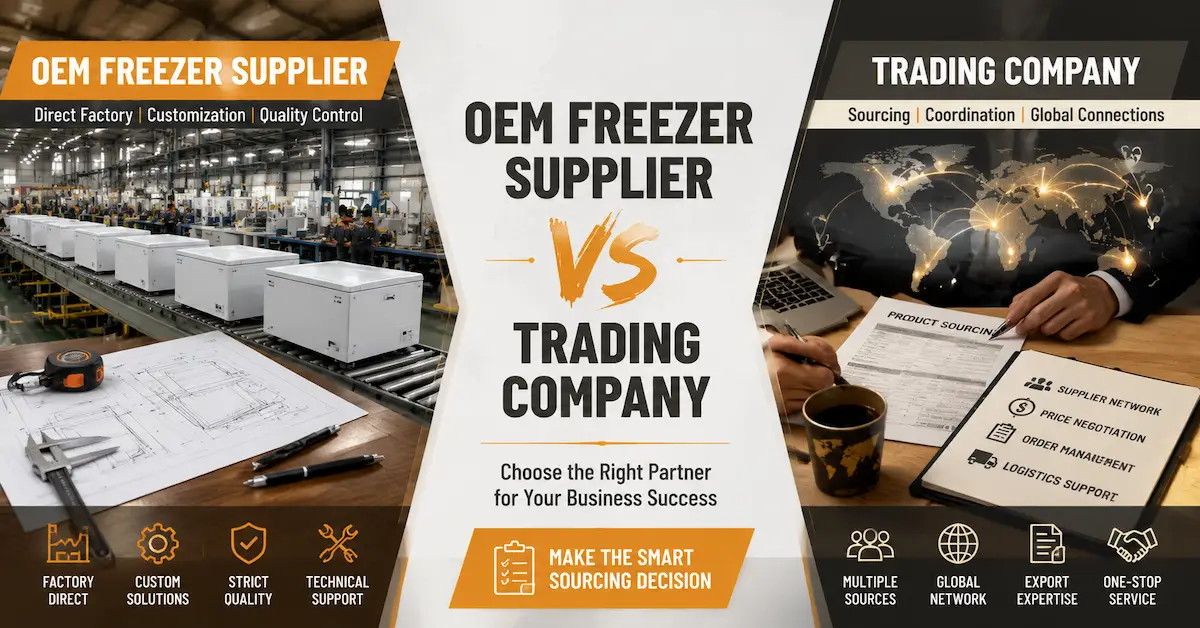
A direct OEM freezer supplier normally manufactures or assembles refrigeration products in its own facility. A trading company primarily sources products from one or more factories and manages the commercial transaction between the factory and the buyer.
Neither option is automatically right or wrong. The better choice depends on the buyer’s order quantity, customization needs, technical knowledge, target market, and supply-chain strategy.
What Is an OEM Freezer Supplier?
An OEM freezer supplier manufactures commercial refrigeration products according to the buyer’s specifications or branding requirements.
Typical OEM services may include:
- Private-label logos
- Customized model numbers
- Rating labels
- Cabinet colors
- Product graphics
- Shelf and basket configurations
- Voltage and plug options
- User manuals
- Export cartons
- Customized packaging
More capable suppliers may also offer ODM development, including changes to:
- Cabinet dimensions
- Door structure
- Refrigeration layout
- Internal configuration
- Temperature controls
- Product appearance
A direct supplier is usually involved in engineering, material purchasing, production scheduling, assembly, testing, inspection, and packaging.
What Is a Trading Company?
A trading company connects buyers with one or more factories.
Its services may include:
- Supplier sourcing
- Product selection
- Quotation consolidation
- Order coordination
- Export documentation
- Quality inspection arrangements
- Logistics support
- Mixed-product purchasing
Some trading companies specialize in commercial refrigeration and have strong technical knowledge. Others handle many unrelated product categories and may depend heavily on factory information.
A trading company can be useful when buyers need:
- Several product categories
- Small mixed orders
- One point of communication
- Sourcing support across multiple factories
- Additional export coordination
The main difference is that the trading company normally does not directly control the production line.
OEM Freezer Supplier vs Trading Company: Quick Comparison
| Evaluation Area | OEM Freezer Supplier | Trading Company |
|---|---|---|
| Production control | Direct | Indirect |
| Product customization | Usually stronger | Depends on factory network |
| Technical communication | Direct with factory team | Often through an intermediary |
| Product range | Focused on factory capabilities | May cover more categories |
| Pricing structure | Factory-based quotation | Factory cost plus service margin |
| MOQ flexibility | Depends on production efficiency | May combine different factory options |
| Quality control | Factory QC system | Factory QC plus optional inspection |
| Lead-time control | Direct production scheduling | Depends on factory coordination |
| Export support | Varies by manufacturer | Often a core service |
| Best for | OEM, bulk orders, long-term sourcing | Mixed sourcing and procurement support |
Factor 1: Factory and Production Control
The most important difference is control over manufacturing.
A direct OEM freezer supplier can normally manage:
- Material preparation
- Component purchasing
- Production scheduling
- Assembly procedures
- Testing standards
- Rework
- Final inspection
- Packaging
This direct control can make it easier to identify and correct problems during production.
A trading company must communicate buyer requirements to the selected factory. When specifications change, the information may pass through several people before reaching the production team.
This can increase the risk of:
- Delayed confirmations
- Incomplete technical details
- Misunderstood customization
- Slower problem resolution
However, an experienced trading company with close factory relationships may still manage production effectively. Buyers should evaluate the actual coordination process rather than relying only on the supplier’s business type.
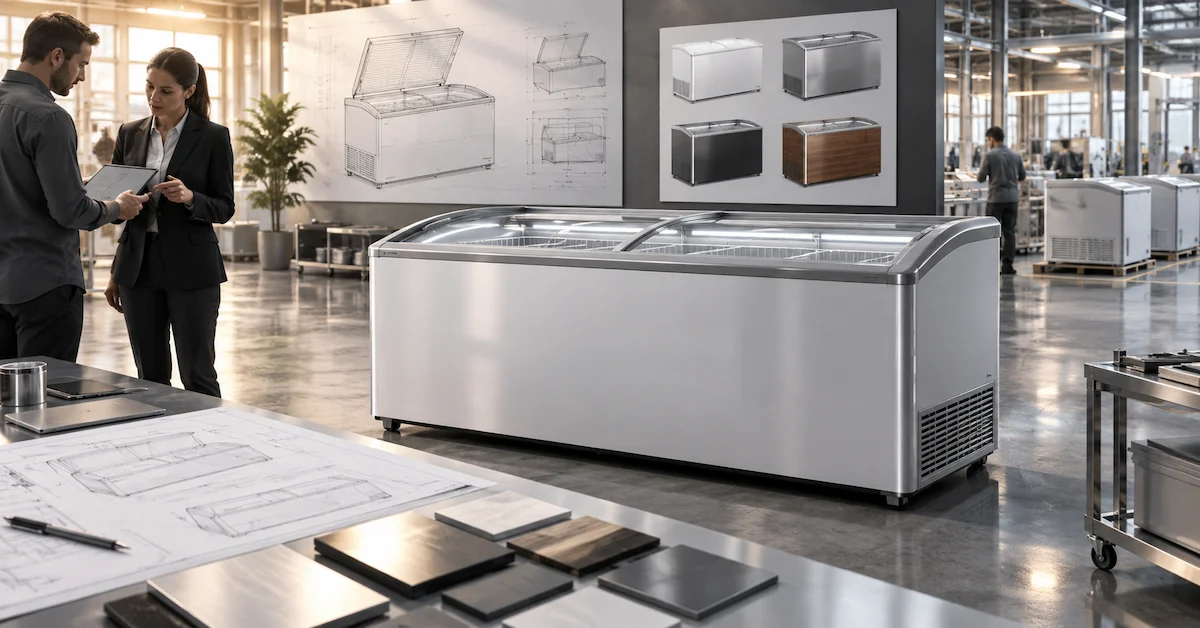
Factor 2: OEM and ODM Customization
Customization is a major consideration in an OEM freezer supplier vs trading company comparison.
Direct manufacturers usually have better access to:
- Engineers
- Technical drawings
- Production tooling
- Component suppliers
- Sample-development processes
- Product testing
This is important when the project involves more than a simple logo change.
Basic customization
Basic OEM requirements may include:
- Logo stickers
- Rating labels
- Manuals
- Carton printing
- Shipping marks
Both direct suppliers and trading companies may support these services.
Advanced customization
More complex requirements may include:
- Exclusive cabinet colors
- Branded lightboxes
- Custom glass
- Modified dimensions
- Alternative compressors
- Special controllers
- New shelf layouts
- Market-specific electrical systems
For these projects, direct access to the factory’s technical team can reduce development time and communication errors.
Snowsea provides OEM and ODM commercial refrigeration solutions for buyers requiring customized freezer configurations.
Factor 3: Product Range
A direct manufacturer may specialize in a limited group of products, such as:
- Chest freezers
- Island freezers
- Upright glass-door freezers
- Ice cream freezers
- Display cabinets
This specialization can provide stronger product knowledge and production efficiency.
A trading company may source from several factories and offer:
- Commercial freezers
- Refrigerators
- Beverage coolers
- Ice makers
- Kitchen equipment
- Other retail equipment
This wider range can be useful for buyers who want to consolidate different product categories into one purchasing project.
However, a wide catalog does not always indicate deep technical expertise. Buyers should verify whether the company understands the performance, components, testing, and market requirements of each product.
Factor 4: Pricing Structure
Direct manufacturers usually quote based on:
- Materials
- Components
- Labor
- Production quantity
- Customization
- Packaging
- Factory overhead
Trading-company pricing may include:
- Factory purchasing price
- Sourcing service
- Communication
- Inspection coordination
- Export handling
- Commercial margin
A factory quotation is not automatically cheaper. A manufacturer may have a higher MOQ, while a trading company may locate a more flexible production source.
Buyers should compare the complete offer, including:
- Unit price
- Sample cost
- OEM fees
- Packaging
- Inspection
- Documentation
- Freight support
- Warranty
- Spare parts
The lowest unit price may not provide the lowest total sourcing cost.
Factor 5: MOQ and Trial Orders
Minimum order quantity depends on product design, materials, branding, packaging, and factory planning.
A direct OEM supplier may offer a competitive MOQ for its standard models but require a higher quantity for:
- Custom colors
- Printed cartons
- Exclusive components
- New tooling
- Structural changes
A trading company may help buyers locate factories that accept smaller orders or consolidate several products.
This can benefit buyers who are:
- Testing a new market
- Launching a new brand
- Buying mixed models
- Working with limited inventory space
For repeat orders and larger volumes, direct factory cooperation often becomes more efficient.
Factor 6: Quality Control
A direct supplier should have an internal quality-control system covering:
- Incoming materials
- Cabinet production
- Refrigeration assembly
- Electrical safety
- Cooling performance
- Appearance
- Packaging
Buyers should ask whether the factory records:
- Pull-down test results
- Temperature stability
- Controller readings
- Electrical checks
- Final inspection results
A trading company may rely on factory inspection or arrange its own inspection team.
This additional inspection layer can be valuable, especially when the trading company has clear standards and experienced inspectors.
The key question is not simply who performs the inspection. Buyers should confirm:
- What is inspected?
- How many units are checked?
- Are test records available?
- How are defects corrected?
- Who approves loading?
Factor 7: Technical Communication
Commercial freezers involve many technical details:
- Temperature range
- Refrigerant
- Compressor
- Climate class
- Voltage
- Frequency
- Plug type
- Defrost method
- Glass design
- Shelf loading
- Controller settings
With a direct supplier, buyers may communicate with salespeople, engineers, and quality teams within the same organization.
With a trading company, technical questions may be forwarded to the factory.
This can be efficient when the trader has strong refrigeration knowledge. It can become slow when the commercial team cannot interpret technical requirements accurately.
During the quotation stage, buyers should evaluate whether the supplier can provide:
- Clear specification sheets
- Accurate drawings
- Component details
- Practical recommendations
- Consistent answers
Factor 8: Production Lead Time
A direct manufacturer has greater visibility into:
- Material availability
- Production capacity
- Order scheduling
- Testing progress
- Packaging completion
This may support more accurate lead-time estimates.
A trading company depends on updates from the selected factory. If the trader works with several factories, it may provide alternative production options, but it may have less direct control over delays.
Buyers should request a schedule covering:
| Stage | Information Required |
|---|---|
| Specification confirmation | Approval deadline |
| Sample | Production and approval time |
| Materials | Purchasing period |
| Bulk production | Start and completion dates |
| Testing | QC schedule |
| Packaging | Completion date |
| Loading | Planned container date |
A realistic schedule is more valuable than an unusually short promise.
Factor 9: Export Documentation and Logistics
Trading companies often have strong experience in:
- Export declarations
- Commercial invoices
- Packing lists
- Certificates of origin
- Freight coordination
- Customs documentation
- Mixed-product shipments
Some manufacturers also have experienced export departments and can manage these processes directly.
Buyers should confirm whether the supplier can support:
- FOB and CIF quotations
- Container-loading plans
- Export packaging
- Shipping marks
- Loading photos
- Document preparation
- Freight-forwarder coordination
The best partner is the one that can manage both production and export requirements reliably.
Factor 10: Packaging and Container Loading
Commercial freezers are vulnerable to:
- Glass breakage
- Cabinet scratches
- Dents
- Moisture
- Compressor damage
- Improper handling
A direct manufacturer can usually design packaging around its own product structure.
A trading company may provide additional export-packaging requirements to the factory or coordinate reinforced protection.
Buyers should request:
- Packaging specifications
- Carton dimensions
- Pallet information
- Wooden-frame options
- Container-loading quantity
- Loading arrangement
- Photographic records
Packaging quality should be evaluated together with the product quotation.
Factor 11: After-Sales Support
After-sales service may include:
- Troubleshooting
- Spare parts
- Technical manuals
- Wiring diagrams
- Component replacement
- Warranty claims
- Repeat-order support
A direct supplier can often access technical information and replacement components more quickly.
A trading company may coordinate claims across different factories, which can be convenient for buyers sourcing multiple products.
Buyers should confirm:
- Warranty period
- Claim procedure
- Spare-parts availability
- Response time
- Technical contact
- Responsibility for replacements
Factor 12: Long-Term Supply Stability
For private-label brands and distributors, long-term stability is more important than one successful shipment.
A suitable supplier should support:
- Consistent product specifications
- Repeat production
- Component continuity
- Stable branding
- Updated certifications
- Forecast planning
- Future customization
Direct cooperation can help buyers build a closer relationship with the production team.
A professional trading company can reduce procurement workload and manage multiple factories.
The better model depends on whether the buyer values manufacturing integration or broader sourcing management.
When Is an OEM Freezer Supplier the Better Choice?
A direct OEM supplier is usually more suitable when buyers require:
- Bulk commercial freezer orders
- Private-label manufacturing
- Customized specifications
- Direct technical communication
- Consistent repeat production
- Detailed quality control
- Long-term product development
It is especially suitable for distributors and brands building a dedicated freezer product line.
When Is a Trading Company the Better Choice?
A trading company may be more suitable when buyers require:
- Multiple equipment categories
- Smaller mixed orders
- Supplier sourcing support
- Consolidated communication
- Export-document assistance
- Flexible factory selection
- Multi-factory shipment coordination
It may also benefit buyers who do not have an internal sourcing or technical team.
Supplier Evaluation Checklist
| Evaluation Area | Questions to Ask |
|---|---|
| Business model | Manufacturer or trading company? |
| Factory access | Can production facilities be verified? |
| Product expertise | Does the team understand refrigeration? |
| Customization | What OEM and ODM services are available? |
| MOQ | Is it per model or total order? |
| Quality | What tests are completed? |
| Lead time | Who controls the schedule? |
| Packaging | What export protection is included? |
| Documentation | Who prepares export documents? |
| Warranty | Who handles technical claims? |
| Spare parts | Are replacements available? |
| Repeat orders | Can specifications remain consistent? |
Common Buyer Mistakes
Assuming Every Manufacturer Is Better
Some factories have limited export, communication, or project-management capability.
Assuming Every Trading Company Is More Expensive
A capable trader may reduce sourcing time, inspection risk, and coordination costs.
Comparing Different Specifications
Quotations must use equivalent capacity, components, testing, packaging, and customization.
Failing to Verify Factory Information
Buyers should confirm who actually manufactures the product.
Ignoring Technical Support
Commercial refrigeration equipment requires more than basic sales communication.
Choosing Only by Unit Price
Quality, packaging, delivery, and after-sales service affect the total cost.
Why Buyers Work With Snowsea
Snowsea provides commercial refrigeration manufacturing and customized sourcing support for:
- Importers
- Distributors
- Supermarket equipment companies
- Frozen-food retailers
- Private-label brands
Product solutions include:
- Chest freezers
- Upright freezers
- Glass-door freezers
- Island freezers
- Display freezers
- Customized refrigeration equipment
Snowsea supports buyers with:
- Model selection
- OEM and ODM customization
- Production planning
- Quality inspection
- Export packaging
- Container-loading coordination
- Technical and after-sales support
Buyers can review Snowsea’s commercial refrigeration products and learn more about its manufacturing capabilities on the About Snowsea page.
FAQ
What is the main difference between an OEM freezer supplier and a trading company?
An OEM freezer supplier directly manufactures or assembles products, while a trading company sources products from one or more factories and manages the commercial transaction.
Is buying directly from a freezer manufacturer always cheaper?
Not always. Pricing depends on MOQ, customization, packaging, service, and order complexity. Buyers should compare total sourcing cost.
Can a trading company provide OEM customization?
Yes, but the actual customization is normally completed by the factory. Buyers should confirm the trader’s technical and factory-management capability.
Which option is better for private-label freezers?
A direct OEM supplier is usually better for long-term private-label manufacturing, especially when products require technical or structural customization.
Which option is better for mixed equipment orders?
A trading company may be more convenient when the order includes products from several manufacturing categories.
How can buyers verify whether a supplier is a manufacturer?
Request factory videos, production records, inspection information, technical documents, and a factory visit or independent audit.
What should buyers compare before making a decision?
Compare factory control, quality systems, customization, MOQ, pricing, lead time, packaging, export experience, warranty, and spare-parts support.
Conclusion
The OEM freezer supplier vs trading company decision depends on the buyer’s sourcing goals.
A direct OEM supplier generally provides stronger manufacturing control, technical communication, customization, and repeat-order consistency. A trading company may offer broader product selection, flexible sourcing, export coordination, and mixed-order management.
Buyers should not decide based only on the company type. The right partner should demonstrate reliable quality, transparent communication, realistic delivery planning, professional export support, and long-term service.
Snowsea supports global buyers with commercial freezer manufacturing, OEM and ODM customization, quality control, export packaging, and international supply coordination.