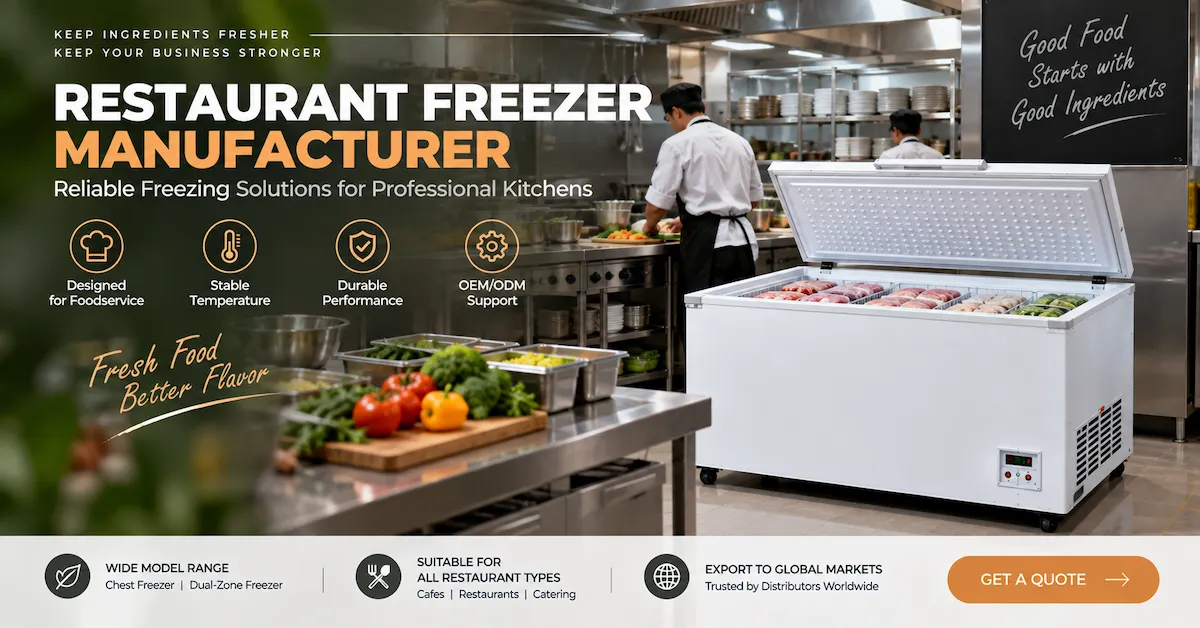
A restaurant freezer manufacturer should help buyers solve a kitchen-storage problem before recommending a cabinet size. A restaurant freezer may hold meat, seafood, frozen vegetables, desserts, prepared ingredients or reserve stock, but the correct cabinet depends on how much inventory arrives at one time, how often staff open the freezer, where it will be installed and how quickly stock turns over. For restaurant groups and foodservice distributors, the purchasing goal is also different from buying one freezer for one kitchen: the equipment needs to fit a repeatable operating model that can be ordered, installed and serviced across multiple sites. SNOWSEA supplies commercial freezer products and supports OEM/ODM refrigeration projects for distributors, brands and project buyers.
Start With the Restaurant Workflow, Not the Freezer Capacity
A 500L cabinet is not automatically better than a 300L cabinet simply because it holds more. The first question should be how frozen ingredients move through the restaurant.Record how many deliveries arrive each week, the largest delivery quantity, which ingredients require frozen storage, how products are packaged and how much stock must remain available between deliveries. A high-volume restaurant with weekly bulk deliveries may need a different storage strategy from a smaller kitchen receiving frozen ingredients several times a week.
Access frequency matters as well. If cooks open a freezer repeatedly during prep and service, the equipment is exposed to a different operating routine from a reserve-storage cabinet opened only a few times each day. SNOWSEA’s own commercial-freezer temperature guidance notes that restaurant buyers should consider temperature recovery and stability in addition to the lowest temperature a cabinet can reach.
For chain buyers, turn these observations into a standard kitchen profile before asking for quotations. That gives a restaurant freezer manufacturer something more useful than “we need a commercial freezer around 300L.”
Who Should Use This Restaurant Freezer Buying Method?
This approach is intended for restaurant chains, franchise groups, commercial kitchen suppliers, hotel and foodservice equipment distributors, catering companies and central purchasing teams standardizing equipment across several locations.These buyers typically need repeatable specifications, replacement availability and a clear process for ordering additional units later.
A small independent restaurant replacing a failed freezer immediately may place more value on local stock and fast installation than factory-direct sourcing. Specialist applications such as blast freezing, medical storage, laboratory use or outdoor installation should also be evaluated separately rather than treated as ordinary restaurant frozen storage.
For central kitchens serving multiple restaurants, capacity and inventory requirements may become substantially larger. SNOWSEA has a separate central kitchen freezer selection guide for those higher-volume foodservice environments.
Divide Restaurant Frozen Storage Into Clear Jobs
A restaurant may need more than one type of frozen-storage task. Separating those jobs makes model selection easier.
| Restaurant storage job | Typical requirement | Purchasing priority |
|---|---|---|
| Daily-access ingredient freezer | Meat, seafood, frozen vegetables and prepared ingredients | Easy access, organization and recovery after opening |
| Reserve freezer | Backup cartons and bulk purchasing | Larger usable volume and efficient loading |
| Dessert or specialty stock | Ice cream,desserts or packaged frozen products | Organized separation and product protection |
| Mixed chilled/frozen requirement | Smaller kitchens needing two temperature functions | Clearly separated zones and controls |
| Low-maintenance freezer | Locations where manual defrost downtime is difficult | Defrost system, controls and maintenance routine |
The purpose of this table is not to prescribe the same equipment for every restaurant. It gives the buyer a way to define the job before comparing cabinets.
Compare SNOWSEA Models by Kitchen Role
The following SNOWSEA models provide several different starting points for restaurant and foodservice buyers. Published capacities and dimensions come from current product information; usable capacity, final accessories, electrical version and suitability for the actual kitchen should be confirmed in the order specification.
| Model | Published information | Potential restaurant role | Main point to confirm |
|---|---|---|---|
| BD-308 chest freezer | 308L chest freezer | Medium-volume ingredient or reserve storage | Actual carton fit, baskets and included options |
| BD-500 chest freezer | 500L; 1650 × 720 × 830 mm; double-lid design; removable basket; R290 | Larger reserve-storage requirement | Kitchen footprint, loading arrangement and access |
| BD/BC-227WA no-frost freezer | 227L air-cooled no-frost chest freezer with electronic temperature control | Restaurant buyers prioritizing defrost convenience | Defrost behavior, controller version and operating data |
| BCD-268 dual-zone freezer | 268L; 1100 × 600 × 870 mm; separate refrigeration and freezing zones | Smaller kitchens needing chilled and frozen storage in one cabinet | Zone capacities, temperature requirements and actual workflow |
SNOWSEA publishes the BD-500 as a 500L chest freezer with a double-lid format and the BD/BC-227WA as its no-frost chest-freezer platform. The BCD-268 is presented with independent refrigeration and freezing zones rather than two lids serving a single temperature space.
The models should therefore be compared by operating role, not simply ranked by liters.
Use the Menu and Delivery Cycle to Estimate Storage
Restaurant buyers often estimate capacity from floor space first. A more useful method starts with inventory.
List the main frozen ingredients, case dimensions and maximum quantities held after a typical delivery. Separate regular working stock from emergency or promotional stock. Then arrange those packages in the proposed freezer or request a loading drawing based on real dimensions.
For example, a restaurant buying bulk cartons of meat may have enough theoretical liters but still struggle to access lower products when cartons are stacked without a workable organization plan. A smaller cabinet with disciplined product allocation may function better than a larger cabinet filled without zones.
Do not calculate usable carton quantity directly from nominal liters. Cabinet geometry, baskets, internal components and loading restrictions all affect the usable arrangement.
Kitchen Dimensions Need More Than Width × Depth × Height
Before approving a model, record the complete installation area. SNOWSEA’s commercial-freezer dimension guidance recommends evaluating floor footprint together with opening space, ventilation, electrical connections, maintenance access and the delivery route.
A restaurant buyer should therefore check:
- Can the cabinet pass through the receiving door and kitchen access route?
- Can staff fully open the lid without hitting shelving or preparation equipment?
- Is there enough space for cleaning and service access?
- Is the freezer positioned away from avoidable heat sources?
- Does its placement interfere with staff movement during peak service?
- Can stock be transferred from delivery to storage without blocking the kitchen?
These questions should be resolved on the floor plan before the purchasing team chooses capacity.
Restaurant Kitchens Can Be Hotter Than Retail Floors
Kitchen environment deserves specific attention because cooking equipment can increase surrounding temperature and reduce available ventilation. SNOWSEA’s ambient-temperature and climate-class content specifically identifies restaurant kitchens as environments where cooking heat, limited ventilation and frequent access can affect freezer operation.
Send the manufacturer the expected ambient conditions and freezer location instead of assuming a cabinet suitable for a comfortable showroom will behave identically next to cooking equipment.
Climate class and internal freezer temperature are also different specifications. Climate class describes the surrounding operating environment, while internal temperature describes the storage condition inside the cabinet. Ask for both where they are relevant to the destination and application.
Build One Restaurant Freezer Specification Sheet
A restaurant freezer manufacturer can provide a more accurate proposal when every important requirement appears in one controlled document.
| Specification area | Buyer should provide | Manufacturer should confirm |
|---|---|---|
| Restaurant type | Fast casual, full service, hotel restaurant, catering or chain kitchen | Recommended product platform |
| Frozen products | Meat, seafood, vegetables, desserts,prepared ingredients | Application suitability |
| Package sizes | Carton and retail-pack dimensions | Usable loading arrangement |
| Inventory cycle | Delivery frequency and peak stock quantity | Recommended capacity |
| Access frequency | Expected opening during prep and service | Relevant operating assumptions |
| Kitchen environment | Ambient conditions, heat sources and ventilation | Supported operating conditions |
| Installation space | Available width, depth,height and access route | Cabinet dimensions and clearances |
| Temperature needs | Required product-storage conditions | Test basis and control configuration |
| Electrical supply | Voltage, frequency and plug | Correct electrical version |
| Defrost preference | Maintenance availability and downtime tolerance | Manual or no-frost configuration |
| Accessories | Baskets, lock,wheels and other required items | Standard versus optional items |
| Branding | Standard product or private label | OEM feasibility |
| Delivery | Number of restaurants and rollout timing | MOQ, production and shipping plan |
| Service | Technician capability and spare-parts expectations | Support scope |
The document should identify which information is confirmed and which remains provisional.
Manual Defrost vs. No-Frost Depends on Kitchen Operations
Defrost type should be selected around staff workload and operating pattern rather than marketing preference.SNOWSEA’s comparison of manual and automatic defrost notes that some chest-freezer applications can accept scheduled manual maintenance, while high-volume kitchens with frequent access may value automatic frost management more highly.
The BD/BC-227WA gives buyers a published no-frost platform for comparison. Before selecting it, request the final defrost logic, electrical version, maintenance instructions and comparable operating data for the target market.
Do not automatically describe no-frost as more energy efficient. Convenience, system complexity, energy use and maintenance should be compared separately.
Temperature Recovery Matters During Prep and Service
Restaurants rarely operate freezers under laboratory-like closed-door conditions. Employees open cabinets to retrieve ingredients, load new deliveries and reorganize stock.
A useful sample or technical review should therefore identify:
- Test ambient condition
- Product or representative load
- Starting temperature of the load
- Measurement locations
- Opening or replenishment pattern
- Test duration
- Recovery requirement
- Acceptance criteria
SNOWSEA’s temperature guidance treats recovery, uniformity and stability as separate purchasing considerations.
Avoid approving performance from one controller photograph. The display indicates what the controller reports; it does not by itself show temperature distribution throughout a loaded cabinet.
Check Organization and Access With Real Kitchen Staff
Restaurant freezer selection should include workflow testing.Ask the kitchen team to retrieve the most frequently used frozen ingredients from the sample layout.
Check whether:
- Common products are accessible without unloading other cartons
- Baskets can separate smaller ingredients
- Heavy packages can be removed safely
- Lower inventory can be reached without excessive searching
- Stock rotation is practical
- Cleaning and drain access remain usable
The BD-308, for example, is published with a removable basket and defrost drain, while the BD-500 also includes a removable basket, drain, lock and double-lid access.
Treat accessories as part of the quoted configuration. If an option matters to the kitchen workflow, identify it explicitly rather than assuming it is standard.
Dual-Zone Storage Can Help Some Smaller Kitchens
A restaurant with limited floor space may want chilled ingredients and frozen ingredients in one cabinet footprint.SNOWSEA’s BCD-268 is published as a 268L dual-zone chest freezer with independent refrigeration and freezing zones.
That configuration can be worth evaluating where the kitchen genuinely needs both functions. It should not be selected simply because “two temperatures” sounds more versatile.
Ask for the usable volume of each zone, actual temperature requirements, access pattern and storage quantities. If the restaurant already has sufficient chilled storage, a dedicated freezer may offer a simpler inventory arrangement.
Materials and Workmanship Should Be Inspectable
Avoid evaluating a restaurant freezer using broad descriptions such as “durable commercial quality.” Turn durability into visible or documentable checks.
Inspect cabinet finish, lid alignment, gasket contact, handles, basket fit, wheel operation where fitted, control-panel accessibility and drain access. Look for surfaces that staff can clean without unnecessary obstruction.
SNOWSEA’s BD-308 content identifies an embossed aluminum liner as an optional configuration, so buyers should confirm the actual liner included in the quotation rather than assuming every published option is standard.
For chain projects, document the approved sample and use the same workmanship reference during bulk inspection.
Connect Quality Control to the Restaurant Model Being Ordered
SNOWSEA’s OEM/ODM manufacturing process describes material processing, cabinet and structural assembly, insulation foaming, refrigeration-system installation, main assembly, performance and temperature testing, final inspection, packing and shipment preparation.
Restaurant chains should ask how their approved freezer specification moves through those stages.
Useful questions include:
- How is the correct electrical version identified?
- Where are baskets and optional accessories checked?
- How is the approved controller confirmed?
- Which performance checks apply to the model?
- What happens when a unit fails inspection?
- How does the packing team identify different restaurant or regional versions?
The value of quality control is not the phrase “strict QC.” It is knowing how the ordered configuration is checked before shipment.
Confirm Compliance by Destination and Model
Restaurants operating across different countries or regions may face different electrical, labeling and product requirements. Provide the destination market before order approval and request the documents relevant to the exact model and configuration.
Do not assume a general certificate shown on a manufacturer’s website automatically covers every product version.OEM changes involving controlled components, labels or technical construction may also require further review.
For restaurant chains, keep applicable documents connected to the approved equipment version so the purchasing team does not reuse old files for a changed specification.
Restaurant Chains Benefit From Standardized Freezer Packages
A multi-location restaurant group can reduce complexity by defining standard kitchen packages.
For example:
Compact kitchen: one medium freezer based on actual inventory needs.
Standard restaurant: one daily-access unit plus additional reserve storage if required.
High-volume restaurant: larger reserve capacity or multiple cabinets organized by ingredient group.
These are planning concepts, not universal SNOWSEA recommendations.
Standardization helps purchasing, installation and service teams know which model belongs in each restaurant format. New locations can then order against an existing specification instead of starting freezer selection from zero.
Calculate Cost Per Restaurant, Not Only Cost Per Unit
Unit price is only one part of restaurant-chain purchasing. Compare each complete kitchen package using the same scope.
Include:
- Freezer and approved accessories
- OEM branding if required
- Packaging
- Inspection
- Freight and importing costs
- Initial spare-parts provision
- Local installation responsibilities
- Warranty and service costs
- Expected inventory requirement
A lower-priced cabinet can become a weaker commercial choice if its configuration requires additional equipment to meet the restaurant’s storage needs.
For chain expansion, calculate equipment cost by restaurant format so management can budget future openings using a consistent specification.
Plan Capacity and Lead Time Around Restaurant Openings
Provide the manufacturer with the rollout schedule instead of one annual quantity.
A restaurant group opening ten locations over six months may not want all units delivered at once. Ask whether production and shipment can align with realistic opening phases and what MOQ or packaging constraints apply.
Separate:
sample approval → production → inspection → shipment readiness → international transport → warehouse delivery → store installation
Do not treat production lead time as the restaurant-ready date.
For franchise networks, also decide whether freezers ship to one central warehouse or directly through regional distributors.
OEM Helps Restaurant Equipment Distributors Build a Repeatable Range
Foodservice equipment distributors may want private-label freezers that align with the rest of their commercial-kitchen portfolio. SNOWSEA’s OEM/ODM program supports branding and product-configuration discussions for overseas distributors and project buyers.
Possible project requirements can include branding, labels, packaging, electrical versions and model-specific configuration. Keep appearance customization separate from engineering modifications.
If cabinet dimensions, insulation, refrigeration configuration or controls change, request technical evaluation and any necessary sample or performance verification.
The best OEM restaurant freezer is not the one with the most custom features. It is the version that solves the defined kitchen requirement and can be reproduced consistently.
Build Spare-Parts Planning Into the First Restaurant Rollout
Restaurants cannot afford unnecessary downtime during service periods.Ask for a model-specific spare-parts list before the first bulk shipment.
SNOWSEA’s company information describes standard spare-parts availability, technical documentation and remote support. Confirm what is available for the selected restaurant models and destination.
Connect spare parts to the production version. Similar-looking controllers, gaskets or baskets should not be assumed interchangeable.
Restaurant chains should also determine who performs local diagnosis, who replaces parts, who pays labor and freight, and what evidence the supplier requires for warranty claims.
What Should You Send a Restaurant Freezer Manufacturer for a Quote?
A useful restaurant freezer RFQ should include the target country, restaurant format, number of locations, frozen-food categories, package sizes, peak inventory, delivery frequency, kitchen dimensions, ambient conditions, voltage and frequency, preferred defrost approach and rollout schedule.
If you need OEM or private-label supply, add logo, packaging, model identification and documentation requirements.
Through the SNOWSEA project inquiry page, ask for a model-specific proposal rather than a generic price list. Request the recommended freezer for each restaurant format, confirmed configuration, sample requirements, MOQ, production milestones and after-sales scope.
A strong opening inquiry can be as simple as:
“We operate three restaurant formats. Here are our frozen inventory levels, kitchen dimensions, operating environment and rollout quantities. Please recommend the freezer platform for each format and identify which specifications still require confirmation.”
Frequently Asked Questions
1. What should I look for in a restaurant freezer manufacturer?
Look for suitable freezer platforms, clear specifications, manufacturing and testing controls, realistic order planning, export packaging and a workable spare-parts strategy. For restaurant chains, repeat-order consistency should also be part of the supplier evaluation.
2.What freezer size is best for a restaurant?
There is no universal best capacity. Estimate peak frozen inventory using real package sizes and delivery frequency, then compare the usable internal arrangement with available kitchen space.
3. Which SNOWSEA freezers can restaurant buyers evaluate?
SNOWSEA publishes chest freezer platforms including BD-308, BD-500 and BD/BC-227WA, as well as dual-temperature products such as BCD-268. The appropriate model depends on the restaurant’s storage requirements and operating conditions.
4. Is a chest freezer suitable for restaurant kitchens?
A chest freezer can be considered for frozen ingredient and reserve storage where the footprint, access pattern and organization suit the kitchen. Restaurant buyers should test real loading and staff access rather than relying only on capacity.
5. Should a restaurant choose manual defrost or no-frost?
The answer depends on access frequency, humidity, maintenance availability and downtime tolerance.SNOWSEA publishes the BD/BC-227WA as a no-frost platform, while other chest freezers may use different defrost arrangements. Compare the actual operating routine before deciding.
6. Can one freezer provide both chilled and frozen storage?
SNOWSEA’s BCD-268 is published with independent refrigeration and freezing zones. Buyers should confirm the usable volume and operating specification of each section before deciding whether it fits the kitchen workflow.
7. Can restaurant freezers be private labeled?
SNOWSEA supports OEM/ODM cooperation for distributors, brand owners and project buyers. Branding, packaging and configuration should be confirmed for the selected model, while engineering changes require separate technical review.
8. What affects restaurant freezer pricing?
Price can vary according to cabinet size, refrigeration configuration, controls, accessories, electrical version, OEM requirements, packaging, quantity and commercial delivery scope. Compare equivalent configurations before selecting the lowest quotation.
9. What should restaurant chains check before bulk shipment?
Confirm model, quantity, electrical version, agreed accessories, visible workmanship, applicable performance checks, labels, documents and packaging. Use the approved specification as the inspection reference.
10. What information does SNOWSEA need for a restaurant freezer quotation?
Provide the restaurant format, frozen products, package sizes, storage quantity, kitchen space, ambient conditions, electrical supply, order quantity and project schedule. Submit these through SNOWSEA Contact Us for a model-specific proposal.
Conclusion
Choosing a restaurant freezer manufacturer should begin with kitchen workflow, frozen-inventory volume and operating conditions rather than a catalog capacity.Define how ingredients are delivered, stored and accessed; check kitchen dimensions and ambient heat; then compare storage layout, defrost method, temperature behavior, accessories and service requirements. For restaurant chains and foodservice distributors, standardizing approved freezer packages can also simplify purchasing, installation, training and spare-parts support across multiple locations. SNOWSEA provides commercial chest-freezer and dual-temperature platforms together with OEM/ODM services for B2B projects. If you are equipping a new restaurant, standardizing a chain or building a foodservice freezer range, send SNOWSEA your kitchen dimensions, frozen inventory, operating conditions and rollout quantities and request a model-by-model proposal covering specification, sample requirements, production planning and long-term support.