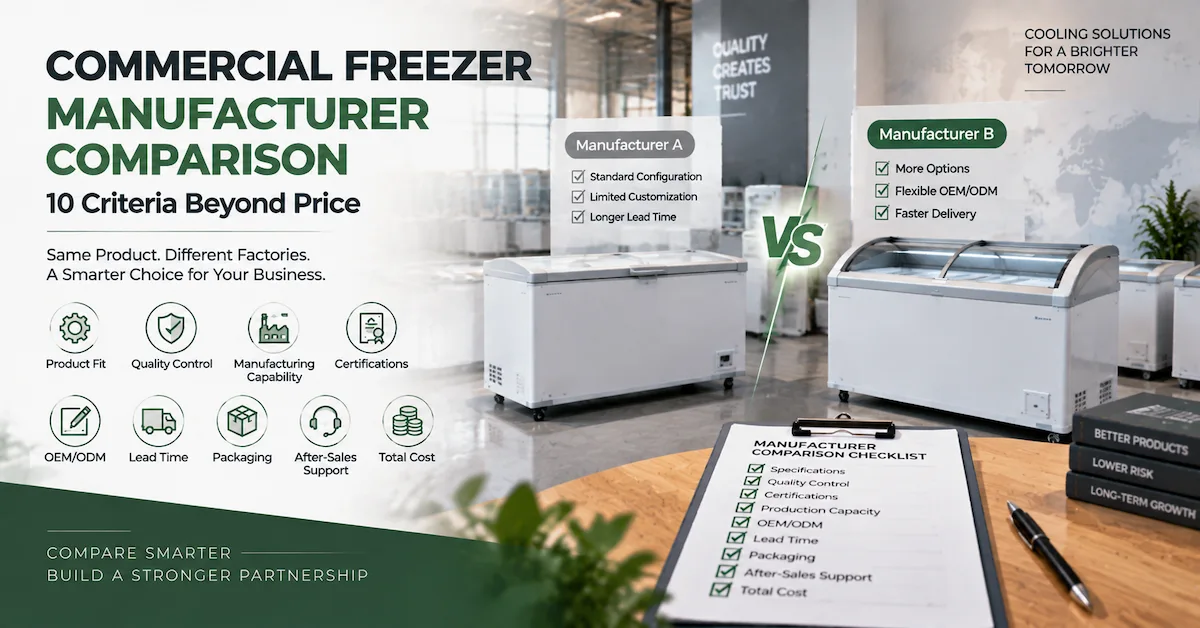
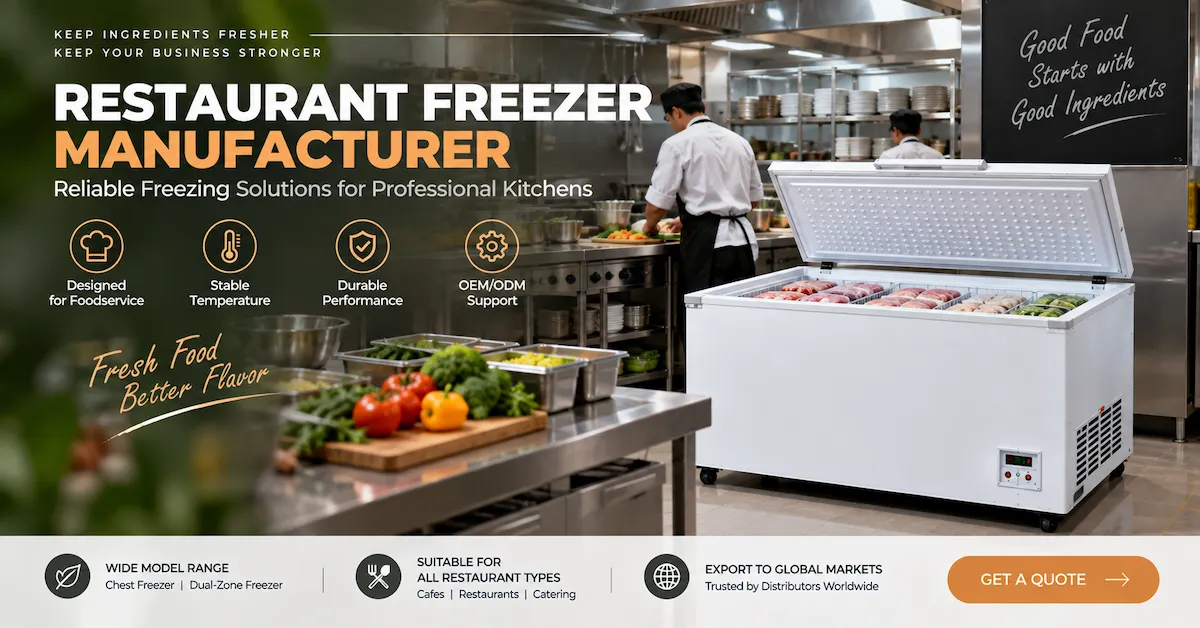
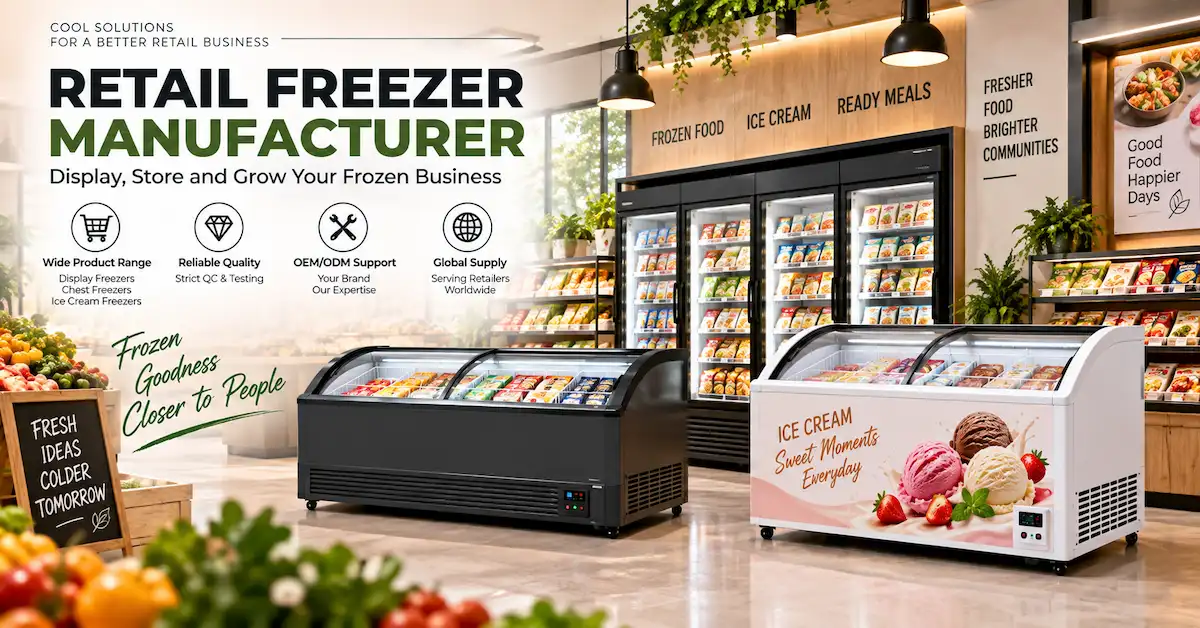
A retail freezer manufacturer should help a buyer build an equipment program, not simply choose one freezer from a catalog. A frozen-food shop, convenience store, supermarket, ice cream outlet and multi-format retail chain can all sell frozen products, but their requirements for visibility, usable storage, customer access, replenishment and floor space are different. For buyers planning multiple locations, the more important question is whether the selected freezer platforms can be standardized, reproduced and supported as the business grows. SNOWSEA separates its commercial refrigeration offering into commercial freezer and ice cream freezer product families, giving retail buyers different starting points for reserve storage and customer-facing frozen display.
What Should a Retail Freezer Manufacturer Help You Standardize?
Retail standardization should not mean placing the same cabinet in every store. It means creating a limited number of approved freezer configurations for recurring store requirements. A compact convenience store may need one customer-facing frozen display and limited reserve storage, while a larger frozen-food retailer may need several merchandising positions and a higher-capacity backroom freezer. An ice cream brand may care more about transparent glass, basket allocation and brand presentation than a restaurant-oriented buyer would. A capable manufacturer should therefore help the buyer connect each freezer model to a defined store role, approved specification and repeat-order reference.
SNOWSEA already addresses the difference between frozen and chilled display in its display freezer selection guide, where retail buyers are encouraged to define the merchandise and temperature application before choosing cabinet appearance. That same discipline should be applied across a complete retail freezer program.
Who Should Use This Retail Freezer Buying Approach?
This approach is most relevant to frozen-food retailers, convenience-store groups, supermarket operators, ice cream brands, appliance importers, refrigeration distributors and private-label companies planning recurring orders. These buyers need more than a technically acceptable freezer; they need equipment that can be fitted into store layouts, explained by sales teams, stocked in warehouses and supported after installation.
It may be less appropriate for an urgent single-unit replacement where local availability is the dominant requirement. Medical storage, laboratory refrigeration, blast freezing and other specialist applications should also be handled separately rather than assumed to fit the standard retail freezer platforms discussed here. The goal is to build a reliable retail product program around applications the equipment is actually intended to serve.
Divide the Retail Program by Store Format Before Selecting Models
Instead of asking a retail freezer manufacturer for “three sizes,” create store-format requirements first. That prevents several similar models from entering the catalog without a clear reason to exist.
| Store format | Primary frozen-food task | Typical purchasing priority | Suitable product direction |
|---|---|---|---|
| Convenience store | Compact packaged frozen-food or ice cream display | Small footprint, visibility, easy customer access | Glass-top ice cream freezer |
| Frozen-food shop | Broader frozen assortment | Display quantity,replenishment and stock organization | Multiple display/freezer roles |
| Supermarket | Frozen aisle, promotions and reserve stock | Repeatable layouts, larger assortment, store standardization | Display freezer + chest freezer |
| Ice cream outlet | Packaged frozen-dessert sales | Visibility,basket arrangement and branding | SD/SC ice cream freezer |
| Retail warehouse/backroom | Reserve frozen inventory | Usable loading volume and stock access | Chest freezer |
| Multi-format retail chain | Several store concepts | Limited approved SKUs and repeat-order consistency | Standardized model matrix |
These are purchasing categories rather than fixed equipment recommendations. Store dimensions, merchandise, operating conditions and required quantities still need to be evaluated for each project.
Create Product Roles Before Creating Retail SKUs
A common retail sourcing mistake is adding another freezer whenever a new capacity appears attractive. That can produce overlapping SKUs, slower stock turnover and more spare-parts complexity. Instead, give every model a commercial role.One model may be the standard medium-capacity backroom freezer. Another may serve larger stock requirements. A third may provide a no-frost alternative. Glass-top models can cover customer-facing packaged ice cream or frozen-dessert sales.
A useful test is simple: if this freezer disappeared from the range, which customer requirement could no longer be served? If the purchasing or sales team cannot answer clearly, the proposed SKU may be creating complexity rather than coverage. This product-role approach also complements SNOWSEA's existing retail freezer OEM development guidance, which focuses on matching freezer development to store layouts, product categories and retail requirements.
Compare SNOWSEA Base Models by Retail Function
SNOWSEA currently lists multiple freezer and ice cream freezer platforms. The following models show how a retail buyer can create differentiated roles instead of ranking products only by nominal capacity. Published figures should be reconfirmed in the final order specification.
| Model | Published positioning | Suggested retail role | Critical buyer check |
|---|---|---|---|
| BD-308 Chest Freezer | 308L chest freezer | Core reserve-storage model | Real package loading, basket arrangement and included accessories |
| BD-500 Chest Freezer | 500L double-lid chest freezer | Larger retail backroom inventory | Store footprint, loading access and required stock volume |
| BD/BC-227WA | 227L air-cooled no-frost chest freezer | Alternative where defrost routine matters | Controller, defrost operation and model-specific operating evidence |
| SD/SC-268PM | 268L flat sliding-glass ice cream freezer | Compact/medium customer-facing frozen display | Real package fit,basket configuration and display access |
| SD/SC-368Y | 368L curved-glass ice cream freezer | Larger packaged frozen-dessert assortment | Floor-space value, product visibility and basket allocation |
SNOWSEA's freezer category currently includes BD-208, BD-100A, BD-800, BCD-200, BD-500, BD-200, BD/BC-227WA, BD-308 and BCD-268, while its ice cream freezer range lists SD/SC-268PM, SD/SC-368Y and SD/SC-158Y.
Build a Retail Freezer Specification Before Asking for the Final Price
Price comparison becomes meaningful only after suppliers are quoting the same requirement. A retail freezer specification should connect merchandise, store operation and the proposed product configuration.
| Specification area | Buyer should define | Manufacturer should confirm |
|---|---|---|
| Merchandise | Frozen-food categories and package dimensions | Suitable product platform |
| Store role | Customer-facing display or reserve storage | Recommended model |
| Capacity | Required stock quantity rather than liters alone | Usable internal arrangement |
| Installation | Available width, depth, height and access route | Cabinet dimensions and model-specific clearances |
| Customer/staff access | Opening and replenishment frequency | Suitable lid or glass arrangement |
| Temperature requirement | Required holding conditions | Operating and test specification |
| Store environment | Ambient temperature and humidity | Supported operating conditions |
| Electrical supply | Voltage,frequency and plug | Correct electrical configuration |
| Accessories | Baskets, dividers, locks and other required items | Standard vs. optional features |
| Branding | Standard, OEM or private label | Available customization scope |
| Packaging | Destination and handling requirements | Final packed dimensions and protection |
| Service | Local maintenance capability | Spare-parts and support arrangement |
This document should have a version or date so later quotations and samples can be checked against the same requirement.
Test Real Merchandise Before Choosing Capacity
Nominal liters can help remove obviously unsuitable models, but retail buyers should make the final choice using real merchandise. Measure cartons, tubs, bags or boxes and place them in the proposed basket or storage layout. Record how many SKUs remain visible, how reserve stock is organized and whether employees can replenish the freezer without unnecessarily rearranging the entire cabinet.
For customer-facing equipment, product visibility matters as much as theoretical storage volume. SNOWSEA’s existing display freezer retail selection article similarly recommends using real package dimensions instead of assuming that liters predict retail merchandising capacity.
For reserve storage, the same principle applies differently: determine whether cartons can be organized so staff can reach frequently used stock while maintaining workable rotation. A bigger freezer that encourages uncontrolled stacking can be less useful than a smaller cabinet with a better inventory routine.
Treat Floor Space as a Retail Cost
Freezer size affects more than purchase price. Every additional centimeter occupies merchandising or circulation space. A retail freezer manufacturer should therefore provide cabinet dimensions early enough for store planners to assess placement.
When comparing SD/SC-268PM with a larger display model, for example, the question should not simply be whether additional capacity is available. Buyers should determine whether the extra floor space produces enough useful assortment or reserve stock to justify it.
Retail project drawings should show surrounding fixtures, customer approach, replenishment access and any installation or service requirements. A cabinet that technically fits into an empty rectangle can still create a poor store layout if customers cannot reach products comfortably or employees cannot service it.
Visibility and Access Matter for Customer-Facing Freezers
Retail equipment has to protect frozen products while also supporting purchasing behavior.For glass-top models, evaluate what customers see from their normal approach direction, whether packaging remains identifiable as stock sells down, how far customers need to reach and whether sliding panels provide sufficient access.
SNOWSEA's existing display freezer visibility content identifies product presentation as a retail consideration rather than treating the cabinet purely as storage equipment.
A useful sample test should therefore use actual retail packaging and representative store lighting. Avoid choosing between flat and curved glass using appearance alone. Compare the complete cabinet, including footprint, opening arrangement, frame visibility, basket design and merchandise fit.
Temperature Performance Needs an Operating Context
A retail freezer should not be approved using only the controller display or an unloaded factory photograph. Request a test basis that identifies the product configuration, ambient conditions, load, measurement locations and duration. If frequent customer opening or staff replenishment is important to the application, discuss how recovery will be evaluated.
Different stores may also operate under different ambient conditions. A freezer placed in an air-conditioned supermarket does not necessarily experience the same environment as equipment in a compact convenience store with frequent door openings and limited space. The retail program should therefore standardize models only across conditions that fall within the approved operating specification.
No-frost functionality should be treated the same way. The BD/BC-227WA provides a no-frost platform, but that feature alone should not be converted into unsupported claims about lower energy cost or superior performance. Compare the maintenance requirement and documented operating data relevant to the project.
Check Components That Affect Daily Retail Operation
Retail employees and customers repeatedly interact with sliding glass, lids, baskets, handles, locks and controls. These parts deserve attention during the sample review.
For display equipment, inspect glass movement, frame alignment, basket fit and cleaning access. For reserve-storage freezers, check lid operation, basket removal, control accessibility and drain access where applicable. If a feature is listed as optional, require it to appear in the quotation rather than assuming it is included because it appears on a product page.
For a chain program, document accepted workmanship on the approved sample and use it as part of the production inspection reference.
Connect Factory Production to the Approved Retail Specification
SNOWSEA's OEM/ODM service supports project discussions for distributors, brands and retail buyers. Its broader manufacturing approach is used to connect product configuration, assembly, testing and packaging with the customer order. For a multi-store program, the buyer should ask how the approved specification reaches production and how different versions are identified.
The useful questions are practical: how does the assembly team know which electrical version is required, where are baskets or accessories checked, how is the correct artwork assigned, and how are nonconforming units prevented from being packed?
This matters more than a generic statement that the factory has quality control. Retail buyers need a repeatable relationship between approved sample, specification, production order and shipment.
Keep OEM Branding Separate From Technical Changes
Retail chains and frozen-food brands may want cabinet graphics, logos, branded cartons or custom product identification. These requests can create a recognizable equipment program across locations, but they should be controlled separately from engineering changes.
Branding includes logo position, cabinet artwork, model naming, labels, manuals and packaging. Technical changes may involve cabinet dimensions, insulation, refrigeration configuration, controls or other components that can affect performance.
SNOWSEA's OEM development guide for retail brands positions customization around store layout, brand requirements and product application. A buyer should still obtain model-specific feasibility confirmation for every technical modification.
For large chains, use an approved artwork package and specification revision for each retail freezer SKU. This reduces the chance of different stores receiving visually or technically inconsistent products.
Review Compliance by Product Version and Destination
A retail freezer manufacturer may serve several export markets, but required documentation should be reviewed against the exact destination, model and electrical configuration being purchased. Do not assume a company-level certificate or another model's report automatically covers a private-label version.
This becomes particularly important when branding or engineering specifications change. Before printing compliance-related markings on labels or cartons, confirm the applicable documentation and whether a modification requires additional review.
The same caution should apply to marketing claims. Claims about energy savings, noise, rapid freezing or other measurable performance should only be used when evidence exists for the relevant product version and test conditions.
Plan MOQ and Production Around the Retail Rollout
A retail program can contain several models, store formats and electrical versions. Ask how MOQ applies to each configuration rather than only requesting one total minimum.
A mixed order may appear commercially attractive because it covers more store requirements, but it can introduce separate production batches, packaging, spare parts and inventory records. Start with the smallest number of variants that can realistically cover the business.
The rollout schedule should distinguish specification approval, sample approval, production, inspection, shipment readiness, transportation and store installation. A promised production lead time is not the same as the date equipment becomes available at a retail location.
Track Complete Store Packages Instead of Total Units
For multi-store buyers, total freezer quantity can hide shortages. Consider an illustrative project in which 15 stores each need one display freezer and one reserve-storage freezer. The project requires 15 complete pairs. Receiving 17 reserve freezers and 13 display freezers gives the warehouse 30 units, but only 13 stores can receive their complete package.
This example is not a SNOWSEA project result; it demonstrates a useful purchasing principle. Track equipment by store requirement as well as by overall quantity.
When placing phased orders, tell the retail freezer manufacturer which locations depend on each model.That allows purchasing teams to evaluate whether a split shipment or delayed store package is preferable when one configuration is not ready.
Calculate Cost by Retail Role, Not Just Factory Unit Price
The lower quoted unit price is not necessarily the lower retail-program cost. Compare equivalent configurations and include packaging, freight, inspection, destination handling, initial spare parts, local service responsibility and relevant customization expenses.
For multi-store operators, another useful calculation is cost per store package. This makes it easier to compare compact, standard and larger retail formats using equipment packages that actually serve each store.
For distributors, also consider inventory turnover. Carrying five similar freezer capacities can absorb more warehouse space and working capital than a focused range of two or three clearly differentiated products.
SNOWSEA's commercial freezer wholesale guide addresses the same issue from a distributor perspective, emphasizing model mix, MOQ and replenishment rather than unit price alone.
Standardize Spare Parts Before Expanding the Range
Every additional freezer platform can create another family of controls, seals, baskets, handles or glass components. Ask for model-specific part references before turning a freezer into a core retail SKU.
Where possible, compare service complexity alongside sales potential. If two models serve similar customers but one introduces several unique components, the business should know that before expanding inventory.
For custom equipment, maintain a cross-reference between the retail brand model, manufacturer model and production revision. Service technicians should not have to identify replacement parts only from photographs.
Use Repeat-Order Control From the First Shipment
A successful first retail rollout should become easier to reorder, not harder. Keep the approved specification, artwork, component configuration, packaging and sample information linked to a revision reference. Put that reference on later purchase orders.
A practical repeat-order instruction is:
“Manufacture according to the approved retail freezer specification revision and identify any proposed deviation before production.”
This gives the manufacturer a formal path to disclose changes and gives purchasing a clear basis for approval. If a change can affect performance or market documentation, determine whether additional sample or test work is necessary.
What Should You Send a Retail Freezer Manufacturer for a Quote?
A high-conversion inquiry should tell the supplier what business you are building. Provide the target country, retail formats, number of locations, frozen-product categories, package dimensions, customer-facing and reserve-storage requirements, available store space, electrical requirements, estimated quantities, branding requirements and rollout schedule.
Through the SNOWSEA contact page, ask for a model-by-model proposal that explains which freezer is recommended for each store role, what configuration is included, which details still require confirmation, and how samples, MOQ, production and after-sales support would be handled.
The most useful first request is not “Send your best retail freezer price.” It is:
“Here are our store formats, frozen-product assortment and expected quantities. Please recommend the minimum freezer model set that can cover these applications and identify the specifications we still need to confirm.”
Frequently Asked Questions
1. What is a retail freezer manufacturer?
A retail freezer manufacturer produces commercial freezing equipment for stores and retail channels, including storage and customer-facing frozen-display applications. Buyers should still distinguish between product families because different freezer structures can serve different retail roles.
2. What types of retailers need commercial freezers?
Frozen-food shops, supermarkets, convenience stores, ice cream outlets, grocery groups and other retailers selling frozen products can require commercial freezer equipment. The appropriate cabinet depends on merchandise, store space, access and storage requirements.
3. Which SNOWSEA models can retail buyers evaluate?
SNOWSEA's current freezer categories include chest freezers such as BD-308, BD-500 and BD/BC-227WA, while its ice cream freezer category includes SD/SC-268PM, SD/SC-368Y and SD/SC-158Y.
4. Is a display freezer better than a chest freezer for retail?
They solve different jobs. A transparent display freezer can support customer-facing merchandising, while a solid-lid chest freezer may be more appropriate for reserve inventory. Start with the store role rather than choosing one structure as universally better.
5. How should I choose freezer capacity for a retail store?
Use nominal capacity for initial screening, then test the actual product dimensions and inventory requirement. Check how merchandise fits inside the approved loading arrangement and how much floor space the cabinet requires.
6.Can retail freezers be customized with my brand?
SNOWSEA provides OEM/ODM cooperation for brand owners, distributors and project buyers. Branding, packaging and product-identification requirements can be discussed, while engineering modifications need model-specific technical evaluation through the OEM/ODM program.
7. What affects retail freezer pricing?
Price can vary with cabinet size, cooling configuration, glass or lid structure, controls, accessories, electrical version, branding, packaging, quantity and commercial delivery scope. Compare equivalent configurations before ranking quotations.
8. How should a retail chain standardize freezer models?
Define several recurring store roles, approve a product specification for each role and keep model, artwork, electrical version, accessories and inspection requirements under controlled references. Avoid creating a new freezer SKU for every small store variation.
9.What should be checked before bulk shipment?
Check models, quantities, electrical versions, approved accessories, appearance, relevant functional or performance requirements, labels, documents and packaging against the purchase specification.
10. How can I request a retail freezer quotation from SNOWSEA?
Provide the store formats, merchandise, package sizes, installation space, operating requirements, quantity and branding needs through SNOWSEA Contact Us. Ask for a recommended model set and order-specific proposal rather than a generic catalog price.
Conclusion
Choosing a retail freezer manufacturer should begin with the roles frozen equipment needs to perform across your stores, not with the largest catalog or the lowest unit quotation. Define customer-facing display and reserve-storage requirements separately, use real merchandise to confirm capacity, standardize a small number of freezer platforms, and connect every model to an approved specification, rollout plan and spare-parts strategy.SNOWSEA provides commercial chest freezer and ice cream freezer platforms together with OEM/ODM support for retail brands, distributors and project buyers. If you are building a frozen-food retail range, expanding a chain or preparing a private-label freezer program, send SNOWSEA your store formats, frozen-product requirements and expected quantities and request a model-by-model proposal covering product selection, customization, samples, MOQ, production planning and repeat-order support.