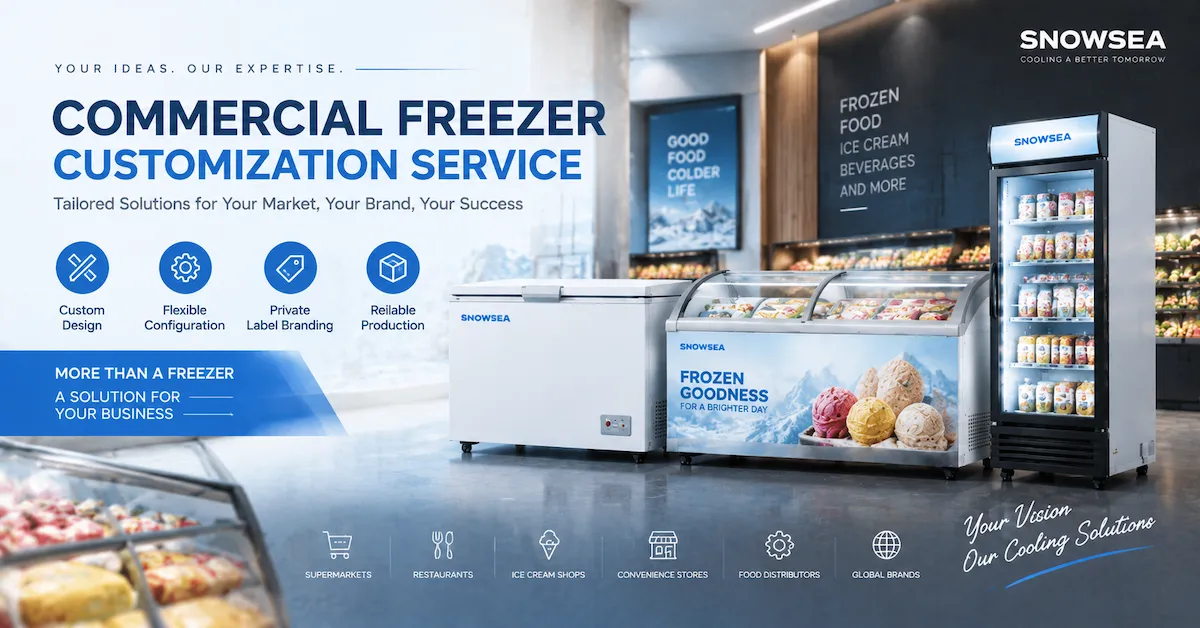
What Should an OEM Glass Door Freezer Supplier Actually Provide?
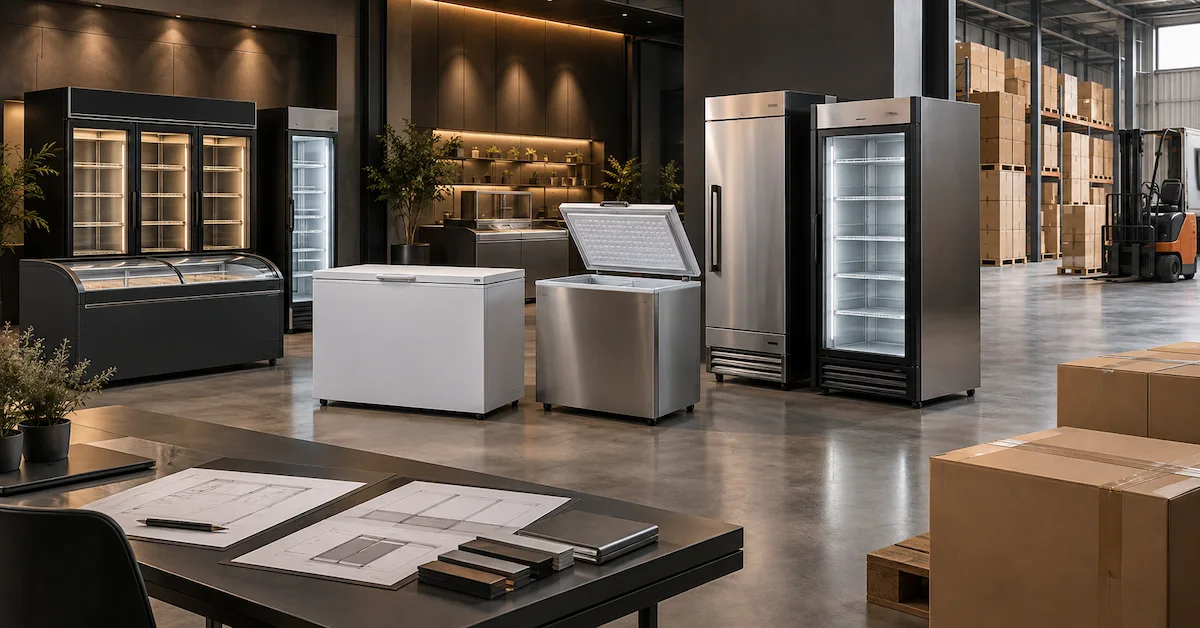
An OEM glass door freezer supplier should provide more than a freezer cabinet with transparent doors and a buyer’s logo. For a B2B project, the supplier needs to translate the buyer’s frozen-storage application, retail environment, merchandise dimensions, access frequency, destination market and branding requirements into one controlled production specification.
The glass door is part of the freezer’s thermal enclosure. Changing its size, construction, frame, gasket, opening method or anti-condensation strategy can influence heat gain, sealing, refrigeration load, temperature recovery, electrical demand, packaging and serviceability. This is why a serious OEM project should treat the door system as an engineering component rather than a cosmetic option.
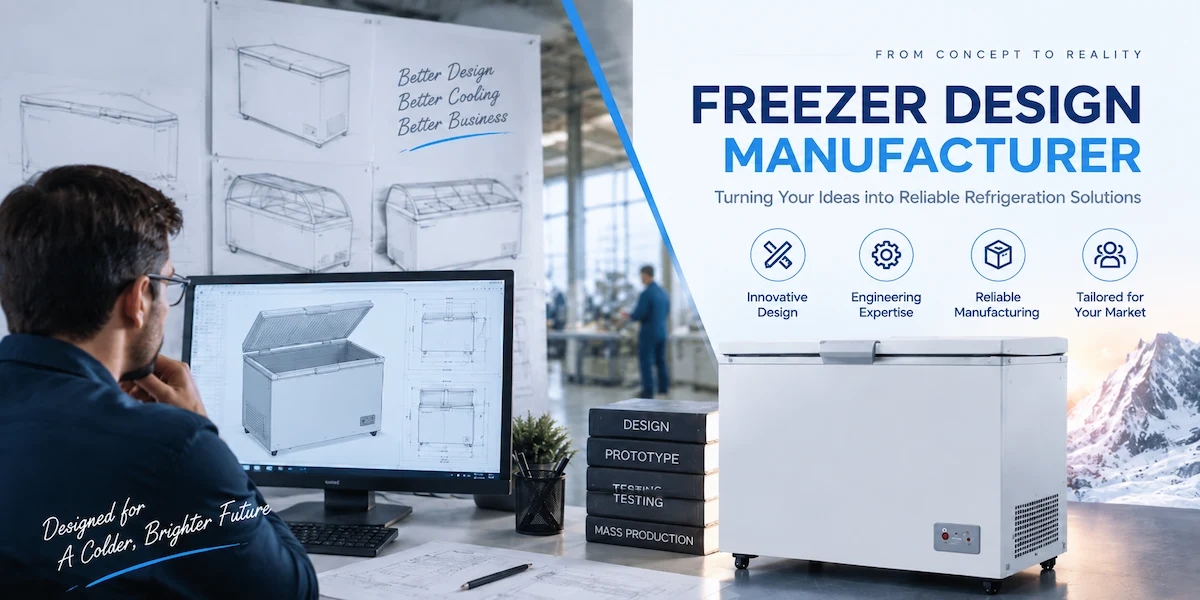
SNOWSEA currently supports OEM/ODM commercial refrigeration projects through an integrated process covering material processing, structural assembly, insulation, refrigeration-system installation, final assembly, performance testing, inspection, packing and shipment. Buyers can review the OEM/ODM manufacturing process before defining a custom glass-door project.
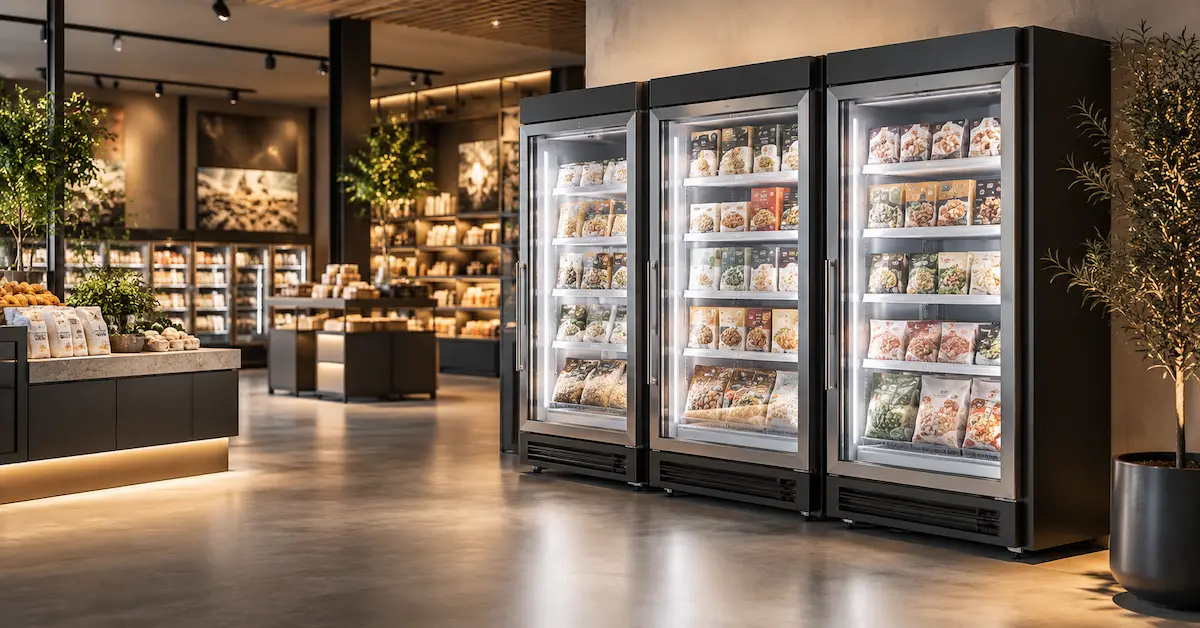
First Confirm Whether You Need a Freezer or a Chilled Showcase
One of the most important sourcing decisions happens before door design begins.
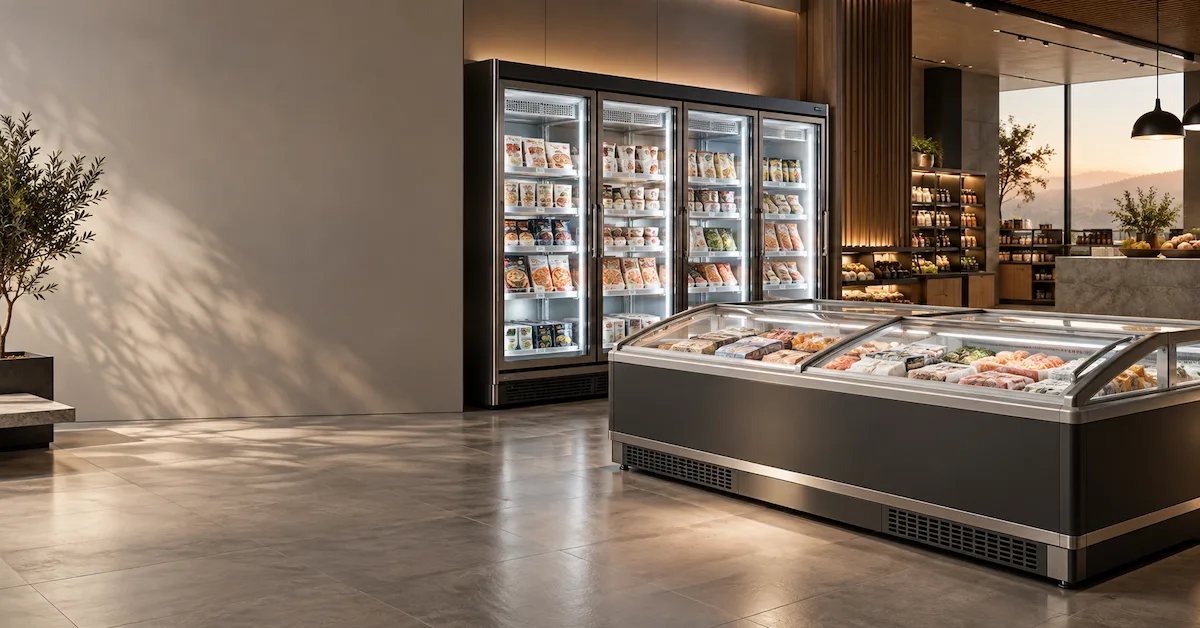
The phrase “glass door freezer” is often used loosely in international sourcing. An upright glass-door cabinet may visually resemble a freezer while actually being designed for chilled beverage or dairy display. SNOWSEA’s own content distinguishes frozen-display equipment from chilled showcase applications and warns buyers not to select equipment only by cabinet appearance.
| Purchasing Requirement | Frozen Glass-Door Application | Chilled Glass-Door Application |
|---|---|---|
| Typical merchandise | Frozen food, packaged frozen products | Beverages, dairy, chilled packaged food |
| Primary requirement | Maintain specified frozen condition | Maintain specified chilled condition |
| Main thermal concern | Heat gain and frozen-temperature recovery | Door-opening recovery and chilled uniformity |
| Display concern | Visibility without compromising frozen performance | Product facing, lighting and shelf access |
| Door-system priority | Insulation, sealing, condensation control | Visibility, access, airflow and sealing |
| Supplier discussion | Freezer performance evidence | Showcase/refrigerator performance evidence |
The RFQ should therefore begin with merchandise and required holding conditions, not with a photograph of the desired cabinet.
If the application is chilled merchandising, buyers should review SNOWSEA’s Showcase category. If the project involves frozen merchandising, the supplier should confirm a freezer platform and corresponding performance specification instead of assuming that a chilled glass-door product can simply be operated at freezer temperatures.
Who Should Work With an OEM Glass Door Freezer Supplier?
OEM cooperation is particularly relevant to refrigeration distributors building private-label catalogs, frozen-food brands deploying branded cabinets, supermarket equipment companies standardizing equipment across stores, importers developing regional freezer ranges and commercial refrigeration brands that need repeatable product specifications.
A distributor may need several capacities sharing the same appearance and service parts. A frozen-food brand may prioritize merchandise visibility and branded graphics. A supermarket project may focus on cabinet dimensions, customer access and equipment standardization. An importer may need market-specific voltage, plug, labels, manuals and export packaging.
These buyers share one requirement: the freezer must be reproducible after the first order.
That makes repeatability one of the most important criteria when selecting an OEM glass door freezer supplier.
Build the OEM Specification Before Comparing Prices
Price comparison is meaningful only when suppliers are quoting the same technical configuration.
A quotation stating “glass door freezer, 500L” does not define enough information for a purchasing decision.
| Specification Area | Buyer Should Define or Confirm |
|---|---|
| Application | Frozen merchandise and operating scenario |
| Merchandise | Package dimensions and loading method |
| Cabinet | Required dimensions and usable layout |
| Door structure | Hinged, sliding or other approved configuration |
| Glass | Approved construction for the selected design |
| Frame | Material and structural configuration |
| Gasket/sealing | Approved door-sealing arrangement |
| Refrigeration | Agreed system configuration |
| Defrost | Required strategy where applicable |
| Controller | Approved controller and settings where relevant |
| Electrical | Voltage, frequency and plug |
| Interior | Shelves, baskets and loading layout |
| Branding | Logo, graphics, model designation |
| Documents | Labels, manuals and required language |
| Packaging | Approved export protection |
| Testing | Agreed performance and inspection requirements |
The completed document should receive a revision number. The quotation, sample, purchase order and repeat order should all refer to the same approved specification.
Glass Door Design Must Balance Visibility and Thermal Performance
Retail buyers naturally want a larger transparent area because it improves product visibility. However, more glass also changes the thermal enclosure.
An experienced supplier should evaluate the door as part of the complete refrigeration system.
Important variables can include glass area, glass construction, frame design, sealing, gasket contact, thermal bridges, opening frequency and the strategy used to manage condensation.
SNOWSEA’s existing OEM freezer custom glass door guide also notes that glass-door changes can influence heat transfer, sealing, temperature recovery, refrigeration workload, packaging and cost.
The correct purchasing question is therefore not:
“Can you make the glass larger?”
It is:
“Can the proposed glass-door design provide the required visibility while maintaining the agreed freezer performance under our intended operating conditions?”
Choose Door Operation Around Real Store Behavior
Door operation affects both customer convenience and freezer performance.
An upright hinged glass door may suit front-facing retail access. A sliding glass structure may be appropriate for other cabinet formats. Top-opening sliding glass is common in some ice cream display applications, but it should not automatically be treated as equivalent to an upright glass-door freezer.
SNOWSEA’s custom freezer door type guide highlights that changing hinged, sliding, solid or glass-door configurations can affect cabinet dimensions, insulation, sealing, accessibility, temperature recovery, energy consumption and packaging.
Before choosing the door format, map the real operating routine: where the customer stands, which direction the door opens, how often staff replenish products, whether adjacent fixtures restrict movement and whether multiple customers need simultaneous access.
Anti-Condensation Requirements Should Be Defined by the Environment
A glass door that looks clear in a sample room may behave differently in a humid retail environment.
Condensation risk depends on several interacting conditions, including indoor temperature, humidity, glass temperature, door opening frequency, sealing and cabinet design.
Depending on the platform and engineering requirements, manufacturers may evaluate different approaches to condensation control. Buyers should not assume that one technology is automatically necessary or standard across every model.
Instead, state the operating environment and define the performance expectation.
For example:
Requirement: The glass should maintain commercially acceptable visibility under the agreed test conditions.
That is more useful than simply requesting “anti-fog glass,” because it allows engineering to evaluate the complete system rather than treating one component name as the solution.
Door Sealing Is a Performance Component, Not a Small Accessory
Door gaskets and frame alignment have direct influence on air infiltration.
A poor seal can increase heat entering the cabinet, cause excessive refrigeration workload and make temperature behavior less stable. It may also create condensation around the frame.
During sample inspection, evaluate whether the door closes consistently across the full perimeter and whether gasket contact remains uniform.
For mass production, the supplier should have an inspection method capable of identifying door alignment and sealing problems before packing.
This is one reason an OEM glass door freezer supplier should be evaluated on manufacturing consistency as well as product design.
Match the Refrigeration System to the Final Door Configuration
A major OEM mistake is modifying the glass area while assuming the original refrigeration configuration requires no review.
Door structure affects heat transfer. The refrigeration system therefore needs to be evaluated against the final cabinet rather than the original product alone.
The supplier may need to consider the interaction between:
- Compressor
- Condenser
- Evaporator
- Refrigerant circuit
- Airflow
- Fans where applicable
- Defrost strategy
- Controller
- Temperature sensors
- Final cabinet insulation
- Glass-door heat gain
Buyers do not need to prescribe every component themselves. They need to define the required operating result and ask the engineering team to demonstrate that the proposed configuration can achieve it.
Defrost Strategy Matters for Glass-Door Frozen Display
Frost management becomes particularly important when frozen equipment combines customer access, glass surfaces and repeated door openings.
The appropriate defrost strategy depends on freezer architecture and should be confirmed for the exact product configuration.
When comparing suppliers, ask how defrost affects temperature behavior, customer visibility, operating cycle and service requirements.
Do not select a freezer simply because the supplier uses the word “no-frost.” Understand how the complete system operates, what conditions were tested and whether the design matches your intended application.
SNOWSEA also offers No Frost Series products that buyers can review when determining whether a no-frost platform is relevant to their project.
Internal Layout Should Be Designed Around Actual Frozen Packages
Glass provides visibility, but the interior determines whether customers can actually see and access the merchandise.
Instead of evaluating only nominal cabinet capacity, give the supplier actual package dimensions.
A useful loading study should answer how many SKUs can be presented, how many front-facing packages remain visible, how much reserve stock fits behind them, whether staff can replenish efficiently and whether lower shelves remain accessible.
This transforms freezer selection from a liters comparison into a retail-space decision.
If the project is based on a frozen display format, buyers can also review SNOWSEA’s Ice Cream Freezer range for examples of display-oriented freezer platforms before requesting deeper customization.
Use an Existing Platform Before Redesigning the Entire Freezer
OEM customization does not require starting from zero.
Beginning with an established production platform can reduce engineering uncertainty, tooling requirements, supply-chain complexity and repeat-order risk.
The project team should identify which requirements are already satisfied by an existing platform and which remaining gaps require customization.
A useful hierarchy is:
Level 1 — Branding: logo, artwork, labels, manuals and carton.
Level 2 — Configuration: baskets, shelves, handles, locks, electrical version and other compatible options.
Level 3 — Engineering: glass structure, door dimensions, cabinet geometry, refrigeration architecture or controller behavior.
The deeper the change, the more carefully sample validation and production control should be managed.
Separate Private-Label Branding From Engineering Changes
Branding is commercially important, but it should not become mixed with technical approval.
A private-label glass door freezer may require cabinet graphics, brand logo, product model, rating label, manual, carton artwork and market-specific identification.
Approve these separately from refrigeration and door-system engineering.
This makes revisions easier to track.
For example, a logo update should not create uncertainty about whether the compressor, controller or glass system also changed.
SNOWSEA’s OEM/ODM service can serve as the internal starting point for discussing how branding and product configuration are handled within a broader manufacturing project.
Validate a Representative Sample Before Mass Production
The sample should represent the actual production configuration as closely as practical.
Do not approve an unbranded standard freezer when the mass-production version will use a substantially different door or technical setup.
A sample review should cover four areas:
Application fit: Load the actual frozen packages and assess visibility, customer access and replenishment.
Technical configuration: Confirm cabinet, glass door, frame, refrigeration system, controller, electrical version and agreed accessories.
Performance: Conduct the agreed temperature and operating evaluation under defined conditions.
Commercial finish: Confirm color, logo, graphics, model number, label, manual and packaging.
Record the sample revision and photograph important details so the production reference remains traceable.
Testing Must Represent the Final OEM Configuration
“Tested before shipment” is not a sufficient acceptance criterion for a customized project.
Define what is tested, under which conditions and against which acceptance criteria.
For a custom glass-door freezer, the test plan may need to consider cabinet temperature, stability, recovery after defined disturbances, door operation, sealing, condensation behavior and relevant electrical or functional checks.
The exact scope depends on the freezer design and target market.
If the glass area, refrigeration configuration or other important technical element changes after approval, ask whether the previous performance validation remains applicable.
This is especially important when developing a product that will be sold under your own brand because field performance becomes your distributor’s or customer’s experience of that brand.
Ask How the Approved Sample Becomes a Production Standard
Prototype approval and production transfer are different milestones.
The factory must convert the approved sample into controlled information that normal production staff can follow.
SNOWSEA states that its OEM/ODM manufacturing workflow covers structural assembly, foaming and insulation, refrigeration-system installation, assembly, performance testing, final inspection, packing and shipment. For a custom project, the buyer should determine where its unique door, controller, electrical version, artwork and packaging requirements enter that process.
Ask the supplier:
How is our approved glass-door configuration identified during normal production?
A clear answer should involve controlled specifications, work instructions, model identification and inspection criteria rather than informal memory.
MOQ Should Be Evaluated at SKU and Component Level
A buyer may order 300 units in total but split them between three capacities, two electrical versions and several branded cartons.
The project is therefore not necessarily one 300-unit production configuration.
Ask what creates the MOQ for each variation.
Custom glass, cabinet color, electrical components, printed packaging or unique accessories may have different purchasing constraints.
The objective is not always to negotiate every MOQ downward. Sometimes the better strategy is to standardize low-value features so the supplier can use stable materials across several models.
Lead Time Should Be Split Into Development and Production
OEM lead time should not be represented by one number before the project scope is defined.
A glass-door freezer project may involve requirement confirmation, engineering review, component preparation, sample production, sample testing, buyer approval, artwork confirmation, material purchasing, production, inspection and packing.
A branding-only project and a structural door redesign should not be expected to follow the same schedule.
Ask the supplier to separate:
Development time → sample approval → material preparation → production → inspection → shipment readiness
This makes project delays easier to identify and manage.
Export Packaging Is Especially Important for Glass-Door Equipment
Glass surfaces increase shipping risk.
Export packaging should protect the glass, frame, hinges or sliding system, handles, cabinet corners and base structure against handling and container transport.
Packaging approval should also verify how accessories are secured inside the cabinet.
If the buyer requests custom cartons, display graphics or additional protective materials, final packed dimensions should be confirmed before calculating loading quantities.
SNOWSEA’s OEM manufacturing workflow includes final inspection and packing before storage and shipment, but the exact packaging standard should still be agreed for the selected OEM model.
Plan Spare Glass and Door Parts Before the First Shipment
The door system is one of the most visible and service-sensitive areas of the freezer.
Before production, ask which components can be supplied as spare parts and how they will be identified.
Depending on the design, this may include glass assemblies, gaskets, handles, hinges, door frames, sensors, controllers or other model-specific parts.
The private-label model number should remain linked to the factory model and production revision.
If a distributor contacts the manufacturer three years later, both sides should be able to identify the correct replacement part without comparing photographs through email.
Control Engineering Changes on Repeat Orders
A repeat order should not quietly become a different product.
Require notification before relevant changes to glass construction, door hardware, controller, refrigeration components, electrical parts, insulation, packaging or other controlled specifications.
A simple repeat-order clause can state:
Manufacture according to the approved specification revision. Any proposed technical, component, artwork or packaging change must be disclosed before implementation.
This protects product consistency and makes after-sales support easier.
How Should Buyers Compare OEM Glass Door Freezer Suppliers?
| Supplier Capability | What Buyers Should Verify |
|---|---|
| Application understanding | Frozen requirement defined before cabinet selection |
| Glass-door engineering | Door treated as part of thermal enclosure |
| Refrigeration matching | System reviewed against final cabinet |
| Condensation strategy | Evaluated for intended environment |
| Door sealing | Repeatable alignment and gasket control |
| Interior layout | Tested with actual merchandise |
| OEM capability | Branding separated from technical changes |
| Sample control | Approved revision traceable |
| Testing | Final configuration evaluated |
| Manufacturing | Sample transferable to normal production |
| Packaging | Glass protected for export |
| Spare parts | Door-related service parts identifiable |
| Change control | Repeat orders protected from silent substitutions |
A suitable OEM glass door freezer supplier should be able to explain each of these areas with project-specific information rather than generic factory claims.
Compare Total Program Cost, Not Only Freezer Price
The lowest quoted freezer may not create the lowest total cost.
OEM glass-door projects can introduce additional expenses from glass customization, tooling, sample development, testing, private-label graphics, packaging, spare parts, inspection, shipping and after-sales stock.
The buyer should separate one-time development costs from recurring unit costs.
Then evaluate whether each customization creates measurable commercial value.
A custom handle that adds little value but requires a separate MOQ may be unnecessary. A glass-door configuration that significantly improves product access in the buyer’s target store may justify additional development.
Commercial logic should determine where customization effort is spent.
What Should You Send an OEM Glass Door Freezer Supplier for an RFQ?
A useful RFQ should include the destination country, intended frozen merchandise, package dimensions, required loading quantity, required temperature condition, store environment, installation space, preferred cabinet style, glass-door concept, opening frequency, electrical version, branding requirements, first order quantity, annual forecast and expected launch date.
If you already use another freezer, include photographs and explain what needs to improve. A supplier can provide a much more useful proposal when it understands why the current product is inadequate.
Buyers can first review SNOWSEA’s commercial refrigeration products, OEM/ODM capabilities and existing glass door freezer purchasing guidance, then send a model-specific inquiry through Contact Us.
Frequently Asked Questions
1. What is an OEM glass door freezer supplier?
An OEM glass door freezer supplier manufactures freezer equipment according to an agreed buyer specification and may support private-label branding, market-specific electrical configurations, door-system customization, packaging and technically feasible engineering changes.
2. Is every upright glass-door cabinet a freezer?
No. Some upright glass-door products are chilled showcases or beverage coolers rather than frozen-storage equipment. Confirm the merchandise and required temperature before selecting the cabinet.
3. Can the glass door size be customized?
Potentially, depending on the base freezer and engineering feasibility. Changing glass dimensions can affect heat gain, sealing, structure, refrigeration load and packaging, so the complete system should be reviewed.
4. Can an OEM supplier provide anti-condensation glass?
Anti-condensation requirements can be evaluated as part of the glass-door system, but the appropriate approach depends on model design and operating conditions. Define the expected temperature and humidity environment first.
5. Should I customize an existing freezer or develop a new model?
Start with an existing platform when it already meets most application requirements. Deeper development is more appropriate when the existing product cannot solve a measurable market, loading, dimensional or performance problem.
6. How should I test an OEM glass door freezer sample?
Test the approved configuration against its intended use, including actual loading, door operation, temperature requirements, sealing, visibility and any agreed environmental or performance conditions.
7. What affects OEM glass door freezer MOQ?
MOQ can be influenced by cabinet model, glass configuration, electrical version, color, branded artwork, cartons and custom components. Ask which specific item is creating the minimum quantity.
8. What should be checked before mass production?
Confirm the specification revision, approved sample, glass-door structure, refrigeration configuration, electrical version, branding, packaging, QC requirements, spare-parts arrangement and production identification.
9. How can importers reduce repeat-order risk?
Reference the approved specification on every purchase order and require the supplier to disclose proposed technical or component changes before production.
10. How can I request an OEM glass door freezer proposal from SNOWSEA?
Prepare your frozen-product application, package and loading data, target temperature, installation dimensions, market, electrical requirements, preferred glass-door configuration, branding scope and expected quantities, then send the project through SNOWSEA Contact Us for evaluation.
Conclusion
Choosing an OEM glass door freezer supplier is not simply a decision about transparent doors, cabinet appearance or factory price. The buyer first needs to confirm that the equipment is genuinely designed for the required frozen application, then control the interaction between glass construction, door sealing, refrigeration capacity, temperature behavior, merchandise layout, electrical configuration and private-label requirements. A strong OEM program starts from a defined application, uses an existing production platform where practical, validates the final configuration through a representative sample and converts that approved sample into a controlled mass-production specification. MOQ, lead time, export packaging, spare parts and engineering change control should also be addressed before bulk ordering. SNOWSEA provides commercial refrigeration products and an integrated OEM/ODM manufacturing process for distributors, brands and project buyers. If you are developing a private-label glass-door freezer range, submit your merchandise information, temperature requirement, cabinet dimensions, glass-door concept, destination market and forecast volume through SNOWSEA Contact Us so the appropriate platform, customization scope, sample plan and production requirements can be evaluated before mass production.