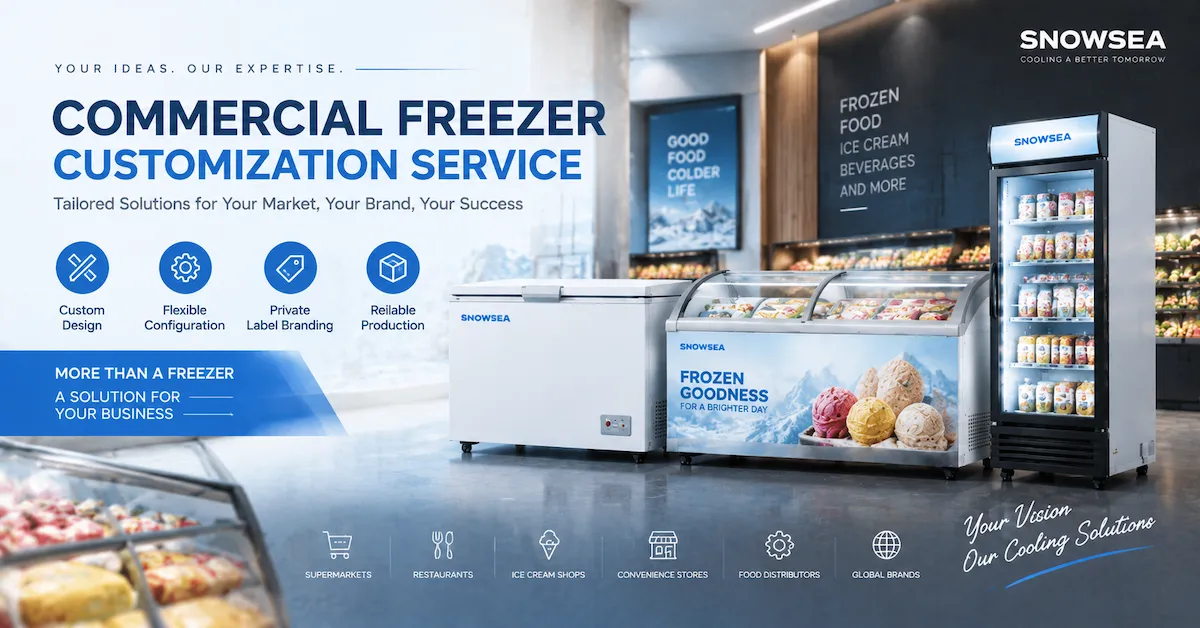
What Should an OEM Display Freezer Manufacturer Actually Deliver?
An OEM display freezer manufacturer should deliver more than a standard cabinet carrying a buyer’s logo. For a distributor, supermarket group, beverage brand or frozen-food company, a successful OEM project must result in a clearly defined display cabinet that performs the required refrigeration task, presents merchandise effectively, fits the retail environment and can be reproduced under the same specification on future orders.
The first decision is not branding. It is application.
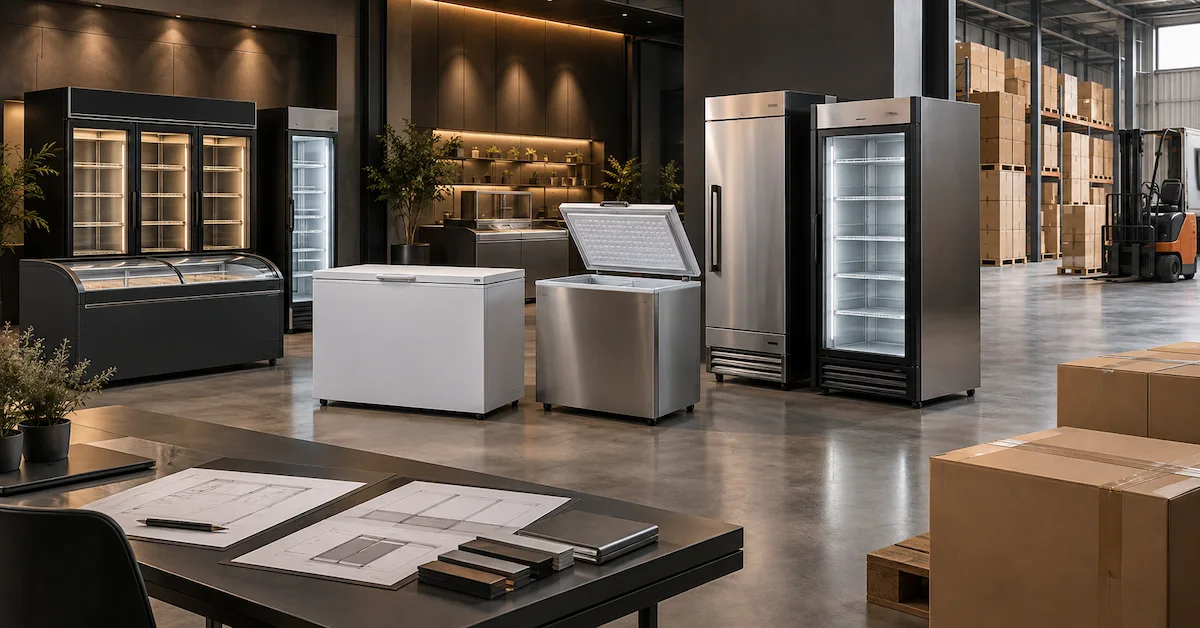
“Display freezer” is often used broadly in purchasing conversations, yet retail display equipment can serve very different temperature requirements. A glass-top cabinet for packaged ice cream is different from an upright glass-door showcase used for chilled beverages. SNOWSEA separates its range into Ice Cream Freezer and Showcase platforms, giving OEM buyers different starting points for frozen and chilled merchandising.
The OEM process should therefore begin by defining what will be displayed, what temperature condition is required, how customers access the merchandise and how the equipment will be installed.
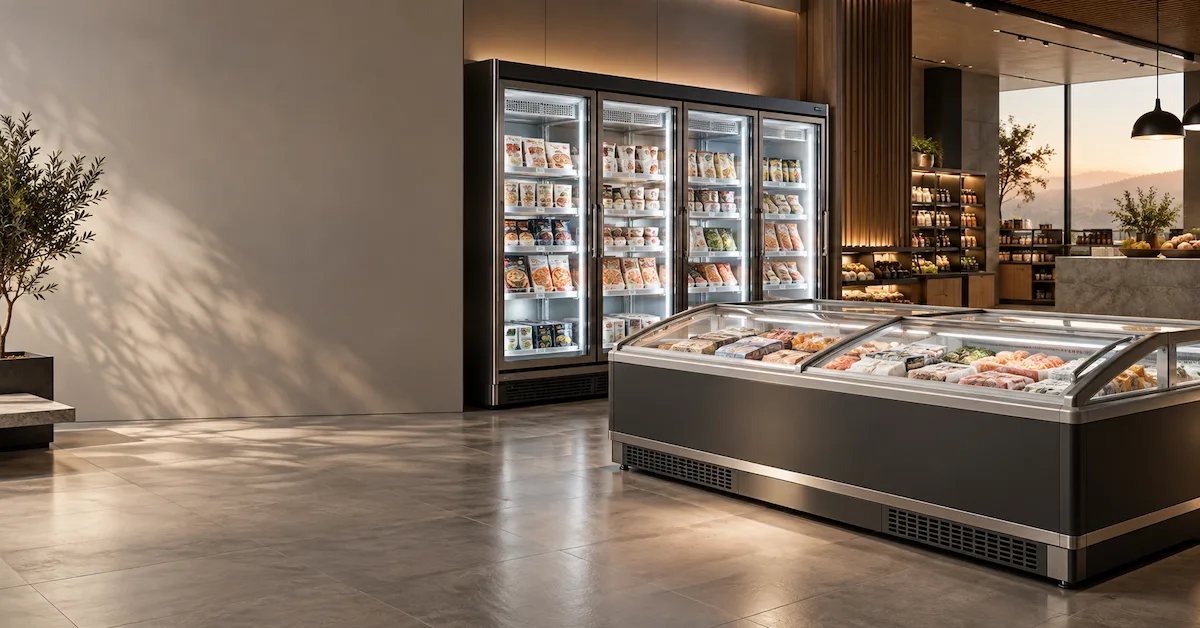
Start by Separating Frozen Display From Chilled Display
A transparent door does not tell you what the cabinet is designed to store.
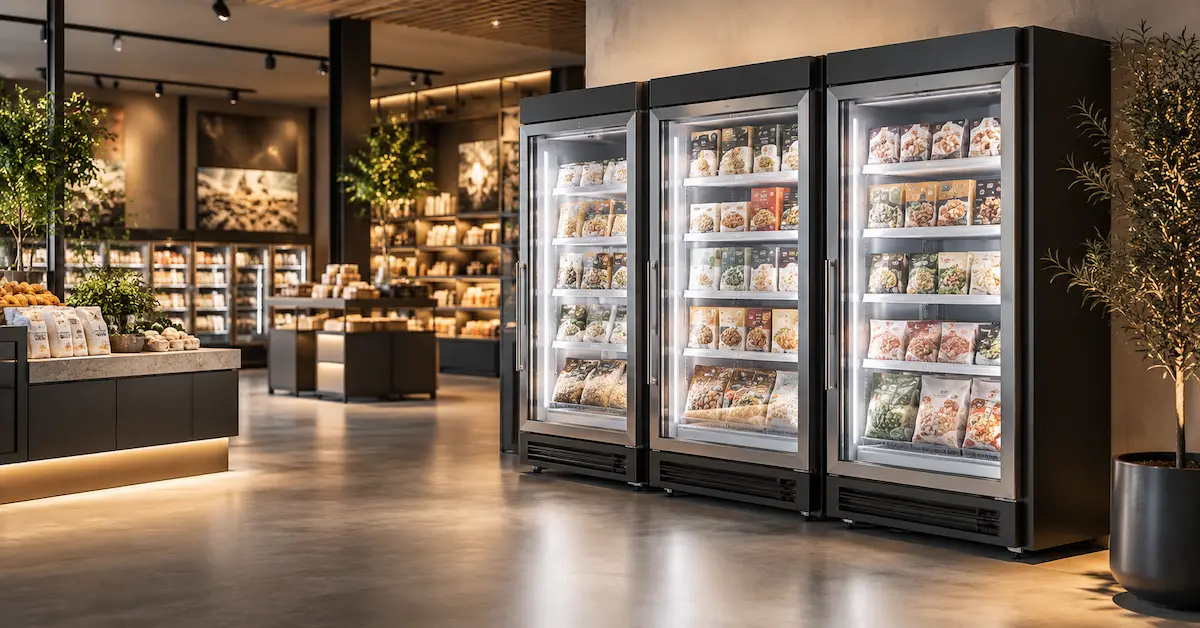
For packaged ice cream and other specified frozen merchandise, buyers may begin with an ice cream freezer platform. For bottled drinks and other chilled packaged products, a showcase refrigerator platform may be more appropriate.
| Purchasing Question | Frozen Display | Chilled Display |
|---|---|---|
| Typical merchandise | Packaged ice cream, selected frozen products | Beverages and chilled packaged foods |
| Typical cabinet | Glass-top freezer | Upright glass-door showcase |
| Customer access | Access from above | Front-door access |
| Main display concern | Product visibility through glass and basket layout | Shelf facing, lighting and door visibility |
| Main operational concern | Frozen holding and access frequency | Door openings and temperature recovery |
| OEM focus | Glass, baskets, graphics, cabinet configuration | Shelves, doors, lighting, graphics, cabinet configuration |
This distinction should be written into the RFQ. If the request simply says “OEM display freezer,” suppliers may quote products that look similar but serve different operating conditions.
SNOWSEA’s recent display freezer selection guide makes the same distinction between frozen ice cream display and chilled showcase applications.
Who Needs an OEM Display Freezer Manufacturer?
OEM cooperation makes the most commercial sense when the buyer intends to build a repeatable retail equipment program rather than buy a few generic cabinets.
Typical projects include refrigeration distributors developing their own branded catalog, frozen-food brands placing display freezers in dealer stores, ice cream companies standardizing retail cabinets, supermarket groups rolling equipment across several locations and beverage suppliers developing branded refrigerated showcases.
The procurement objective varies by buyer. A distributor may prioritize a manageable model range and replacement parts. A retail chain may care more about standard dimensions and consistent visual appearance. A frozen-food brand may focus on graphics, product visibility and access. A private-label importer may need all of these plus packaging, manuals and destination-market electrical configurations.
That is why the OEM specification should describe the buyer’s business model—not only the freezer itself.
Build the OEM Range Around Merchandise, Not Catalog Size
A common mistake is choosing several attractive display cabinets first and deciding what to sell in them later.
Instead, assign every model a commercial role.
For example, one model might handle compact packaged-ice-cream merchandising near a checkout area. Another may provide larger frozen-product display in a supermarket aisle. An upright showcase may serve chilled beverages in convenience retail.
SNOWSEA’s broader commercial refrigeration product range includes freezer, ice cream freezer, refrigerator and showcase categories, but an OEM buyer does not necessarily need every category.
A smaller range with clearly differentiated use cases can be easier to quote, stock, sell, service and reorder than a large range of overlapping capacities.
Use Existing Platforms Before Creating Unnecessary New Designs
OEM does not automatically mean designing a completely new cabinet.
A more controlled process is to begin with the closest production platform and identify only the changes that have real commercial value.
For frozen merchandising, buyers can evaluate products such as the SD/SC-268PM ice cream freezer or other models in SNOWSEA’s ice cream freezer category. For chilled merchandising, products such as the LC-208 showcase, LC-650 showcase or LC-380DD double-door beverage cooler can provide starting references for a model-specific evaluation.
The engineering question should be:
What prevents the existing platform from meeting the intended market requirement?
If the answer is only cabinet branding, there may be little reason to modify the refrigeration structure. If the problem involves package fit, store dimensions, display access or another functional requirement, deeper customization can then be evaluated.
Separate OEM Branding From Technical Customization
Not all customization creates the same risk.
Brand and Commercial Customization
Logo placement, cabinet graphics, model designation, rating labels, manuals and cartons are primarily commercial-control items. They still require artwork approval, revision control and production checks, but they may not require major refrigeration engineering changes.
Configuration Customization
Shelf arrangement, basket layout, casters, locks, handles, lighting or other model-dependent options may influence usability and should be confirmed against the selected platform.
Engineering Customization
Cabinet dimensions, glass structure, insulation geometry, refrigeration configuration, controller logic and other technical changes can affect thermal performance, production processes, packaging and documentation.
An experienced OEM display freezer manufacturer should make this distinction clear before quoting so the buyer understands which changes are low-risk options and which changes may require engineering or additional validation.
Make Product Visibility a Measurable OEM Requirement
Display refrigeration serves both a temperature-control function and a merchandising function.
Poor visibility can come from unsuitable glass geometry, shelf arrangement, basket position, lighting, product placement or condensation. SNOWSEA’s existing content on display freezer visibility design discusses visibility as a core retail consideration rather than simply an appearance feature.
For OEM projects, do not specify “good visibility.”
Specify what needs to be visible.
A buyer can provide the actual product package dimensions, number of SKUs, desired facing quantity and typical replenishment arrangement. The manufacturer can then evaluate the cabinet using real merchandise rather than empty-volume calculations.
Use Actual Product Packages to Validate Internal Layout
Nominal liters are useful for broad comparison, but they do not tell a retailer how many products can be displayed effectively.
Consider two cabinets with similar published capacities. One may accommodate the intended ice cream tubs efficiently, while another may leave unusable spaces because basket dimensions do not match the packages.
Before sample approval, create a basic loading plan.
| Loading Item | OEM Buyer Should Confirm |
|---|---|
| Package dimensions | Length × width × height |
| Number of SKUs | Actual selling assortment |
| Desired facing | Products visible to shoppers |
| Reserve stock | Quantity behind/below display |
| Replenishment access | How staff reload products |
| Customer access | Reach and opening behavior |
| Basket/shelf layout | Actual usable arrangement |
SNOWSEA’s ice cream display freezer customization guide also treats internal layout, glass design and branding as connected retail-development decisions.
Glass Design Should Be Evaluated as Part of the Complete Cabinet
Glass is visually important, but it is also part of the cabinet’s thermal and mechanical structure.
Depending on the display format, buyers may need to evaluate sliding movement, seals, frame structure, opening access, condensation behavior and transport protection.
A curved-glass cabinet can create a different visual impression from flat sliding glass, but appearance alone should not determine selection.
For retail buyers, the more useful questions are:
Does the customer see the merchandise clearly? Can staff replenish it efficiently? Is access practical? Can the glass system be protected during export? Does the approved design remain suitable under the intended operating conditions?
The answers should come from the complete cabinet configuration rather than one component viewed in isolation.
Lighting Should Improve Merchandising Without Creating Unnecessary Complexity
For upright display equipment, internal illumination can improve front-facing visibility and brand presentation.
OEM buyers should define where lighting adds value instead of simply requesting more LEDs.
Consider merchandise visibility, shelf arrangement, door configuration, power consumption, serviceability and replacement access. Lighting components that are difficult to replace may increase long-term service cost even if they look attractive on the sample.
The OEM specification should identify the approved lighting configuration so production units do not differ from the sales sample.
Control the Refrigeration Specification Behind the Branded Exterior
Two cabinets can carry identical graphics while using different internal configurations.
That is why OEM approval should document the refrigeration-related specification, not just appearance.
A controlled technical file can include:
| Area | OEM Specification Should Identify |
|---|---|
| Base model | Factory reference |
| Buyer model | Private-label model number |
| Application | Frozen or chilled merchandise |
| Cabinet | Approved dimensions/configuration |
| Glass/door | Approved structure |
| Insulation | Approved configuration |
| Refrigeration | Approved system configuration |
| Controller | Approved model/settings where applicable |
| Electrical | Voltage/frequency/plug |
| Lighting | Approved configuration |
| Interior | Shelves/baskets |
| Accessories | Approved included items |
| Branding | Artwork revision |
| Packaging | Approved carton/protection |
| Testing | Agreed acceptance requirements |
Without this document, the OEM project can become a visual branding exercise rather than a controlled manufacturing program.
Define Electrical Versions by Destination Market
If an OEM range will be sold across different countries, do not treat voltage and plug changes as an administrative detail at the end of production.
Electrical version should be part of the SKU definition from the beginning.
A buyer may eventually have the same commercial model name in different market versions. Those variants should remain identifiable in the purchase order, production specification, carton and service documentation.
This prevents warehouse or dealer teams from receiving visually identical cabinets with different electrical requirements.
Model-Specific Compliance Must Be Checked Before Mass Production
Compliance should be reviewed against the actual model, destination and OEM modification.
Do not assume that a document associated with one product automatically applies to every branded or customized version. Changes to controlled components or structure may need review.
The safer procurement sequence is:
Destination market → proposed model → proposed OEM changes → applicable documentation → confirmation → production artwork.
That review should happen before rating labels and manuals are finalized.
How Should Buyers Evaluate Display Freezer Testing?
Testing should correspond to the intended retail use rather than relying on a generic statement such as “100% tested.”
For a frozen display product, the buyer may need evidence related to the required storage condition under the agreed load and environment. For an upright chilled display cabinet, door-opening behavior and temperature recovery may be relevant.
The acceptance plan can define the selected model, measurement method, ambient condition, product/load condition, test duration and acceptance criteria.
A test result only proves the configuration and conditions that were actually evaluated. If a significant OEM modification is introduced after sample validation, ask whether additional verification is needed.
Sample Approval Should Cover More Than Appearance
An OEM sample is the physical reference for the production order.
Review it in several dimensions.
First, verify application fit: load the real packages, check visibility and confirm customer access.
Second, verify technical configuration: cabinet, electrical version, controller, shelves or baskets, glass and agreed accessories.
Third, verify branding: logo, model designation, graphics, labels, manual and carton.
Fourth, verify packaging if the sample will represent the export-production configuration.
The approval record should state the sample revision rather than simply saying “approved.”
SNOWSEA’s OEM/ODM service positions customization and manufacturing as a connected process covering cabinet preparation, insulation, refrigeration installation, assembly, testing and final packing.
Why Production Transfer Matters After Sample Approval
A perfect sample does not automatically guarantee a perfect production run.
The OEM manufacturer must convert the approved sample into repeatable factory instructions.
That transfer should cover the production specification, artwork, model identification, controlled components, assembly requirements, testing criteria and packaging instructions.
The useful question is not:
“Can you make this sample?”
It is:
“How will normal production reproduce this exact approved configuration?”
This is particularly important for buyers ordering the same branded model over several years.
Plan MOQ Around the Exact OEM Configuration
MOQ should be discussed at SKU level.
A buyer may want one cabinet platform in two colors, three electrical versions and several private-label cartons. The total quantity can be large while each actual manufacturing configuration remains relatively small.
Ask which element creates the MOQ:
- Base cabinet
- Electrical configuration
- Glass or door option
- Custom color
- Printed graphics
- Private-label carton
- Custom component
Where a low-value customization creates a high purchasing minimum, retaining a standard part may improve commercial flexibility.
Lead Time Should Be Broken Into Project Stages
A single headline lead time can be misleading for an OEM project.
A more useful schedule separates requirement confirmation, sample preparation, sample approval, artwork approval, material preparation, production, testing, inspection, packing and shipment.
Deep technical customization can require more development work than a branding-only program. The supplier should therefore confirm timing only after the OEM scope is clear.
For buyers rolling equipment into supermarket networks, SNOWSEA’s existing OEM display freezer sourcing guide for supermarket chains provides additional context on standardization across multi-store programs.
Export Packaging Should Be Included in OEM Development
Retail display cabinets frequently contain glass doors, lids, frames, lighting or other visible elements that require careful shipping protection.
Packaging should therefore be approved as part of the product—not added after production.
The buyer should confirm protection for glass, cabinet corners, control areas, handles, base structure and accessories. Carton identification should make it possible to distinguish models and electrical versions in the destination warehouse.
If custom graphics or cartons alter packed dimensions, use the final packaging data when preparing container-loading plans.
Compare OEM Display Freezer Manufacturers on Repeatability
Unit price matters, but price alone does not show whether the supplier can support a private-label program.
| Evaluation Area | What the Buyer Should Verify |
|---|---|
| Product range | Suitable frozen/chilled base platforms |
| Application support | Correct cabinet for actual merchandise |
| OEM scope | Clear distinction between branding and engineering |
| Sample control | Traceable approved configuration |
| Manufacturing | Ability to reproduce the sample |
| Quality control | Defined model-specific checks |
| Packaging | Export-ready protection |
| Documentation | Model/destination-specific review |
| MOQ | Configuration-level explanation |
| Spare parts | Identification and supply approach |
| Change control | Approval before substitutions |
| Repeat orders | Same product definition over time |
This is a more useful comparison than simply ranking factories by price or catalog size.
Calculate the Cost of the OEM Program, Not Only the Unit Price
An OEM display freezer project can include sample costs, engineering changes, custom graphics, packaging, inspection, logistics, spare parts and local after-sales responsibilities.
A low quotation may not create the lowest total purchasing cost if the model is difficult to service or requires separate low-volume custom components.
Buyers should distinguish one-time development expenses from recurring unit expenses.
Then ask a more useful commercial question:
Does this customization create enough market value to justify the additional supply-chain complexity?
Plan Spare Parts Before the First Shipment
Retail equipment remains in service long after the first container arrives.
The importer should therefore know how replacement items are identified and ordered.
Model-specific service planning can cover controllers, lights, shelves, baskets, glass-related components, gaskets, handles and other replaceable items depending on the product.
The private-label model number should always remain connected to the factory model and approved production revision.
Otherwise, a service request several years later may become difficult to match to the correct component.
Use Change Control for Every Repeat Order
Once a model succeeds, consistency becomes more valuable than novelty.
Future purchase orders should reference the approved specification and require the manufacturer to disclose relevant changes before implementation.
This matters when a supplier proposes a component substitution, controller update, material adjustment, packaging change or other production modification.
A controlled OEM range should evolve through documented decisions—not unnoticed substitutions.
What Should You Send an OEM Display Freezer Manufacturer for a Quote?
For a useful OEM quotation, provide the destination market, buyer type, merchandise, frozen or chilled requirement, package dimensions, required loading, installation limits, preferred cabinet format, electrical configuration, operating environment, branding needs, expected customization, sample quantity, first order quantity and annual forecast.
If a reference product already exists, include photographs, measurements or the current model and explain what problem the new product must solve.
For chilled retail display projects, buyers can also review SNOWSEA’s refrigeration showcase OEM solution. For frozen merchandising, review the ice cream freezer range.
When the requirement is ready, submit it through SNOWSEA Contact Us for a model-specific evaluation rather than requesting only a generic OEM price.
Frequently Asked Questions
1. What does an OEM display freezer manufacturer do?
An OEM manufacturer produces display refrigeration equipment according to an agreed product configuration and commercial program. Depending on the project, this may include base-model selection, branding, electrical adaptation, accessories, packaging and technically feasible product modifications.
2. Is a display freezer always used for frozen products?
No. The term “display” describes merchandising rather than one temperature class. Glass-top ice cream freezers can serve frozen display applications, while upright showcases can be used for chilled merchandising. Confirm the merchandise and required temperature first.
3. What can be customized on an OEM display freezer?
Customization can involve branding, graphics, labels, packaging, electrical versions, interior arrangements and model-dependent hardware. Deeper changes to cabinet structure, glass, refrigeration or controls require technical evaluation.
4. Should buyers choose a standard platform or develop a new cabinet?
Use an existing platform when it already meets most of the application requirements. A new or heavily modified design is more appropriate when a measurable market or operating requirement cannot be solved by the existing cabinet.
5. How should an OEM display freezer sample be approved?
Check real product loading, visibility, access, refrigeration requirements, electrical configuration, accessories, branding, labels and packaging against the agreed specification. Record the approved revision.
6. What affects OEM display freezer MOQ?
MOQ may be influenced by the base cabinet, electrical version, graphics, color, carton, glass configuration or special components. Ask which individual requirement creates the minimum.
7. What should distributors check before bulk production?
Confirm the controlled product specification, approved sample, electrical version, artwork, packaging, test requirements, production identification, spare-parts arrangement and change-control procedure.
8. Can one OEM manufacturer supply both frozen and chilled display equipment?
SNOWSEA currently offers separate ice cream freezer and showcase categories and supports OEM/ODM refrigeration projects. Buyers should still evaluate each model according to its actual temperature application rather than treating the categories as technically interchangeable.
9. How should buyers compare OEM display freezer prices?
First align the technical and commercial specifications. Then compare the base cabinet, customization, sample or engineering costs, packaging, inspection, spare parts, logistics responsibilities and repeat-order requirements.
10. How can I request an OEM display freezer proposal from SNOWSEA?
Prepare the target market, merchandise, temperature application, dimensions, package/loading data, electrical requirements, branding scope and expected order quantity, then send them through SNOWSEA Contact Us for model-specific evaluation.
Conclusion
Choosing an OEM display freezer manufacturer should begin with the merchandise and retail application, not the logo, glass shape or catalog price. Decide first whether the project requires frozen display or chilled merchandising, then select the closest proven platform and define product loading, cabinet configuration, glass or door structure, electrical version, branding, testing and export packaging in one controlled specification. For distributors and private-label brands, the strongest OEM program is one that can be sampled, verified, produced, serviced and reordered without redefining the product each time.SNOWSEA provides ice cream freezer and showcase platforms together with OEM/ODM manufacturing support for B2B refrigeration projects. If you are developing a branded display freezer range, supermarket program or retail refrigeration project, send your merchandise information, application, target market, OEM scope and expected quantities through SNOWSEA Contact Us so the appropriate platform, customization scope, sample plan and production requirements can be evaluated before bulk ordering.