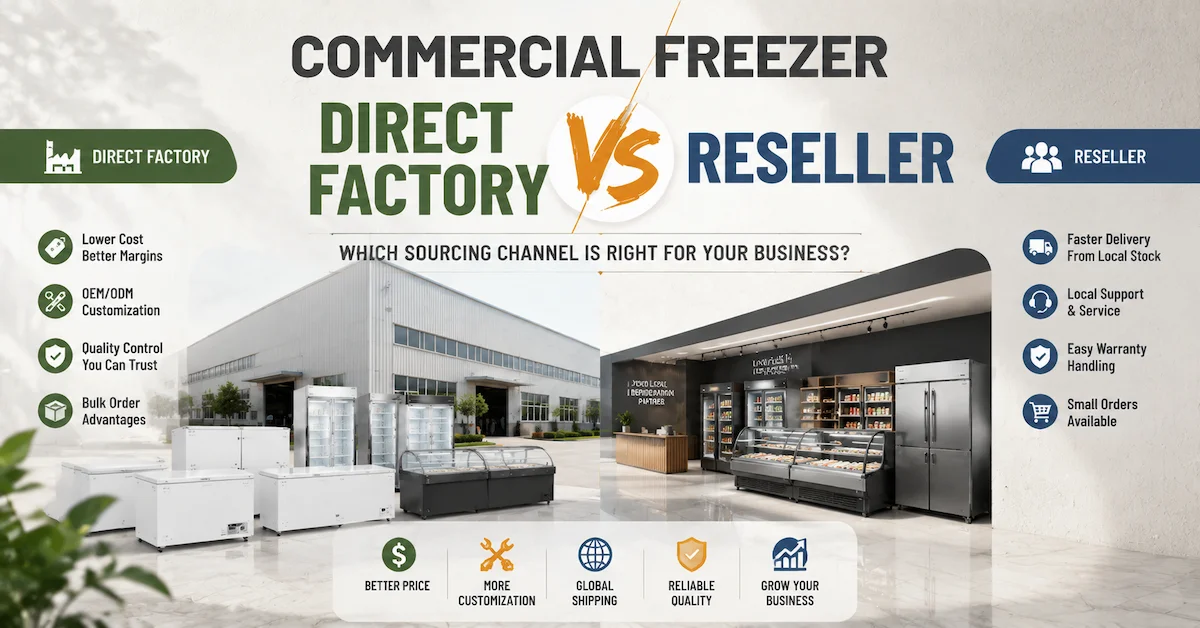
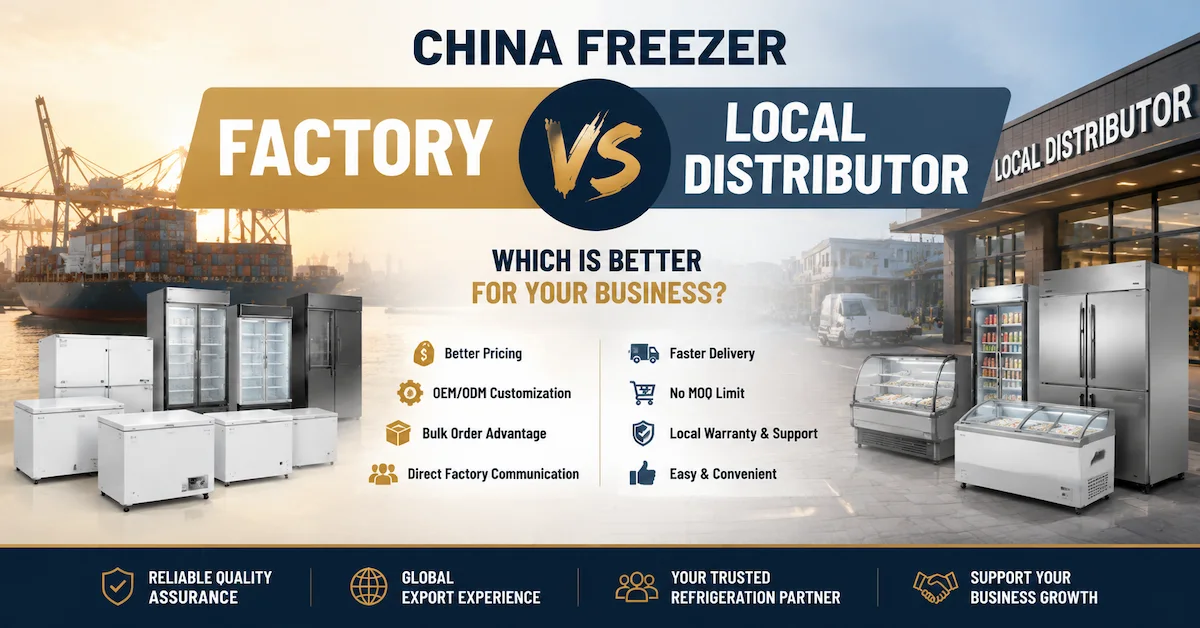
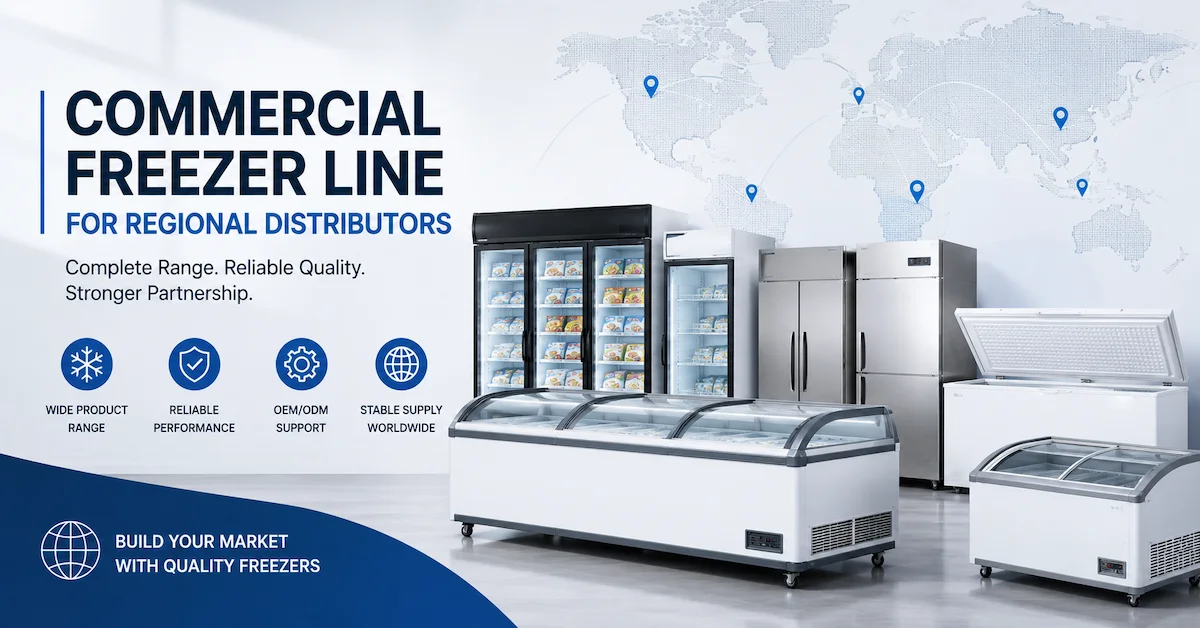
For refrigeration wholesalers, importers, supermarket equipment suppliers, and regional distributors, developing a reliable commercial freezer line for regional distributors is an important step toward serving more customers and building sustainable sales growth.
Regional distributors often supply equipment to different customer groups, including supermarkets, convenience stores, frozen food retailers, restaurants, hotels, seafood businesses, and local equipment dealers. Each customer has different requirements for freezer size, capacity, display design, temperature range, energy use, and price positioning.
A successful freezer line should therefore include more than one popular model. It should offer a balanced mix of storage freezers, display freezers, compact models, high-capacity cabinets, and customizable products.
Poor product-line planning can create problems such as:
- Too many similar models
- Limited coverage of customer applications
- Excess inventory
- Frequent stock shortages
- Difficulty competing in different market segments
- High after-sales pressure
Snowsea provides commercial refrigeration products including upright freezers, chest freezers, island freezers, display freezers, sliding glass freezers, ice cream freezers, refrigerators, beverage coolers, and showcase cabinets. Snowsea also supports OEM/ODM customization, private label development, quality inspection, export packaging, and bulk production for regional distributors.
Why Regional Distributors Need a Complete Commercial Freezer Line
Regional distributors rarely serve only one type of customer. A distributor may supply compact freezers to convenience stores, large island freezers to supermarkets, chest freezers to seafood retailers, and upright storage models to restaurants.
A complete freezer line helps distributors:
- Serve multiple industries
- Increase average order value
- Reduce dependence on one customer segment
- Support project-based sales
- Build stronger dealer networks
- Improve repeat purchasing
It also makes the distributor more valuable to local customers. Instead of purchasing different freezer types from several suppliers, customers can source a broader refrigeration solution from one regional partner.
Step 1: Identify the Main Customer Groups
Before selecting products, distributors should clearly define their target customers.
| Customer Group | Common Freezer Requirements |
|---|---|
| Supermarkets | Island freezers, upright display freezers, multi-door cabinets |
| Convenience stores | Compact upright freezers, sliding glass freezers |
| Frozen food shops | Display freezers, chest freezers, upright cabinets |
| Restaurants and hotels | Upright storage freezers, chest freezers |
| Seafood retailers | Chest freezers, island freezers, display cabinets |
| Ice cream distributors | Ice cream freezers, curved or sliding glass models |
| Local equipment dealers | Mixed standard models with stable availability |
Understanding the customer mix helps distributors avoid purchasing products that do not match local demand.
A regional distributor serving supermarkets should prioritize display capacity and store layout. A distributor serving food-service customers should focus more on storage efficiency, durability, and easy access.
Step 2: Build a Balanced Freezer Portfolio
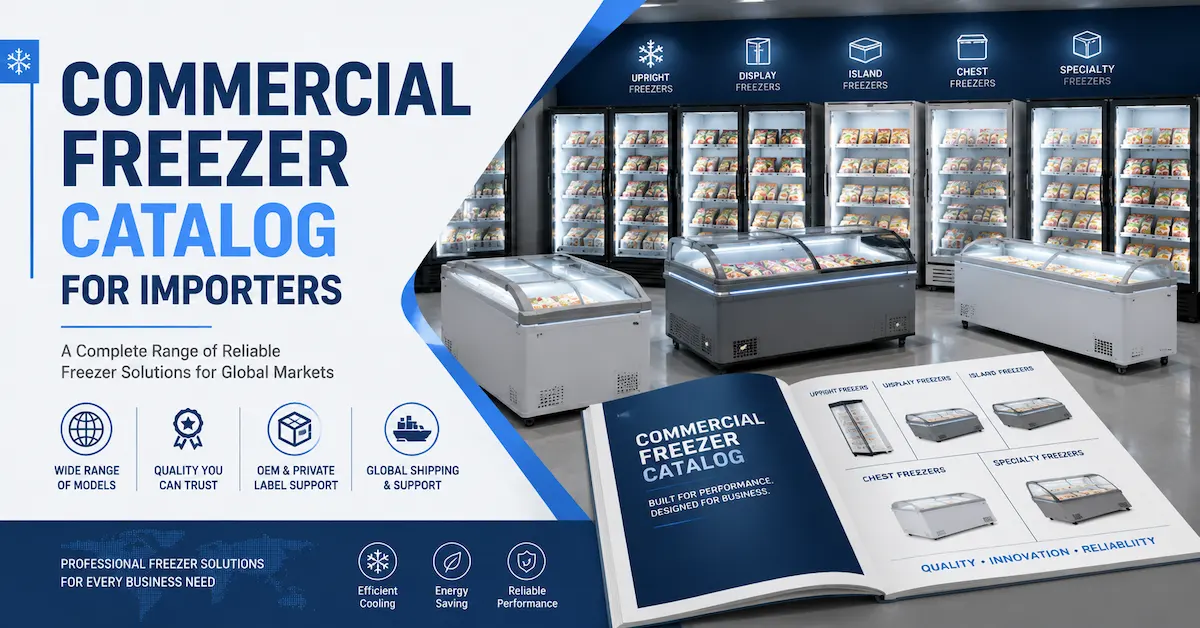
A strong commercial freezer line for regional distributors should include several core categories.
Upright Glass Door Freezers
Suitable for:
- Supermarkets
- Grocery stores
- Frozen food shops
- Convenience stores
Main advantages:
- Strong product visibility
- Efficient use of vertical space
- Organized shelf display
- Easy customer access
These models are important for customer-facing retail applications.
Chest Freezers
Suitable for:
- Restaurants
- Seafood retailers
- Food distributors
- Backroom storage
Main advantages:
- Large storage capacity
- Strong temperature retention
- Simple operation
- Flexible use
Chest freezers are often suitable for price-sensitive customers and bulk storage applications.
Island Freezers
Suitable for:
- Large supermarkets
- Hypermarkets
- High-volume frozen food zones
Main advantages:
- Large display area
- Customer access from multiple sides
- Strong retail presence
- Flexible product classification
Island freezers can support larger projects and higher-value orders.
Sliding Glass Freezers
Suitable for:
- Convenience stores
- Ice cream retailers
- Compact frozen food areas
Main advantages:
- Space-saving access
- Clear product visibility
- Good temperature retention
- Easy self-service operation
Commercial Upright Storage Freezers
Suitable for:
- Restaurants
- Hotels
- Commercial kitchens
- Food-service operations
Main advantages:
- Organized storage
- Fast product access
- Efficient use of limited floor space
Distributors can review Snowsea’s available refrigeration categories on the commercial refrigeration products page.
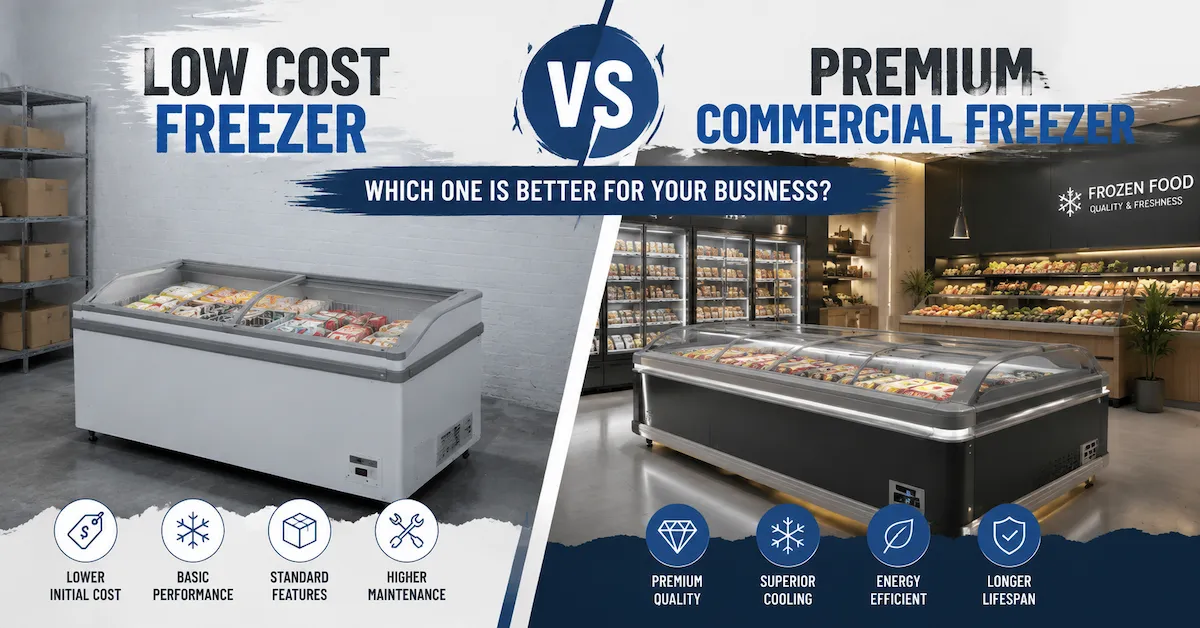
Step 3: Choose Entry-Level, Standard, and Premium Models
A regional market usually contains customers with different budgets. Offering only one price level can limit sales opportunities.
A balanced product line may include:
| Market Position | Buyer Priority | Recommended Features |
|---|---|---|
| Entry level | Competitive initial price | Standard capacity, practical design |
| Standard | Balance of cost and performance | Stable cooling, good insulation, flexible sizes |
| Premium | Display, efficiency, branding | Better glass, lighting, design, customization |
Entry-level models may attract small retailers and new businesses. Standard models can support most regular orders. Premium freezers may be suitable for supermarket chains, branded retailers, and customized projects.
This tiered structure helps distributors compete without relying only on low pricing.
Step 4: Plan Capacity and Size Options
Customers often begin by asking for a specific freezer type, but capacity and external dimensions usually determine whether the model is practical.
Distributors should include several capacity options within each major category.
Important considerations include:
- Available store space
- Daily product volume
- Restocking frequency
- Aisle width
- Door-opening clearance
- Warehouse storage space
- Transport and delivery limitations
Offering compact, medium, and large-capacity options allows distributors to serve both small stores and larger retail projects.
However, too many nearly identical sizes can create inventory pressure. Distributors should prioritize models that cover clearly different use cases.
Step 5: Include OEM and Private Label Options
Regional distributors often compete against local wholesalers selling similar standard products. OEM and private label services can create stronger differentiation.
Customization options may include:
- Distributor logo
- Cabinet color
- Product labels
- Model-number system
- Side-panel graphics
- Top lightbox branding
- User manuals
- Carton design
- Voltage and plug configuration
- Shelf or basket arrangement
A private label freezer line allows distributors to build their own regional brand rather than competing only on product price.
Snowsea supports branding, cabinet appearance, packaging, labels, technical configurations, and other OEM/ODM requirements. Buyers can review the available options on the OEM and custom freezer solutions page.
Step 6: Evaluate Product Quality and Consistency
For regional distributors, product consistency is often more important than one impressive sample.
Repeat orders should maintain the same:
- Cooling performance
- Cabinet structure
- Components
- Appearance
- Packaging standard
- Branding details
Important quality checks include:
- Temperature testing
- Compressor operation
- Electrical safety
- Door and lid sealing
- Glass quality
- Controller accuracy
- Shelf and basket completeness
- Cabinet appearance
- Packaging protection
One repeated quality problem can affect multiple downstream dealers and damage the distributor’s reputation throughout the region.
A reliable supplier should therefore inspect both technical performance and visible appearance before shipment.
Step 7: Plan Inventory Around Core and Project Models
Not every freezer model needs to be held in stock.
A practical product-line structure can divide products into two groups:
Core Inventory Models
These are frequently requested products with predictable sales, such as:
- Standard chest freezers
- Popular upright glass door freezers
- Compact retail models
- Common storage freezers
Keeping limited stock of core models can improve delivery speed.
Project-Based Models
These may include:
- Large island freezers
- Multi-door cabinets
- Customized branding projects
- Special voltage configurations
- Large supermarket installations
Project models can be ordered after customer requirements are confirmed, reducing unnecessary inventory.
This approach allows regional distributors to offer a broad product range without carrying every model in their warehouse.
Step 8: Coordinate Production and Delivery Planning
Commercial freezers require production, testing, packaging, and international transportation time. Distributors should coordinate purchasing schedules with expected market demand.
Planning should include:
- Forecast order quantity
- Production lead time
- OEM artwork confirmation
- Quality inspection date
- Container loading
- Shipping schedule
- Local warehouse availability
- Customer delivery plans
Seasonal demand should also be considered. Ice cream freezer demand may increase before summer, while frozen food retail projects may increase around new store openings or holiday sales periods.
Early planning reduces the risk of stock shortages and expensive urgent shipments.
Step 9: Evaluate Supplier Support Beyond Production
A supplier should contribute more than manufacturing capacity.
Regional distributors benefit from suppliers that can provide:
- Product recommendations
- Technical specification support
- OEM artwork review
- Packing dimensions
- Container-loading information
- Spare-parts communication
- Repeat-order management
- New model development
Clear communication is especially important when distributors are managing several customer projects at the same time.
A supplier that understands regional distribution can help simplify model selection and reduce purchasing errors.
Commercial Freezer Line Planning Checklist
Before building or expanding a freezer portfolio, distributors should confirm:
| Planning Area | Key Question |
|---|---|
| Target customers | Which industries and store types do we serve? |
| Core products | Which models generate regular demand? |
| Product tiers | Do we cover entry, standard, and premium buyers? |
| Capacity options | Are there clear compact, medium, and large choices? |
| OEM requirements | Do we need private label or dealer branding? |
| Inventory strategy | Which models should remain in stock? |
| Project models | Which products should be ordered per project? |
| Production timing | How long will manufacturing and testing take? |
| Shipping plan | How will products be packed and loaded? |
| Quality standard | What must be inspected before shipment? |
Common Product-Line Mistakes Distributors Should Avoid
Mistake 1: Ordering Too Many Similar Models
Too many overlapping products increase inventory complexity without creating meaningful customer choice.
Mistake 2: Focusing Only on Low-Priced Freezers
A price-only product line may not meet the needs of supermarket chains or premium retail projects.
Mistake 3: Ignoring Local Applications
Products should be selected according to local store formats, customer industries, electrical standards, and climate conditions.
Mistake 4: Treating OEM as Only Logo Printing
Private label projects may also involve model numbers, manuals, cartons, colors, labels, plugs, and technical specifications.
Mistake 5: Choosing a Supplier Without Repeat-Order Stability
Regional distributors need consistent production and long-term availability, not only attractive samples.
Why Snowsea Supports Regional Freezer Distributors
Snowsea focuses on commercial refrigeration and freezing solutions for distributors, supermarkets, frozen food retailers, restaurants, convenience stores, seafood businesses, and food-service companies.
For regional distributors, Snowsea can support:
- Commercial freezer portfolio planning
- Upright freezer supply
- Chest freezer supply
- Island freezer projects
- Display freezer solutions
- Ice cream freezer solutions
- OEM/ODM customization
- Private label development
- Quality inspection
- Export packaging
- Bulk production
- Repeat-order cooperation
Buyers can learn more about Snowsea and its refrigeration capabilities on the About Snowsea page.
FAQ
1. What should a commercial freezer line for regional distributors include?
A balanced line should include upright display freezers, chest freezers, island freezers, sliding glass models, and commercial storage freezers for different customer applications.
2. How many freezer models should a distributor start with?
The number depends on market demand, but distributors should begin with several clearly differentiated core models instead of stocking many similar products.
3. Should regional distributors develop private label freezers?
Private label products can help distributors improve brand recognition, protect margins, and reduce direct price comparison.
4. Which freezers should distributors keep in inventory?
Frequently requested standard chest freezers, upright display freezers, and compact models are often suitable for inventory. Large or customized models can be ordered by project.
5. How can distributors reduce freezer sourcing risks?
They should evaluate supplier capability, confirm specifications, inspect product quality, review packaging, plan demand, and build long-term cooperation with a reliable manufacturer.
Conclusion
Building a reliable commercial freezer line for regional distributors requires careful product selection, customer analysis, inventory planning, quality control, and supplier coordination.
The strongest product portfolios provide clear solutions for different customer groups without creating unnecessary model duplication or inventory pressure.
Snowsea supports regional distributors with commercial freezer products, OEM/ODM customization, private label development, export packaging, quality inspection, bulk manufacturing, and long-term supply cooperation.
Explore Snowsea’s commercial freezer products or review its OEM and custom refrigeration solutions to begin planning a regional freezer product line.
To explore freezer solutions, visit:
https://www.snowseax.com/products
For OEM/ODM refrigeration projects, visit: