The commercial freezer production process is more than a sequence of factory operations. For an importer, distributor or private-label buyer, it is the system that converts an approved product specification into hundreds of cabinets that should remain consistent in dimensions, refrigeration configuration, electrical version, accessories, branding and packaging. A polished sample is useful, but the real purchasing question is whether the factory can reproduce that sample when volume production begins.
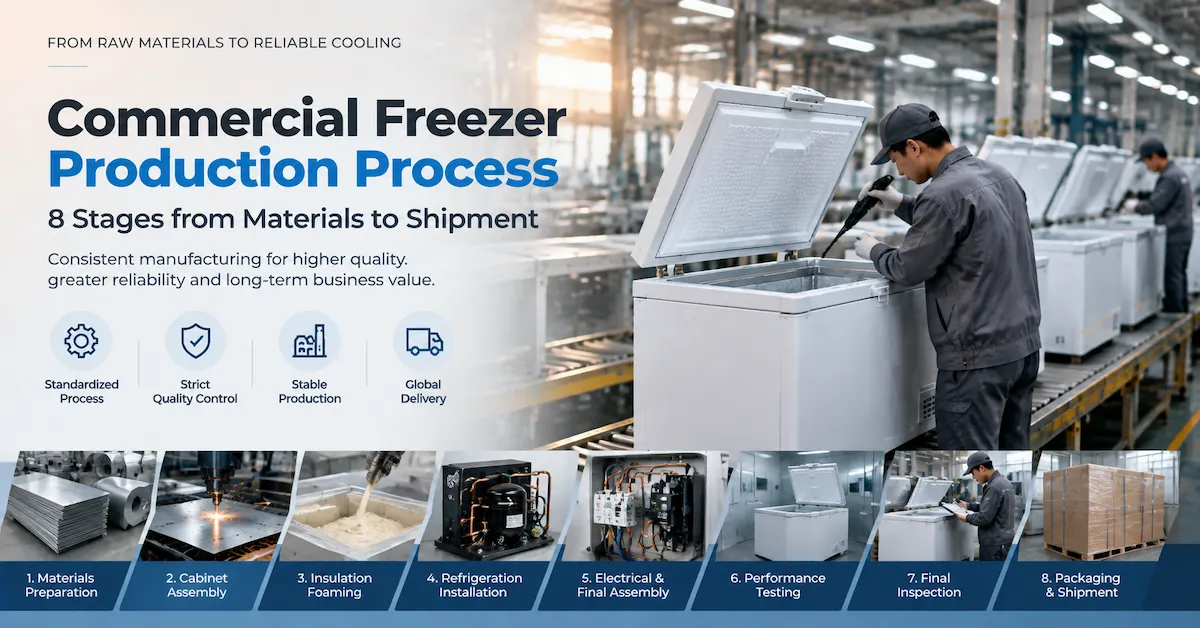
SNOWSEA describes its OEM/ODM manufacturing process around material processing, structural assembly, insulation foaming, refrigeration-system installation, final assembly, performance and temperature testing, final inspection and packing, followed by storage and shipment. The website also states that SNOWSEA operates integrated production lines, testing facilities and manufacturing workshops for its commercial refrigeration range.
Why Should B2B Buyers Understand the Commercial Freezer Production Process?
A buyer does not need to become a refrigeration engineer to purchase freezers successfully. However, understanding the production flow makes it easier to ask the right questions before a bulk order.
If the cabinet dimensions are wrong during structural assembly, final testing cannot solve the fit problem. If a controller version is changed during component preparation, an approved sample may no longer represent the production batch. If insulation or refrigeration configuration changes, earlier performance results may need to be reconsidered. If the product passes functional testing but receives inadequate export packaging, the commercial result can still fail during transport.
That is why production should be reviewed as a chain. Each stage receives information or materials from the previous stage and creates something that the next stage depends on.
A useful buyer-side process is:
Approved specification → controlled materials → cabinet construction → insulation → refrigeration assembly → final assembly → performance verification → final QC → packaging and shipment.
Before Stage 1: Freeze the Product Specification
Manufacturing quality begins before factory production starts.
The buyer and supplier should first agree on the exact product version. That can include model, intended application, dimensions, refrigeration type, refrigerant, controller, electrical configuration, baskets, locks, glass or lid type, branding and packaging.
For example, SNOWSEA publishes several different commercial freezer platforms. The BD-500 is listed as a 500L chest freezer with a double-lid format, removable basket, drain, lock and R290 refrigerant. The BD/BC-227WA is separately positioned as a 227L air-cooled no-frost platform with electronic temperature control. These are not simply different capacities; they represent different product configurations that production must keep separate.
| Pre-Production Item | Buyer Should Confirm | Why It Matters in Production |
|---|---|---|
| Model | Exact model/reference | Prevents similar cabinets being mixed |
| Dimensions | Approved cabinet size | Controls panel and structural production |
| Cooling system | Standard or no-frost configuration | Affects refrigeration assembly |
| Refrigerant | Approved version | Must match production documentation |
| Controller | Approved type/version | Affects electrical assembly and operation |
| Electrical | Voltage, frequency, plug | Prevents wrong-market production |
| Accessories | Baskets, locks, lights, wheels | Must be issued correctly to assembly |
| Branding | Logo,label and model name | Controls OEM production |
| Packaging | Carton/protection requirement | Influences final packed size and loading |
| Revision | Approved specification version | Gives factory one production reference |
SNOWSEA’s own OEM specification-control guidance emphasizes that the approved product version should be connected to production rather than managed through scattered emails or memory.
Stage 1: Material Preparation and Component Control
The first physical stage of the commercial freezer production process is preparing the materials and components needed for the approved model.
Depending on the freezer design, production may require cabinet panels, liner materials, insulation-related inputs, refrigeration components, controller and electrical parts, gaskets, baskets, hinges, locks, handles and packaging materials.
The buyer does not need to specify every screw. More important is knowing whether commercially important components are controlled.
For an OEM project, ask:
- Does the production order identify the approved controller?
- How is the correct refrigerant configuration identified?
- Are baskets and accessories standard or order-specific?
- What happens if an approved component is temporarily unavailable?
- Who authorizes an alternative?
- Does a substitution require buyer approval or new testing?
This becomes particularly important for repeat orders. A model number can remain unchanged while the internal configuration changes if component-control rules are weak.
Stage 2: Cabinet Panel Processing and Structural Assembly
Next, the freezer begins to take physical shape.
Panels, cabinet structures, internal liners and supporting components must be processed and assembled according to the approved dimensional design. At this stage, errors can later appear as uneven lid fit, gasket problems, poor alignment or installation difficulties.
For buyers reviewing the factory, visible workmanship should be converted into inspection points rather than broad phrases such as “strong cabinet.”
Check items such as:
- External dimensions
- Panel alignment
- Surface condition
- Liner installation
- Lid or door alignment
- Handle location
- Lock installation
- Drain location
- Basket fit
- Wheel or foot placement where applicable
Different product structures create different priorities. A medium BD-308 chest freezer and a glass-top ice cream cabinet should not use an identical workmanship checklist because their access structures and merchandising functions differ. SNOWSEA’s current purchasing materials list the BD-308 as a 308L chest-freezer platform and the SD/SC-268PM as a 268L flat sliding-glass ice cream freezer.
Stage 3: Insulation Foaming
Insulation is one of the least visible parts of a finished freezer, which is why manufacturing-process control matters.
SNOWSEA lists foaming and insulation as a distinct step in its production workflow.
At this stage, insulation is introduced between cabinet structures to reduce heat transfer. After the cabinet is closed, the buyer usually cannot inspect the insulation directly without destructive examination, so the factory must control the process before final assembly.
Buyers considering customized cabinet dimensions or insulation changes should ask whether those changes affect the existing manufacturing and validation process.
Avoid using insulation wording alone to make unsupported performance claims. “Thicker insulation” does not automatically prove a particular energy-saving percentage. The relevant question is whether the approved cabinet construction produces acceptable performance under the agreed test conditions.
Stage 4: Refrigeration-System Installation
This is where the cabinet becomes refrigeration equipment rather than an insulated box.
The refrigeration-system installation can involve the compressor, condenser, evaporator, piping, refrigerant circuit and related components according to the selected product architecture.
SNOWSEA’s manufacturing flow specifically identifies refrigeration-system installation as a production stage before final assembly and performance testing.
For buyers, the most important issue is configuration control.
A standard storage chest freezer and the BD/BC-227WA no-frost platform should not automatically be assumed to use the same cooling architecture. The BD/BC-227WA is presented as an air-cooled no-frost product with electronic temperature control, so airflow, defrost and controller operation become relevant parts of that production version.
A useful factory review asks:
Which refrigeration configuration belongs to this model?
How does production identify it?
Which components are critical to the approved performance?
What happens if one of those components changes?
Stage 5: Electrical and Final Product Assembly
After the main cabinet and refrigeration system are prepared, the remaining systems and accessories must be integrated into the finished product.
Depending on the model, this can include controller installation, sensors, lighting, switches, fans, power cable, plug, baskets, locks, handles, glass assemblies and exterior components.
For export buyers, electrical-version control deserves particular attention.
A factory serving different markets may produce cabinets that look almost identical but use different voltage, frequency or plug configurations. The production system must keep those versions identifiable through assembly, labeling and packaging.
This is particularly important for private-label programs. A branded cabinet with the right logo but the wrong electrical version is still the wrong product.
How Different Freezer Platforms Change Production Priorities
Not every commercial freezer production process has the same inspection emphasis.
| SNOWSEA Platform | Published Starting Point | Production Areas Buyers Should Watch Closely |
|---|---|---|
| BD-308 | 308L chest freezer | Cabinet workmanship, baskets, liner, controls and accessories |
| BD-500 | 500L double-lid chest freezer, R290 listed | Large cabinet structure, lid alignment,refrigeration and loading configuration |
| BD/BC-227WA | 227L air-cooled no-frost freezer | Controller, airflow, fan/defrost operation and electrical version |
| SD/SC-268PM | 268L flat sliding-glass ice cream freezer | Glass assembly, basket layout, merchandise access and transport protection |
SNOWSEA’s recent purchasing content uses these same models to illustrate different storage, no-frost and retail-display requirements.
The lesson for buyers is simple: factory capability should be assessed against the actual model being purchased.
Stage 6: Performance and Temperature Testing
A finished freezer should be tested before shipment, but the phrase “performance tested” needs more detail.
SNOWSEA’s BD-500 product information states that model testing can include temperature uniformity, cooling efficiency and operational stability.
For B2B purchasing, useful questions include:
- What ambient condition is used?
- Is the freezer empty or loaded?
- What controller setting is used?
- Where are temperatures measured?
- How long is the test?
- Is pull-down evaluated?
- Is temperature stability monitored?
- Is recovery after opening or loading relevant?
- How is no-frost operation checked where applicable?
- What result is considered acceptable?
Do not treat a controller display showing a low temperature as a complete performance test.
SNOWSEA’s existing OEM purchasing guidance also recommends distinguishing controller setting from actual cabinet and product temperatures and asking for configuration-specific test records.
Stage 7: Final Quality Inspection
Once functional testing is complete, the freezer still needs final inspection before it can be released for packing.
Final QC should connect the physical unit to the approved order.
A practical inspection can include:
| Final QC Area | Buyer Acceptance Question |
|---|---|
| Model | Is this the correct approved model? |
| Appearance | Does workmanship meet the agreed reference? |
| Dimensions | Does cabinet size match specification? |
| Lid/door/glass | Does it open,close and align correctly? |
| Gasket | Is contact and fit acceptable? |
| Control | Is the correct version fitted and operating? |
| Electrical | Does voltage/frequency/plug match destination? |
| Accessories | Are baskets, locks,wheels and options included? |
| Label | Is model/electrical identification correct? |
| Branding | Does OEM artwork match approved files? |
| Documentation | Are correct manuals included? |
| Performance | Are required production checks passed? |
Quality inspection should also define what happens to a failed unit. The useful process is not “we never have failures,” but identify → isolate → correct where allowed → retest → approve or reject.
That is one reason SNOWSEA’s commercial freezer factory audit guide recommends following real product evidence through production rather than relying on factory appearance alone.
Stage 8: Packaging, Storage and Shipment
The commercial freezer production process is not finished when QC signs the product.
The equipment still has to survive handling, warehousing, container loading and international transport.
Packaging requirements can differ according to product structure. A solid-lid chest freezer and a glass-top ice cream cabinet do not have identical transport risks.
Important checks can include:
- Cabinet surface protection
- Corner protection
- Base protection
- Lid or glass fixation
- Control-panel protection
- Accessory fixation
- Carton identification
- Model marking
- Shipping marks
- Manual placement
- Packed dimensions
SNOWSEA’s manufacturing description places final inspection and packing immediately before storage and shipment, reinforcing that packaging is part of the production-delivery chain rather than a separate marketing task.
For buyers calculating container quantities, use the final approved packing dimensions. Custom cartons, added protection or cabinet changes can alter the actual loading plan.
How Does OEM/ODM Change the Production Process?
OEM production adds another layer of control because the factory is no longer producing only its standard product identity.
A private-label order may include logo, rating label, model number, manual, carton artwork, cabinet graphics or electrical-market changes. Deeper projects may involve structural or refrigeration modifications.
SNOWSEA’s OEM/ODM service supports distributor, brand and project-buyer customization, while its current OEM content stresses the importance of locking the approved specification before mass production.
A useful OEM production package should therefore link:
Base model → approved technical specification → approved artwork → electrical version → accessories → sample revision → packaging revision.
If one element changes, the factory should know whether approval or retesting is required.
How Should Buyers Handle Component Substitutions During Production?
Component substitutions are a normal potential supply-chain issue, but uncontrolled substitution creates purchasing risk.
Before production, agree which components or requirements are critical. Where alternatives are permitted, record them.Where an unapproved alternative is proposed, require written review before implementation.
This is especially relevant to controllers, refrigeration components and parts that affect documentation or replacement service.
A supplier telling the buyer about a change is not evidence of weak production. A supplier changing an important component without disclosure is a much more serious concern.
Where Should Quality Records Connect to the Production Process?
Testing and inspection become more useful when records can be linked to identifiable products or batches.
Buyers can ask whether the factory records:
- Production model
- Date or batch
- Electrical version
- Test status
- Inspection result
- Rework status
- Packing status
The amount of traceability required will depend on the project, but a recurring B2B program benefits from being able to distinguish different production versions.
For private-label buyers, this can become particularly useful several months later when a customer requests a replacement component.
Production Capacity Is Different From Order Lead Time
Seeing a large production line does not answer the question “When will my order be ready?”
Ask how your actual quantity and model mix fit into the factory plan.
A commercial order can involve material preparation, several assembly processes, testing, inspection and packaging. Customized artwork or special components can create additional dependencies.
SNOWSEA’s BD-500 FAQ states that structured production planning and in-house manufacturing control are used to manage large-volume scheduling, but actual timing should still be confirmed for the specific order.
Buyers should separate:
Specification approval → material preparation → production → testing → inspection → packing → shipment readiness → transportation.
A production lead time should not be confused with warehouse arrival.
What Production Evidence Should Buyers Request Before a Bulk Order?
The appropriate evidence depends on order value and customization, but a serious first-order review can include:
- Approved product specification
- Model/configuration list
- Sample approval record
- Technical drawings where relevant
- Product photos
- Performance-test information
- Inspection criteria
- Destination-market documentation
- Packaging specification
- Production schedule
- Final inspection report
- Packing list
- Spare-parts reference
Do not request documents simply to create a larger procurement folder. Every record should answer a purchasing question.
If you are planning a factory visit, SNOWSEA’s factory audit checklist provides a useful follow-on framework for tracing these controls through the workshop.
What Can Go Wrong During Commercial Freezer Production?
Production risk is easier to manage when buyers recognize where errors can enter the process.
Common examples include:
Wrong specification revision: production follows an old configuration.
Incorrect electrical version: similar cabinets for different markets are mixed.
Uncontrolled component change: an alternative controller or part enters production without review.
Accessory mismatch: baskets, locks or optional features do not match the quotation.
Appearance inconsistency: OEM branding or label versions differ across units.
Incomplete performance verification: test results do not represent the production configuration.
Packaging mismatch: final protection differs from the approved transport requirement.
The solution is not additional marketing promises. It is clearer product definition, controlled revisions and inspection at the right production stages.
What Should a Buyer Verify During a Factory Visit?
If you visit a commercial freezer factory, do not spend the entire appointment looking at rows of finished cabinets.
Choose one proposed product and follow the sequence:
Material/component area → cabinet construction → insulation → refrigeration assembly → final assembly → testing → QC → packaging.
At every step, ask the same question:
How does this station know which version of our freezer to build or inspect?
That single question often reveals more about production control than counting equipment.
Frequently Asked Questions
1. What is the commercial freezer production process?
The commercial freezer production process converts an approved product specification into a finished refrigeration unit through material preparation, cabinet construction, insulation, refrigeration installation, final assembly, testing, inspection, packaging and shipment.
2. What is the first stage of freezer manufacturing?
Before physical manufacturing, the product configuration should be confirmed. Material preparation then supplies the cabinet, refrigeration, electrical and accessory components needed for the approved model.
3.Why is insulation foaming important in freezer production?
Insulation reduces unwanted heat transfer through the cabinet. Because insulation becomes hidden after assembly, manufacturers need process control during foaming rather than relying only on finished-product appearance.
4. What happens during refrigeration-system assembly?
The factory installs the refrigeration configuration required by the model, which can include compressor and related refrigeration-circuit components. The exact architecture varies by product, so buyers should confirm the configuration being purchased.
5. How are commercial freezers tested after production?
Testing can include model-specific performance and temperature checks. Buyers should ask about ambient conditions, loading, measurement locations, duration and acceptance criteria rather than relying on a single controller reading.
6. Is final inspection the same as performance testing?
No.Performance testing evaluates relevant operating behavior, while final inspection checks the completed unit against the approved product and order requirements, including workmanship, configuration, accessories, labels and packaging.
7. How does OEM production differ from standard freezer production?
OEM production adds buyer-specific requirements such as branding, labels, packaging, electrical versions or custom configurations. These requirements need revision control so the correct customer version reaches production and shipment.
8. Which SNOWSEA models show different production requirements?
SNOWSEA offers standard chest freezer platforms such as BD-308 and BD-500, a no-frost BD/BC-227WA, and glass-top products such as SD/SC-268PM. Their structures create different production and inspection priorities.
9.What should buyers inspect before freezer shipment?
Check model, quantity, electrical version, appearance, controls, accessories, identification, documentation, agreed functional checks and packaging against the purchase specification.
10. How can I discuss a production project with SNOWSEA?
Prepare your target market, freezer application, model or capacity requirement, electrical specification, quantity, customization and delivery requirements, then submit them through SNOWSEA Contact Us for a model-specific manufacturing discussion.
Conclusion
The commercial freezer production process should give B2B buyers a clear path from an approved specification to a repeatable finished product. Material control, cabinet construction, insulation foaming, refrigeration-system installation, electrical and final assembly, performance testing, final inspection and export packaging all affect the commercial result; no single stage can compensate for an uncontrolled requirement earlier in the process.SNOWSEA presents an integrated OEM/ODM manufacturing workflow and several commercial freezer platforms for distributors, brands and project buyers. If you are preparing a standard wholesale order, private-label program or custom freezer project, send SNOWSEA your application, specification, target market and expected quantity and request a production proposal that clearly identifies the product configuration, sample requirements, manufacturing stages, quality checks, packaging and shipment milestones.