What Should a Freezer for Hospital Kitchen Storage Actually Do?
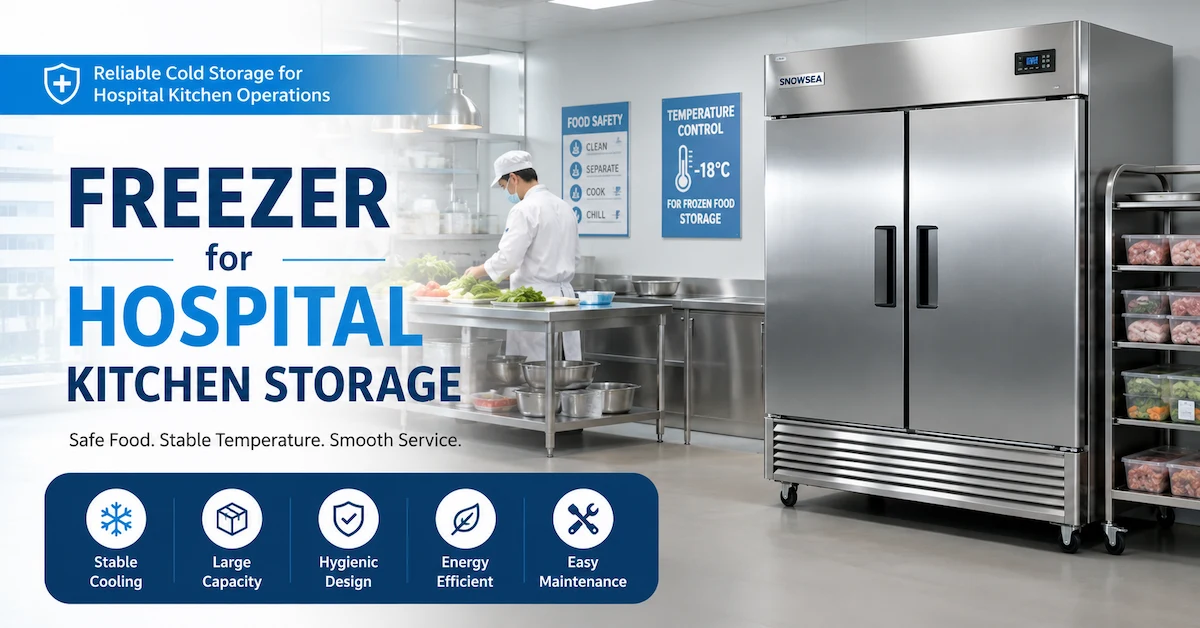
A freezer for hospital kitchen storage is commercial refrigeration equipment used to store frozen ingredients, prepared food components, backup inventory, and other foodservice products within a hospital or healthcare facility kitchen.
The procurement requirement is different from a household freezer and also different from a supermarket display freezer.
Hospital foodservice operations may need to support several workflows at the same time, including patient meal production, staff dining, cafeteria service, banquet or meeting support, and contingency food inventory.
For that reason, buyers should evaluate more than cabinet volume.
A suitable commercial freezer should balance:
- Reliable temperature control
- Fast recovery after repeated door openings
- Practical food organization
- Easy cleaning and maintenance
- Energy efficiency
- Long-term commercial reliability
- Local foodservice compliance requirements
The freezer itself is foodservice equipment, not medical equipment. Food-storage requirements, sanitation procedures, and applicable regulations should therefore be confirmed according to the hospital's own food safety program and the destination market.
Snowsea provides commercial refrigeration products for institutional kitchens, foodservice operations, retail businesses, and other commercial applications.
Why Is Hospital Kitchen Freezer Selection Different From Ordinary Foodservice?
A hospital kitchen may run on a more structured schedule than a small restaurant while simultaneously handling larger meal volumes and multiple food categories.
The procurement team therefore needs to consider not only how much food fits inside the freezer, but also how the equipment performs during actual operating cycles.
For example, frequent loading after ingredient deliveries can introduce warmer products and ambient air into the cabinet. Repeated door opening during preparation periods can also increase the refrigeration load.
A freezer that performs adequately during static storage may perform differently during intensive kitchen use.
This makes factors such as temperature recovery, door sealing, insulation, compressor sizing, and airflow important purchasing criteria.
For more detail on recovery performance, buyers can review Snowsea's commercial freezer temperature recovery guide.
Who Should Evaluate the Freezer Before Purchase?
Hospital refrigeration purchases may involve several decision-makers.
The foodservice manager may care about accessibility and storage organization. Facility teams may focus on energy consumption, maintenance access, electrical requirements, and equipment reliability. Procurement departments may compare quotations, lead time, warranty terms, replacement parts, and total ownership cost.
For larger projects, the buyer should therefore avoid selecting equipment from one specification alone.
A useful RFQ should bring together operational and procurement requirements before suppliers quote.
Which Freezer Type Fits a Hospital Kitchen?
The right configuration depends on kitchen layout, food volume, access frequency, and inventory management.
| Freezer Type | Main Advantage | Best Fit | Buyer Consideration |
|---|---|---|---|
| Upright commercial freezer | Easy organization and fast access | Daily-use ingredients | Shelf layout and door-opening frequency |
| Chest freezer | Strong storage density and cold retention | Bulk and backup inventory | Product accessibility and floor space |
| Multiple cabinet system | Separates food categories | Medium to large hospital kitchens | Standardization and maintenance |
| Walk-in freezer | Very high storage capacity | Large institutional kitchens | Installation, refrigeration design and facility planning |
An upright cabinet may work better for ingredients used repeatedly during meal preparation, while chest freezers can be useful for bulk inventory that does not require constant access.
For large hospitals, one oversized freezer is not always the most efficient solution. Multiple units can sometimes improve food zoning, workflow, redundancy, and inventory control.
How Much Freezer Capacity Does a Hospital Kitchen Need?
Capacity should be calculated from real operating demand rather than simply choosing the largest available cabinet.
Important inputs include:
- Number of meals produced per day
- Number of meal services
- Frequency of supplier deliveries
- Frozen ingredient categories
- Backup inventory requirements
- Seasonal or emergency stock policies
- Available kitchen floor space
A hospital receiving frozen ingredients several times per week may require a different storage strategy from a facility receiving larger weekly deliveries.
Procurement teams should also distinguish between gross cabinet volume and usable storage space.
Shelf spacing, baskets, evaporator position, airflow clearance, packaging sizes, and loading practices can all affect usable capacity.
Snowsea's commercial freezer shelf capacity guide provides additional guidance for storage planning.
Temperature Stability Matters More Than the Set Point Alone
Buyers often ask for the freezer's temperature range first.
That is necessary, but it does not fully describe real-world performance.
A more useful evaluation asks:
How well does the freezer maintain and recover its temperature when used under the expected hospital kitchen workload?
Hospital kitchens may experience periods of frequent access during food preparation. Large quantities of food may also be loaded after delivery.
Procurement teams should therefore compare:
- Operating temperature range
- Temperature uniformity
- Recovery after door opening
- Performance under loaded conditions
- Control system accuracy
- Alarm or monitoring options where required
Snowsea's commercial freezer temperature range guide can be used as a related technical reference.
Insulation and Door Sealing Affect Operating Cost
A hospital kitchen freezer may operate continuously for years, so small differences in thermal performance can accumulate into meaningful operating costs.
Important components include cabinet insulation, door gasket quality, door-closing behavior, and thermal bridging around the cabinet structure.
Good insulation helps reduce heat transfer into the storage compartment, while effective door seals help limit cold-air loss.
When comparing suppliers, hospital buyers should therefore ask for more than insulation thickness alone.
They should also evaluate:
- Insulation material
- Foam consistency
- Cabinet construction
- Door gasket design
- Sealing performance
- Product testing methods
Related technical references include Snowsea's commercial freezer insulation thickness guide and freezer door gasket sealing performance guide.
Hygiene-Focused Design Should Be Part of the RFQ
In institutional foodservice, cleaning convenience directly affects daily operation.
Hospital buyers should evaluate whether internal surfaces, shelves, baskets, door seals, and corners are easy to access and clean according to the facility's sanitation procedures.
Useful questions include:
- Can shelves and baskets be removed easily?
- Are internal surfaces practical to wipe down?
- Are there difficult-to-reach food debris traps?
- Is drainage required for the selected model?
- Can technicians access refrigeration components without disrupting food storage areas?
This type of operational detail is often more useful than comparing cosmetic appearance alone.
Stainless Steel, Coated Steel, or Other Cabinet Materials?
Material selection should match the operating environment and buyer priorities.
Stainless steel may be preferred where durability, frequent cleaning, and professional kitchen appearance are important.
Other commercial cabinet constructions may provide an appropriate balance between cost, corrosion resistance, insulation performance, and application requirements.
Instead of specifying a material based only on appearance, buyers should ask suppliers to confirm:
- Internal liner material
- External cabinet material
- Corrosion protection
- Cleaning compatibility
- Expected operating environment
For institutional projects, specification consistency across multiple purchased units is also important.
How Important Is Airflow in Hospital Kitchen Storage?
Airflow can influence temperature distribution inside forced-air freezer systems.
Poor loading practices can obstruct circulation even when the refrigeration system itself is properly designed.
Procurement and kitchen teams should therefore consider both equipment design and daily loading procedures.
Freezers should not be packed in a way that blocks designed air channels.
For related technical information, see Snowsea's commercial freezer fan motor selection guide.
Energy Efficiency Should Be Evaluated as Lifecycle Cost
Hospital buyers often receive quotations with noticeable differences in purchase price.
The lowest initial price does not automatically create the lowest total cost.
A more useful comparison includes:
| Cost Factor | Why It Matters |
|---|---|
| Purchase price | Initial project budget |
| Electricity consumption | Continuous operating expense |
| Maintenance | Affects facility workload |
| Replacement parts | Important for long-term support |
| Downtime | Can disrupt kitchen operations |
| Service life | Influences replacement cycle |
| Warranty/support | Reduces procurement uncertainty |
For a facility purchasing multiple units, differences in energy consumption and maintenance requirements can become more significant over the equipment lifecycle.
This is why buyers should request comparable specifications rather than simply comparing unit prices.
What Reliability Questions Should Hospital Buyers Ask?
Before placing an order, procurement teams should ask suppliers how commercial freezers are tested.
Relevant questions include:
- Is temperature stability tested?
- Is temperature recovery evaluated?
- Are loaded operating conditions considered?
- Are door seals inspected?
- Is electrical safety checked?
- Are compressors and refrigeration components verified before shipment?
- Is final inspection performed before packing?
Snowsea's commercial freezer quality testing procedure provides a useful framework for evaluating this part of supplier capability.
Buyers should request model-specific test information where necessary rather than assuming every model uses the same procedure.
Hospital Kitchen Freezer Procurement: What Should Be Customized?
For multi-unit institutional projects, standardization can simplify operation and maintenance.
Depending on the project and selected model, buyers may need to discuss:
- Capacity
- Cabinet dimensions
- Shelf configuration
- Door type
- Voltage and frequency
- Plug type
- Temperature range
- Refrigerant
- Branding
- Packaging
- Spare parts
- Documentation
Snowsea's OEM/ODM solutions can be used when discussing project-specific configuration requirements.
Certification and compliance requirements vary by destination and project. Buyers should therefore provide the target country and required standards in the RFQ so the supplier can confirm compatibility for the exact model.
Upright vs Chest Freezer for Hospital Kitchens
There is no universal best choice.
Choose an upright commercial freezer when staff need frequent access, organized shelving, and fast ingredient identification.
Choose a chest freezer when bulk storage density and cold retention are more important than rapid access.
For many institutional kitchens, using both can be more practical:
Upright freezer → daily-use inventory
Chest freezer → bulk and reserve inventory
This reduces unnecessary searching and can improve kitchen workflow.
What Should a High-Quality Hospital Freezer RFQ Include?
A vague request such as “Please send your hospital freezer price” usually produces quotations that are difficult to compare.
A better inquiry should include:
- Hospital or institutional kitchen type
- Number of meals produced per day
- Frozen product categories
- Required usable capacity
- Preferred freezer type
- Available installation dimensions
- Required temperature range
- Voltage and frequency
- Expected operating hours
- Door-opening frequency or workload description
- Required quantity
- Destination country
- Required certifications or project standards
- Preferred Incoterm
- Spare-part or after-sales requirements
- Required delivery schedule
Providing these details allows manufacturers to recommend a more appropriate configuration and prepare a more comparable quotation.
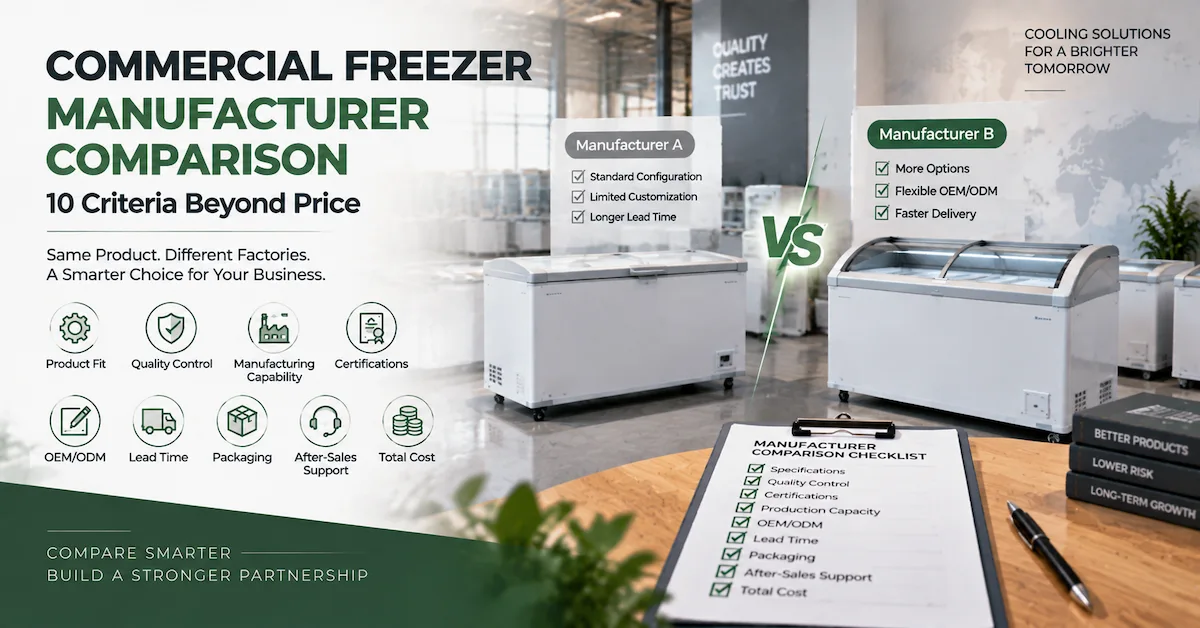
What Should Buyers Compare Between Two Freezer Suppliers?
Do not compare suppliers only by FOB or unit price.
A stronger supplier comparison should cover:
- Refrigeration configuration
- Insulation and cabinet construction
- Temperature performance
- Usable storage layout
- Energy consumption
- Quality testing
- Spare parts availability
- Warranty terms
- Export packaging
- Lead time
- OEM/ODM flexibility
- Documentation
- Communication quality
This approach reduces the risk of selecting a low quotation that later creates higher operating or maintenance costs.
When Should a Hospital Buyer Request a Sample or Trial Unit?
For a large multi-unit project, a sample or trial unit can be useful when the buyer needs to verify:
- Fit within the kitchen layout
- Storage organization
- Door access
- Temperature performance
- Cleaning convenience
- Noise level
- Staff usability
The appropriate validation process depends on project size and procurement policy.
For large orders, confirming critical specifications before mass production can reduce avoidable changes later.
How Snowsea Can Support Institutional Freezer Projects
Snowsea works with commercial refrigeration applications where buyers may require different capacities, configurations, and project specifications.
For a hospital kitchen project, the most productive first step is not simply requesting a price list.
Send Snowsea your:
- Required freezer type
- Capacity
- Quantity
- Installation dimensions
- Voltage/frequency
- Destination market
- Application requirements
- Required delivery schedule
Snowsea can then evaluate the project requirements and discuss suitable commercial refrigeration options.
Browse Snowsea commercial refrigeration products or contact Snowsea for a project quotation.
FAQ
What is the best freezer for hospital kitchen storage?
The best freezer depends on meal volume, kitchen layout, food categories, access frequency, and inventory strategy. Upright freezers are useful for organized daily access, while chest freezers are often suited to bulk inventory.
How much freezer capacity does a hospital kitchen need?
Capacity should be based on meal volume, delivery frequency, frozen food categories, backup inventory, and usable storage space rather than gross cabinet volume alone.
Are upright freezers suitable for hospital kitchens?
Yes. Upright commercial freezers are useful where staff require organized shelves and frequent access to frozen ingredients.
Are chest freezers useful in institutional kitchens?
Yes. Chest freezers can be practical for bulk ingredients, reserve inventory, and products that do not require constant access.
Why is temperature recovery important?
Frequent door opening and product loading introduce heat into the cabinet. Faster, stable recovery helps the freezer return toward its normal operating condition after these events.
Should hospital kitchen buyers compare energy consumption?
Yes. Commercial freezers may operate continuously, so energy consumption can significantly influence lifecycle cost, especially when multiple units are installed.
What freezer features make cleaning easier?
Accessible internal surfaces, removable shelves or baskets, practical door seals, and maintenance-friendly cabinet design can simplify cleaning routines.
Can hospital kitchen freezers be customized?
Customization depends on the model and project. Buyers can discuss capacity, shelves, voltage, temperature range, door configuration, branding, packaging, and other requirements with the supplier.
What information is needed for an accurate freezer quotation?
Provide capacity, quantity, dimensions, temperature range, voltage, destination country, operating conditions, certifications, customization, and delivery requirements.
Can Snowsea provide freezer solutions for institutional kitchens?
Snowsea provides commercial refrigeration solutions and can evaluate hospital kitchen storage requirements based on the project's capacity, configuration, destination market, and purchasing needs.
Conclusion
Choosing a freezer for hospital kitchen storage should be treated as an institutional procurement decision rather than a simple equipment purchase.
The strongest option is not automatically the largest cabinet or the lowest quotation. Hospital foodservice buyers should compare usable capacity, temperature recovery, insulation, cleaning convenience, energy consumption, reliability, maintenance, and supplier support together.
For multi-unit or project-based purchasing, a detailed RFQ also makes supplier quotations easier to compare and reduces specification misunderstandings before production.
If you are planning a hospital, university, institutional kitchen, or foodservice refrigeration project, send Snowsea your capacity, quantity, voltage, destination market, installation space, and operating requirements through the contact page to request a model recommendation and commercial quotation.