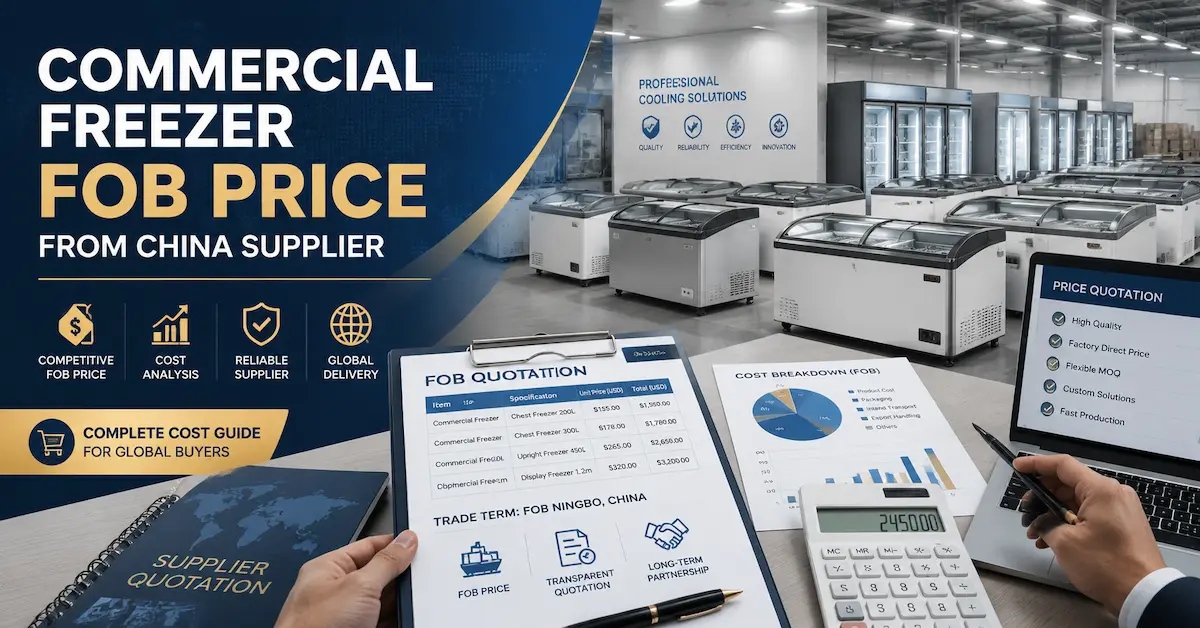
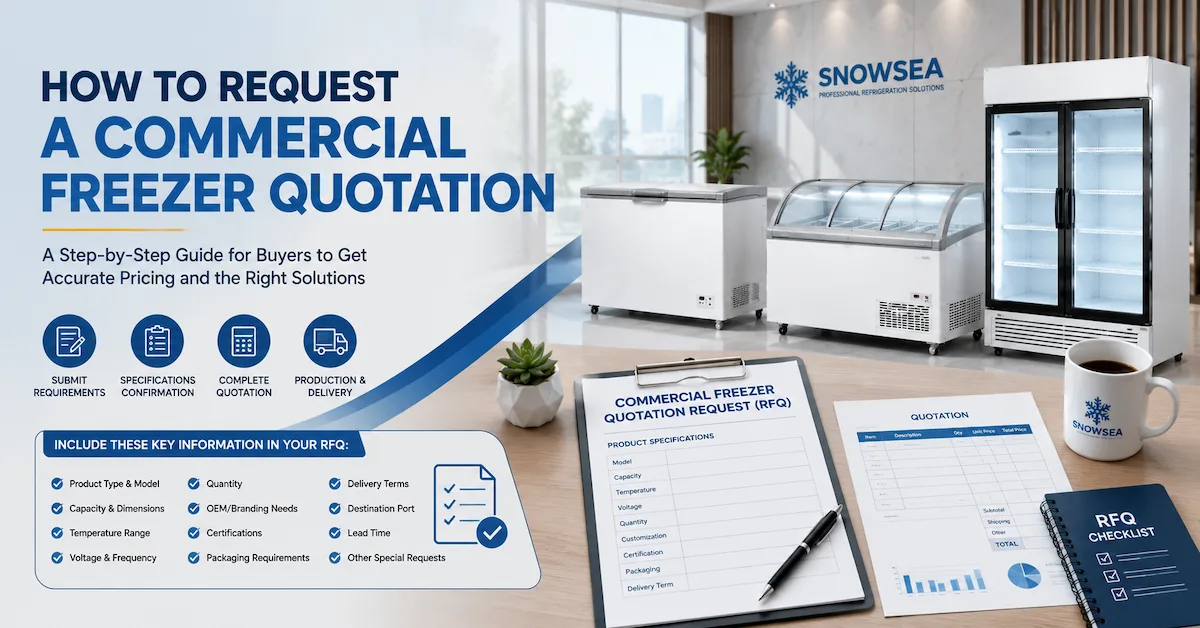
For importers, commercial refrigeration distributors, supermarket equipment buyers, frozen food companies, and hospitality project contractors, preparing a complete commercial freezer quotation request is the first step toward receiving accurate pricing and avoiding unnecessary delays.
A quotation based only on a message such as “Please send your freezer price” is rarely useful. Commercial freezer prices depend on the cabinet type, capacity, cooling system, temperature range, electrical standard, branding requirements, order quantity, packaging method, and destination market.
When key information is missing, suppliers may provide only a rough reference price. The final cost may change after technical requirements, customization, or shipping conditions are confirmed.
A professional request for quotation, or RFQ, helps buyers:
- Receive more accurate prices
- Compare suppliers fairly
- Reduce repeated communication
- Confirm technical requirements early
- Control project budgets
- Plan production and delivery
- Reduce specification mistakes
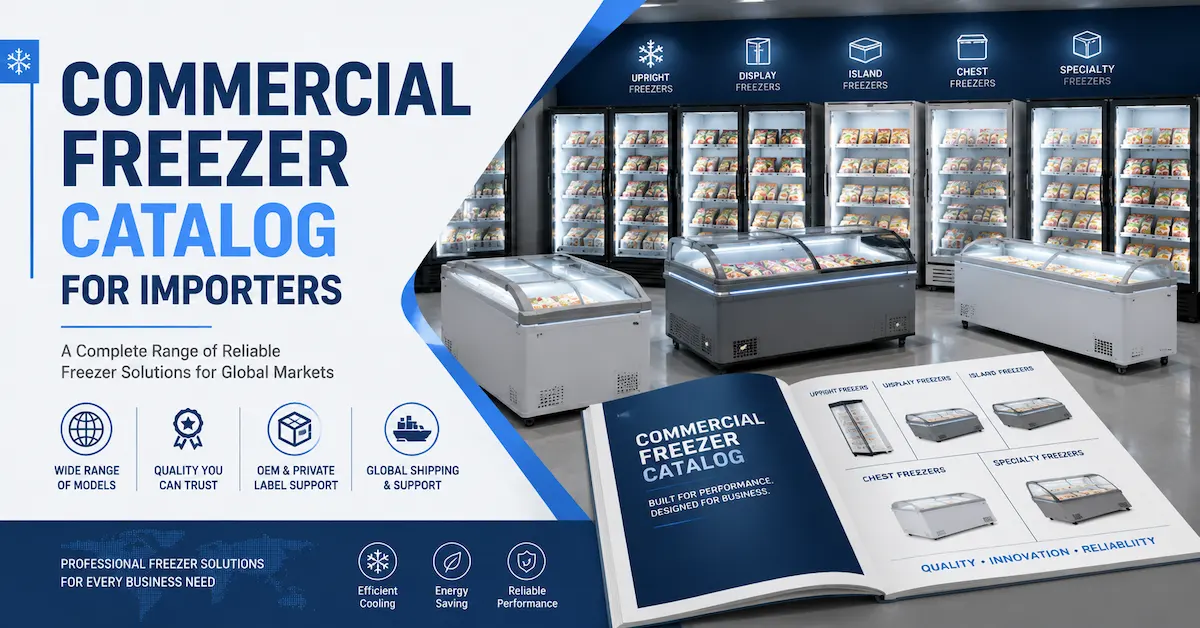
Snowsea supplies chest freezers, upright freezers, display freezers, island freezers, ice cream freezers, refrigeration cabinets, refrigerators, beverage coolers, and customized commercial refrigeration equipment. Buyers can use the following process to prepare a clear and actionable quotation request.
Why a Complete Commercial Freezer RFQ Matters
A commercial freezer is not a standardized consumer product. Two cabinets with a similar appearance may have very different specifications, components, capacities, and operating costs.
A supplier must understand several basic questions before preparing an accurate quotation:
- What products will be stored?
- Where will the freezer be used?
- What temperature range is required?
- How many units are needed?
- Does the buyer require OEM branding?
- What voltage and plug are required?
- What is the destination country?
- Is export packaging needed?
- What delivery term should be quoted?
A detailed RFQ helps the supplier select a suitable model instead of quoting an unsuitable product at an attractive but misleading price.
It also helps buyers compare equivalent solutions. Comparing a standard chest freezer with a customized display freezer does not provide meaningful purchasing information.
Step 1: Identify the Required Freezer Type
The first part of a commercial freezer quotation request should clearly state the required equipment type.
Common options include:
| Freezer Type | Typical Application |
|---|---|
| Chest freezer | Bulk frozen food, meat, seafood, storage |
| Upright freezer | Organized storage and fast product access |
| Glass-door display freezer | Supermarkets and frozen food retail |
| Island freezer | Large supermarket frozen sections |
| Sliding-glass freezer | Ice cream and self-service retail |
| Ice cream freezer | Frozen desserts and branded promotions |
| Refrigeration cabinet | Chilled or frozen commercial display |
The application should also be explained.
For example:
We need upright glass-door freezers for packaged frozen meals in supermarket stores.
This is more useful than simply requesting “commercial freezers.”
Buyers can review Snowsea’s available categories on the commercial refrigeration products page.
Step 2: Provide Capacity and Dimension Requirements
Capacity strongly affects the product model and quotation.
Buyers should provide one or more of the following:
- Required internal volume
- Preferred external dimensions
- Available installation space
- Number of doors
- Number of shelves or baskets
- Package dimensions
- Expected storage quantity
For store projects, external dimensions may be more important than internal volume. The freezer must fit the available wall, aisle, or promotional area.
For warehouse and food-service applications, internal storage capacity may be the main priority.
A useful RFQ example is:
Required capacity: approximately 1,000 liters. Maximum external width: 1,900 mm. Three glass doors preferred.
If the buyer is uncertain, sharing the application and installation space allows the manufacturer to recommend a suitable model.
Step 3: Define the Temperature Range
The required operating temperature should be included in the RFQ.
Different products may require different conditions:
| Product Category | Common Requirement |
|---|---|
| Frozen meals | Low-temperature frozen storage |
| Ice cream | Stable deep-freezing performance |
| Meat and seafood | Reliable frozen storage |
| Beverages | Chilled refrigeration |
| Dairy products | Controlled positive temperature |
| Fresh food | Chilled display conditions |
Buyers should avoid requesting the lowest possible temperature unless it is genuinely needed. Lower operating temperatures may require different components and may increase equipment and energy costs.
The quotation request should also mention the expected ambient environment, especially when the freezer will operate in a hot climate, busy supermarket, commercial kitchen, or non-air-conditioned warehouse.
Step 4: Confirm Voltage, Frequency, and Plug Type
Electrical requirements must match the destination market.
The RFQ should state:
- Voltage
- Frequency
- Phase requirement, if applicable
- Plug type
- Destination country
Examples include:
- 220–240 V, 50 Hz
- 110–120 V, 60 Hz
- EU plug
- UK plug
- US plug
- Customized power cord
Incorrect electrical specifications can delay installation and create additional modification costs.
Providing the destination country helps the supplier identify common electrical and compliance requirements.
Step 5: State the Order Quantity
Commercial freezer pricing normally changes according to order quantity.
The buyer should state whether the request is for:
- One sample unit
- A trial order
- A mixed-model container
- A wholesale order
- A multi-store project
- Repeat annual purchasing
A supplier may offer different prices for 5, 20, 50, or 100 units because manufacturing, component purchasing, branding, and packaging costs are distributed differently.
A useful RFQ may state:
Initial order: 30 units. Estimated annual demand: 100–150 units.
This helps the manufacturer understand both the immediate requirement and the potential long-term project.
Step 6: Explain OEM and Customization Requirements
OEM customization can significantly affect the quotation.
Customization may include:
- Buyer logo
- Cabinet color
- Side-panel graphics
- Top lightbox
- Product labels
- Model-number system
- User manuals
- Carton printing
- Shelf configuration
- Basket arrangement
- Controller settings
- Voltage and plug
- Packaging design
Buyers should distinguish between essential and optional customization.
For example:
Required: private label, rating label, user manual, and custom carton. Optional: blue cabinet side panels.
This allows the supplier to provide a base quotation and separate optional costs.
Snowsea’s available customization services are explained on the OEM and custom refrigeration solutions page.
Step 7: Specify Quality and Component Expectations
Some buyers have preferred components or quality requirements.
The RFQ may include expectations for:
- Compressor
- Controller
- Refrigerant
- Glass-door structure
- Insulation
- Lighting
- Shelves
- Casters
- Door locks
- Temperature display
- Defrost method
Buyers should focus on performance requirements instead of specifying a component brand without understanding whether it is suitable for the design.
A performance-based request may be more effective:
The freezer must maintain stable operation in a 32°C supermarket environment and recover temperature quickly after frequent door opening.
This gives the manufacturer more flexibility to recommend an appropriate configuration.
Step 8: List Required Certifications and Documents
Compliance requirements vary by destination market and project.
Buyers should state any required:
- Product certifications
- Electrical compliance
- Environmental documentation
- Test reports
- Certificate of origin
- Product specification sheets
- Commercial invoice
- Packing list
- User manuals
Certifications should be confirmed before ordering because product configuration and testing requirements may affect cost and lead time.
Buyers should not assume that one certification is valid for every model or market. The exact product and document scope should be verified.
Step 9: Define Packaging Requirements
Commercial freezers are large and may contain glass, compressors, electronic controls, shelves, and finished cabinet surfaces.
The RFQ should mention whether the buyer requires:
- Standard factory packaging
- Reinforced export cartons
- Foam protection
- Wooden frames
- Pallets
- Corner guards
- Protective film
- Customized shipping marks
- Private label cartons
Packaging requirements may depend on the shipping route, handling process, and destination warehouse.
For fragile display freezers or long-distance ocean shipments, stronger protection may reduce the risk of damage and replacement costs.
Step 10: Provide the Delivery Destination
Freight cannot be estimated accurately without destination information.
The buyer should provide:
- Destination country
- Destination port
- Final delivery city, when required
- Preferred shipping method
- Whether the buyer has a freight forwarder
The quotation can then be requested under a suitable trade term.
Common options include:
| Trade Term | General Meaning |
|---|---|
| EXW | Buyer collects from the factory |
| FOB | Supplier delivers to the export port |
| CIF | Supplier includes freight and insurance to destination port |
| DDP | Delivery including more destination-side arrangements |
The exact responsibilities should be confirmed in the quotation and contract.
Step 11: Request Production and Delivery Information
Price alone is not enough. Buyers should request:
- Sample lead time
- Bulk production lead time
- OEM artwork approval time
- Inspection schedule
- Estimated shipping date
- Packing dimensions
- Container-loading quantity
- Warranty terms
- Spare-parts support
This information helps buyers compare the complete supply proposal instead of only the unit price.
For store openings, exhibitions, seasonal demand, or customer projects, the required delivery date should be stated clearly.
Step 12: Ask for a Detailed Price Breakdown
A professional quotation should separate major cost items when applicable.
Buyers may request:
- Unit price
- OEM fee
- Packaging fee
- Sample fee
- Tooling or development fee
- Spare-parts cost
- Freight estimate
- Document or certification cost
This makes it easier to understand why two quotations differ.
A low unit price may exclude important costs such as branding, reinforced packaging, spare parts, or freight.
Information Suppliers Need for a Freezer Quotation
A complete RFQ can include the following table:
| RFQ Information | Example |
|---|---|
| Product type | Three-door upright display freezer |
| Application | Frozen meals in supermarket stores |
| Capacity | Approximately 1,000 L |
| Dimensions | Maximum width 1,900 mm |
| Temperature | Frozen storage requirement |
| Voltage | 220–240 V, 50 Hz |
| Quantity | 30 units |
| OEM | Logo, labels, manual, custom carton |
| Destination | Hamburg, Germany |
| Trade term | FOB or CIF |
| Certification | Required market documents |
| Delivery | Needed before project launch |
| Packaging | Reinforced export packaging |
The more complete this information is, the more accurate the supplier’s recommendation and quotation will be.
Sample Commercial Freezer Quotation Request
Buyers can use the following template:
Subject: RFQ for Commercial Display Freezers
Dear Sales Team,
We are sourcing commercial display freezers for a supermarket project. Please provide a quotation based on the following requirements:
Product: Three-door upright glass-door freezer
Application: Packaged frozen meals
Quantity: 30 units
Capacity: Approximately 1,000 liters
Voltage: 220–240 V, 50 Hz
Destination: Hamburg, Germany
OEM requirements: Buyer logo, rating label, English manual, and custom carton
Packaging: Reinforced export packaging
Quotation term: Please provide FOB and CIF options
Required information: Unit price, production lead time, packing dimensions, container-loading quantity, warranty, and available certificationsPlease recommend a suitable model if the above capacity is unavailable.
This request gives the supplier enough information to respond efficiently.
How to Compare Commercial Freezer Quotations
After receiving quotations, buyers should compare more than the price.
| Evaluation Area | What to Compare |
|---|---|
| Product specification | Capacity, dimensions, temperature, configuration |
| Component quality | Compressor, controller, glass, insulation |
| OEM scope | Logo, labels, colors, manuals, packaging |
| Quality control | Testing and inspection procedures |
| Lead time | Sample and bulk production |
| Packaging | Standard or reinforced export protection |
| Warranty | Duration and coverage |
| Spare parts | Availability and cost |
| Shipping | Trade terms and freight scope |
| Supplier capability | Factory, production, export experience |
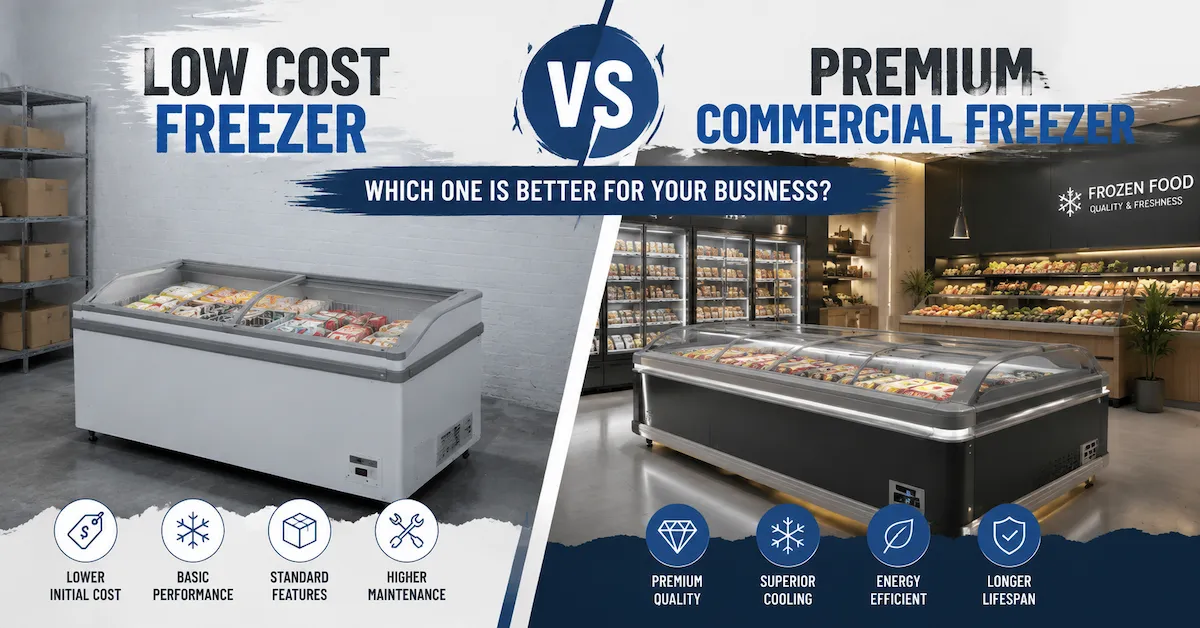
The lowest quotation may not represent the best total value.
A higher quotation may include stronger components, better packaging, more complete customization, or better service.
Common Commercial Freezer RFQ Mistakes
Asking Only for the Lowest Price
Without specifications, the supplier may quote the simplest product rather than the most suitable one.
Failing to State the Application
The same freezer may perform differently in a supermarket, warehouse, restaurant, or hot-climate environment.
Omitting Order Quantity
The supplier cannot calculate accurate bulk pricing without quantity information.
Confirming OEM Requirements After Quotation
Late branding or packaging requests may increase cost and delay production.
Ignoring Freight and Packaging
Unit price alone does not show the total landed cost.
Comparing Different Specifications
Buyers should confirm that every quotation is based on equivalent capacity, components, performance, and customization.
How Snowsea Supports Commercial Freezer RFQs
Snowsea supplies commercial refrigeration products for supermarkets, frozen food retailers, distributors, restaurants, hotels, cold chain companies, and international buyers.
For each commercial freezer quotation request, Snowsea can support:
- Product-model recommendations
- Technical specification confirmation
- Capacity and dimension selection
- OEM/ODM customization
- Private label development
- Packaging planning
- Quality inspection
- Export documentation
- Container-loading information
- Bulk production planning
Buyers can learn more about Snowsea’s manufacturing and international supply capabilities on the About Snowsea page.
FAQ
What information is needed for a commercial freezer quotation request?
Buyers should provide the freezer type, application, capacity, dimensions, temperature, voltage, quantity, OEM requirements, destination, packaging needs, and delivery schedule.
Can I request a quotation without knowing the exact freezer model?
Yes. Provide the application, product category, available space, capacity requirement, and target market so the supplier can recommend a suitable model.
Why do commercial freezer quotations vary between suppliers?
Differences may result from capacity, components, insulation, cooling systems, certifications, OEM scope, packaging, warranty, and service.
Should I request FOB or CIF pricing?
Requesting both can help buyers compare factory-side costs and estimated international freight. The best option depends on the buyer’s logistics arrangement.
How can I receive a quotation faster?
Provide complete technical, commercial, customization, destination, and quantity information in the initial RFQ.
Conclusion
A complete commercial freezer quotation request helps buyers receive accurate prices, suitable product recommendations, clear delivery information, and comparable supplier offers.
The request should define the freezer type, application, capacity, temperature, electrical standard, quantity, OEM requirements, packaging, destination, trade term, and required delivery schedule.
Snowsea supports global buyers with commercial freezer recommendations, customized refrigeration solutions, quality inspection, export packaging, and bulk production.
Explore Snowsea’s commercial refrigeration products or submit your requirements through its OEM and custom solutions to prepare an accurate freezer quotation.