In many commercial environments, complex refrigeration systems are not always the best solution. Businesses often face issues such as high maintenance costs, uneven cooling, or unnecessary energy consumption. A direct cooling freezer system provides a simpler, more stable alternative, especially for applications where consistent low temperature and durability matter more than airflow complexity.
Why Cooling Stability Matters in Commercial Freezers
Temperature fluctuation is one of the main reasons for product loss in frozen storage. In traditional air-circulation systems, uneven airflow can create hot spots or cause moisture imbalance.
Direct cooling systems address this by:
- Using natural heat exchange through evaporator surfaces
- Minimizing airflow disturbance inside the cabinet
- Maintaining more stable and localized cooling zones
This makes them especially suitable for long-term frozen storage rather than frequent display use.
How Direct Cooling Freezer Systems Work
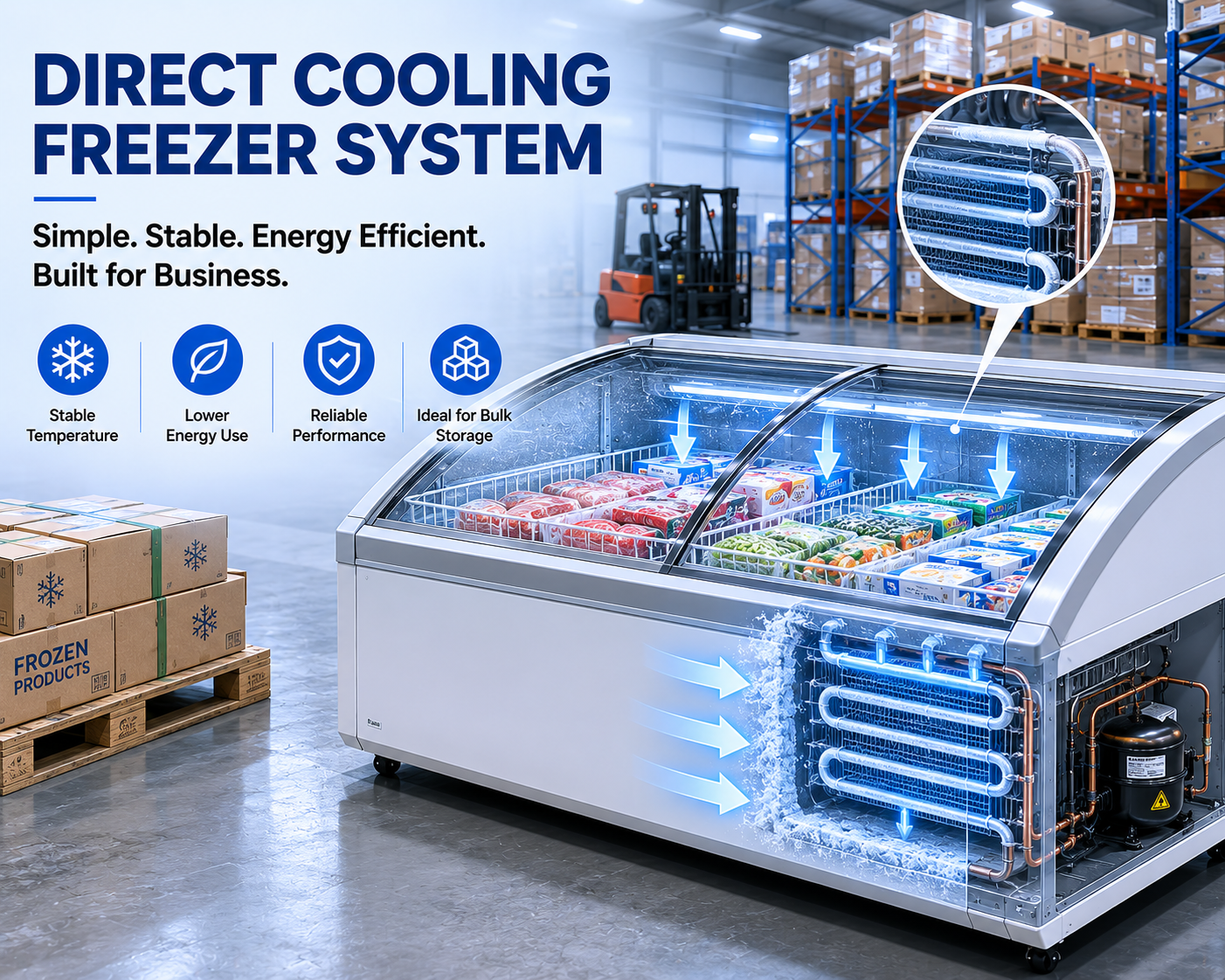
Unlike no frost systems, direct cooling relies on evaporator coils directly absorbing heat from inside the freezer.
Core Mechanism:
- Refrigerant flows through internal coils
- Heat is absorbed directly from stored products
- Cold surfaces gradually reduce internal temperature
Key Technical Characteristics:
| Feature | Direct Cooling System | Benefit |
|---|---|---|
| Cooling Method | Static cooling | Stable temperature |
| Energy Use | Low | Reduced electricity cost |
| Moisture Retention | Higher | Prevents food dehydration |
| Frost Formation | Present | Requires periodic defrost |
While frost may form over time, this trade-off results in better energy efficiency and product preservation.
Where Direct Cooling Freezers Perform Best
A direct cooling freezer system is commonly used in:
- Cold storage warehouses for bulk frozen goods
- Food processing facilities storing meat, seafood, and raw materials
- Low-turnover retail storage where frequent door opening is limited
- Export and logistics hubs requiring stable long-term freezing
Typical Product Scenarios:
- Freezer for Bulk Storage
- Freezer for Supply Chain
- Freezer for Importers
Direct Cooling vs No Frost: Practical Comparison
| Aspect | Direct Cooling | No Frost |
|---|---|---|
| Temperature Stability | High | Moderate |
| Energy Consumption | Lower | Higher |
| Maintenance | Manual defrost | Automatic |
| Moisture Retention | Better | Lower |
| Best Use Case | Storage | Display |
For B2B buyers, the choice depends on whether the priority is efficiency and preservation or convenience and display.
FAQ
Q1: Does frost affect freezer performance?
A1: Over time, excessive frost can reduce efficiency, but periodic defrosting maintains optimal performance.
Q2: Is direct cooling more energy-efficient than no frost?
A2: Yes, it typically consumes less energy due to simpler operation and reduced airflow systems.
Q3: Is it suitable for retail display?
A3: It can be used, but it is better suited for storage rather than high-frequency access environments.
Choosing the Right Cooling System for Your Business
A direct cooling freezer system is ideal for businesses prioritizing stability, energy efficiency, and long-term storage performance.
If your operation focuses on bulk storage, supply chain efficiency, or industrial refrigeration, direct cooling offers a cost-effective and reliable solution.
Explore our full freezer range here: https://www.snowseax.com/
For customized solutions, contact us: https://www.snowseax.com/contact-us