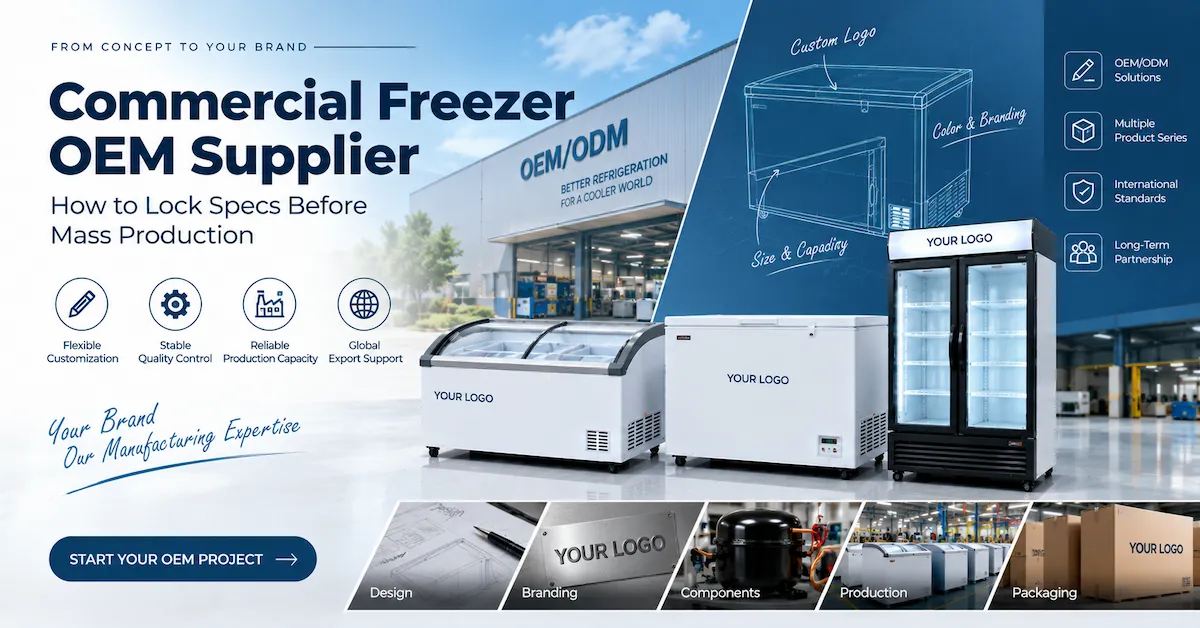
A commercial freezer OEM supplier should not be judged only by whether it can print your logo or offer an attractive sample. For distributors and private-label refrigeration brands, the harder question is whether the exact freezer you approve can be reproduced consistently when hundreds of units enter production and again when the next order is placed.
That makes specification control one of the most important parts of an OEM project. A buyer should know which model is being supplied, which features are standard, which components or appearance details are customized, how the sample will be tested, and what must happen before any change is introduced. If you are still at the supplier-screening stage, SNOWSEA’s existing commercial freezer OEM supplier guide covers the broader partner-selection process. This guide focuses on what happens after you have shortlisted a supplier and need to convert the quotation into a repeatable product.
Who Needs Specification Control in an OEM Freezer Project?
This approach is most useful for importers placing recurring container orders, distributors building their own branded commercial freezer range, frozen-food and ice cream brands deploying equipment into retail locations, and refrigeration companies selling private-label equipment through dealers.
The priorities differ. An importer needs a specification that survives several purchasing cycles. A distributor needs models that local sales and service teams can understand. A retail brand needs consistent graphics, package loading and equipment appearance across locations. A private-label refrigeration company needs the approved product to remain recognizable when replacement parts or repeat orders are requested months later.
For a one-time emergency replacement, a stocked standard freezer may be more practical than developing an OEM version. Likewise, specialist medical, laboratory, blast-freezing or outdoor projects should not be treated as standard OEM food-storage applications without separate technical evaluation.
Start with a Base Model Before Adding OEM Requirements
An OEM project becomes difficult when the customization brief is created before the cabinet itself has been selected. Begin with the application—frozen storage, packaged ice cream display or another clearly defined commercial use—then select the closest standard platform.
SNOWSEA’s commercial refrigeration product range includes freezers, ice cream freezers, refrigerators and display equipment. Its OEM/ODM service is positioned for overseas distributors, brand owners and project buyers that need product configuration, manufacturing and customization support.
A useful base model should already solve most of the technical requirement. OEM work can then focus on justified differences such as branding, labels, packaging, electrical version, accessories or approved configuration changes. If the existing platform cannot meet the basic application, the project may require a deeper ODM development process instead of simple OEM customization.
Compare Base Models by the Job They Need to Perform
The following SNOWSEA products illustrate three different OEM starting points. Published specifications should be reconfirmed in the final quotation and approved product sheet.
| Model | Published information | Potential OEM role | Key item to lock before production |
|---|---|---|---|
| BD-500 | 500L chest freezer, R290, double-lid design, 1650 × 720 × 830 mm | Larger frozen-food storage range | Cabinet configuration, baskets, electrical version and agreed loading requirement |
| BD/BC-227WA | 227L air-cooled no-frost chest freezer with electronic temperature control | Range requiring a no-frost platform | Controller, defrost configuration and applicable performance data |
| SD/SC-268PM | 268L flat sliding-glass ice cream freezer | Branded packaged ice cream display | Glass configuration, basket arrangement, graphics and real package fit |
The BD-500 product page describes adjustable temperature control, removable basket, drain, lock, R290 refrigerant and project-level OEM discussion around target market, capacity, temperature and certification requirements. The BD/BC-227WA is separately positioned as a no-frost series, while SD/SC-268PM belongs to SNOWSEA’s ice cream freezer category.
Do not select a platform by nominal capacity alone. The most suitable base cabinet is the one that already matches the customer’s storage or display task with the fewest unverified technical changes.
Create One Master Specification for the OEM Order
A professional OEM quotation should eventually become a master specification. That document should give purchasing, engineering, quality and the supplier the same version of the product.
The table below can be used as a buyer-side RFQ and approval structure.
| Specification area | What should be defined | What should be approved |
|---|---|---|
| Base model | Exact model and product category | Final model reference |
| Application | Product type and usage environment | Written intended use |
| Capacity and layout | Required loading, basket or shelf arrangement | Approved usable arrangement |
| Cabinet construction | Dimensions, liner, lid or glass configuration | Drawing or product specification |
| Refrigeration system | Cooling type, refrigerant and relevant controls | Quoted component configuration |
| Temperature requirement | Required holding conditions | Test conditions and acceptance criteria |
| Electrical configuration | Voltage, frequency and plug | Nameplate and wiring version |
| Branding | Logo, graphics, cabinet color and model name | Approved artwork |
| Labels and manuals | Rating label, barcode, languages and user documentation | Final document files |
| Packaging | Carton, protection, shipping marks and accessories | Approved packing specification |
| Quality control | Appearance and performance checks | Inspection criteria |
| After-sales | Warranty scope and spare-parts requirements | Written service terms |
The purpose is not to create paperwork for its own sake. It is to prevent a technically important requirement from existing only in a chat message or an old quotation attachment.
Separate OEM Branding from Engineering Changes
Branding changes and engineering changes should follow different approval paths.
Logo placement, cabinet graphics, carton artwork, manuals and model naming are mainly brand-control issues. SNOWSEA’s published OEM information includes logo, cabinet color, side graphics, labels, manuals, carton design, voltage and plug adaptation among typical OEM requirements.
Changes to cabinet dimensions, insulation, refrigeration-system configuration, compressor options or control panels are different. SNOWSEA’s BD-500 product information states that these areas can be evaluated according to project requirements. Because these changes can affect how the product operates, they should not be approved merely by signing off an appearance sample.
A practical OEM approval sheet can therefore divide every request into three columns: branding, configuration, and engineering review required. That simple separation makes it easier to identify which changes need another technical check.
Approve the Sample Against the Specification, Not Memory
A pre-production sample should answer specific questions. Does it contain the agreed component configuration? Does the cabinet match the approved drawing? Is the logo positioned correctly? Are the basket, handle, lid or glass details correct? Does the product identification match the approved model? Does the packaging reflect the correct artwork?
For retail-display equipment, load the sample with the real merchandise whenever possible. An ice cream brand should check actual carton or tub dimensions rather than assuming a 268L cabinet displays a certain number of products. A frozen-food distributor should test whether typical packages can be loaded and removed without creating an impractical arrangement.
Use a sample approval record with three outcomes: approved, requires correction, or not applicable. Avoid a general message such as “sample approved” while technical issues remain unresolved.
Write Temperature Performance as a Test Requirement
“Stable cooling” is not detailed enough for an OEM specification. The buyer should define what must be measured and under what conditions.
The test discussion may include ambient conditions, product load, starting condition, measurement positions, test duration and any opening or replenishment routine relevant to the application. The controller display should not be treated as the only measurement point.
SNOWSEA states that model testing can include temperature uniformity, cooling efficiency and operational stability, while its OEM manufacturing page describes in-house manufacturing and testing as part of the production system. Buyers should request the test information that applies to the specific model and configuration being ordered.
If a specification changes after the sample—for example, a controller or refrigeration component is replaced—ask whether the relevant verification needs to be repeated.
Connect the Approved Specification to Production
A strong commercial freezer OEM supplier should be able to explain how an approved product version reaches the factory floor.
SNOWSEA describes an OEM/ODM production flow including material processing, structural assembly, insulation work, refrigeration-system installation, main assembly, performance testing, final inspection and packaging.
Use that process as a practical review path. Ask where the approved component list is checked. Ask which document tells assembly staff which controller or label belongs to the order. Ask how the correct packaging artwork reaches the packing station. Ask how a unit that fails inspection is identified and handled.
This is more useful than asking only whether the factory has “strict QC.” Quality control becomes meaningful when it can be connected to the product revision you actually purchased.
Define Approved Component Alternatives Before They Are Needed
OEM supply chains occasionally require substitutions. The buyer should decide in advance how substitutions are handled.
For important components, the specification can identify a primary version and any pre-approved alternative. If a proposed replacement is not on that list, require written approval before use. Decide whether the change needs documentation updates or additional performance confirmation.
This protects both sides. The factory has a clear route when a component becomes unavailable, while the buyer avoids discovering a different controller, handle, gasket or packaging material after a container arrives.
For repeat orders, the same rule prevents the model name from remaining unchanged while the product quietly changes underneath it.
Match Certification Documents to the Exact OEM Version
Certification should be handled as a model-specific requirement rather than a company-wide marketing statement.
Provide the target country and applicable product requirements at the start of the project. SNOWSEA’s BD-500 information states that certification support is arranged according to destination-country standards, and its OEM content asks buyers to provide target market and certification requirements during project evaluation.
Before printing compliance-related markings, ask which document covers the quoted model, electrical version and configuration. If the OEM project introduces a structural or component change, confirm whether existing documentation still applies.
Do not assume that a certificate shown elsewhere on a website automatically covers your private-label model.
Ask for MOQ and Lead Time After the Configuration Is Defined
MOQ and lead time make more sense after the OEM scope is clear. A standard model with private-label artwork may have a different commercial structure from a project using special components or modified construction.
Ask whether MOQ applies by model, color, artwork version, voltage configuration or special component. For a product family, clarify whether different models can be combined in one shipment.
The production schedule should also identify the real milestones: specification approval, sample approval, material preparation, production, testing, inspection, packing and shipment readiness. SNOWSEA states that its production planning and in-house manufacturing control are used to manage capacity scheduling for larger orders; the actual timing should still be confirmed for the specific project.
Treat “lead time” and “arrival date” as different things. International transport and destination handling should be shown separately.
Compare OEM Cost Using the Same Approved Configuration
The lowest quotation can become the most expensive option if it excludes requirements that appear in another supplier’s price.
Compare the base freezer, accessories, branding, packaging, sample cost, development cost where applicable, testing, spare parts and delivery responsibilities on the same basis. Mark every item as included, optional, buyer-arranged, or not yet confirmed.
A useful commercial comparison looks like this:
| Cost area | Supplier quotation should clarify |
|---|---|
| Base unit | Exact model and approved configuration |
| Branding | Logo, graphics, labels and manuals |
| Packaging | Standard or customized export packing |
| Samples | Product, freight and revision charges |
| Engineering | Any one-time development work |
| Testing | Standard checks vs. additional buyer requirements |
| Inspection | Factory inspection or separately arranged inspection |
| Spare parts | Initial package and later availability |
| Logistics | Delivery term and excluded destination costs |
Do not describe a quotation as “20% cheaper” until the specification and commercial scope are equivalent.
Build Repeat-Order Control into the First Purchase
The first OEM order should already prepare for the second.
Give the approved product a revision number and reference it on the purchase order. Keep the approved specification, artwork, sample photographs, component list and packaging information together. On the next RFQ, instruct the commercial freezer OEM supplier to quote against that revision and identify any proposed deviation.
SNOWSEA’s company information states that standard spare parts, technical documentation and remote support are provided for long-term product support. Buyers should still confirm which parts and service arrangements apply to the exact model and market.
Version control also helps after-sales teams. When a customer requests a controller, gasket or other component, the service team can refer to the production version rather than relying on a product photograph.
Reduce Packaging and Shipment Risk Before the Container Is Loaded
An OEM cabinet may be technically correct but still create problems if packaging is not part of the approved version.
Confirm carton artwork, model identification, accessories, protective materials and shipping marks before mass production. For glass-top products, discuss glass protection and handling. For private-label equipment, verify that the branding on the cabinet, carton, manual and rating information all correspond to the same approved model.
Before shipment, agree on what the final inspection will verify. The inspection may include quantity, appearance, labeling, accessories, functional checks and packaging. Keep the checklist tied to the purchase specification rather than using a generic inspection form for every freezer.
Send an RFQ That Makes OEM Evaluation Easier
A strong first inquiry gives the supplier enough information to recommend a product instead of guessing what “OEM freezer” means.
Provide the target country, customer type, application, required capacity or product loading, expected operating conditions, voltage and frequency, quantity, branding requirements, packaging needs and target schedule. Add any mandatory documentation and explain which requirements are preferences rather than fixed conditions.
SNOWSEA invites distributors, brand owners and project buyers to discuss OEM/ODM commercial freezer projects through its OEM/ODM page and project contact page. Ask for a model-specific proposal that identifies the base cabinet, confirmed OEM items, items requiring engineering review, sample scope and order-specific commercial terms.
Frequently Asked Questions
1. What does a commercial freezer OEM supplier do?
An OEM supplier provides an existing freezer platform that can be adapted for a buyer’s branding and approved specifications. Typical projects may involve logo, cabinet appearance, packaging, product identification, electrical configuration and selected product options. More substantial design work may move the project closer to ODM development.
2. How is OEM different from buying a standard freezer?
A standard purchase normally uses the supplier’s existing product configuration and branding structure. OEM purchasing adds buyer-specific requirements that must be recorded and approved before production. That makes specification and change control more important.
3. How is OEM different from ODM?
OEM generally starts from an existing product platform and produces it according to the buyer’s approved brand or specification. ODM involves more product-development work, such as structural redesign or deeper technical modification. SNOWSEA presents both OEM and ODM cooperation.
4. What information should I send before asking for an OEM quotation?
Provide the target market, intended use, model or capacity requirement, quantity, electrical requirements, logo or branding needs, packaging requirements and target schedule. If temperature or certification requirements are mandatory, include them in the first brief.
5. Should I approve a sample before mass production?
For branded or modified projects, a sample or pre-production approval can help verify appearance and configuration before volume manufacturing. The approval should refer to a written specification rather than appearance alone.
6. Can the refrigeration system or cabinet structure be customized?
SNOWSEA’s published product information identifies cabinet dimensions, insulation, refrigeration configuration, compressor options and control panels as project-level customization areas. Feasibility should be confirmed for the selected model, and significant changes may require additional verification.
7. What should be checked during OEM freezer quality control?
Checks can include the approved model and components, cabinet appearance, lid or glass operation, seals, accessories, electrical configuration, temperature performance, labels and packaging. Define which checks are performed on every unit and which use an agreed sampling method.
8. What affects OEM freezer MOQ?
MOQ can depend on model, branding, packaging, color, electrical version and custom components. Ask for the MOQ of the actual configuration rather than applying a general number to the entire product range.
9. How can I prevent repeat orders from changing?
Reference an approved specification revision on every purchase order and require the supplier to disclose proposed deviations before production. Keep component, artwork, packaging and sample records associated with that revision.
10. Can SNOWSEA support private-label commercial freezer projects?
SNOWSEA states that its OEM/ODM program serves overseas distributors, brand owners and project buyers and includes integrated production and testing. Buyers can submit project details through the SNOWSEA contact page for model and configuration evaluation.
Conclusion
Choosing a commercial freezer OEM supplier is only the first step in building a reliable private-label product line. The real work is converting the selected freezer into a controlled specification that covers the base model, components, branding, electrical version, performance requirements, packaging, documentation and after-sales support. Approve the sample against that specification, control later changes and reference the same revision when repeat orders are placed. For a SNOWSEA OEM project, send your target market, application, quantity and customization requirements and request a proposal that clearly separates the standard base model, confirmed OEM options, engineering-review items, sample plan and commercial terms.