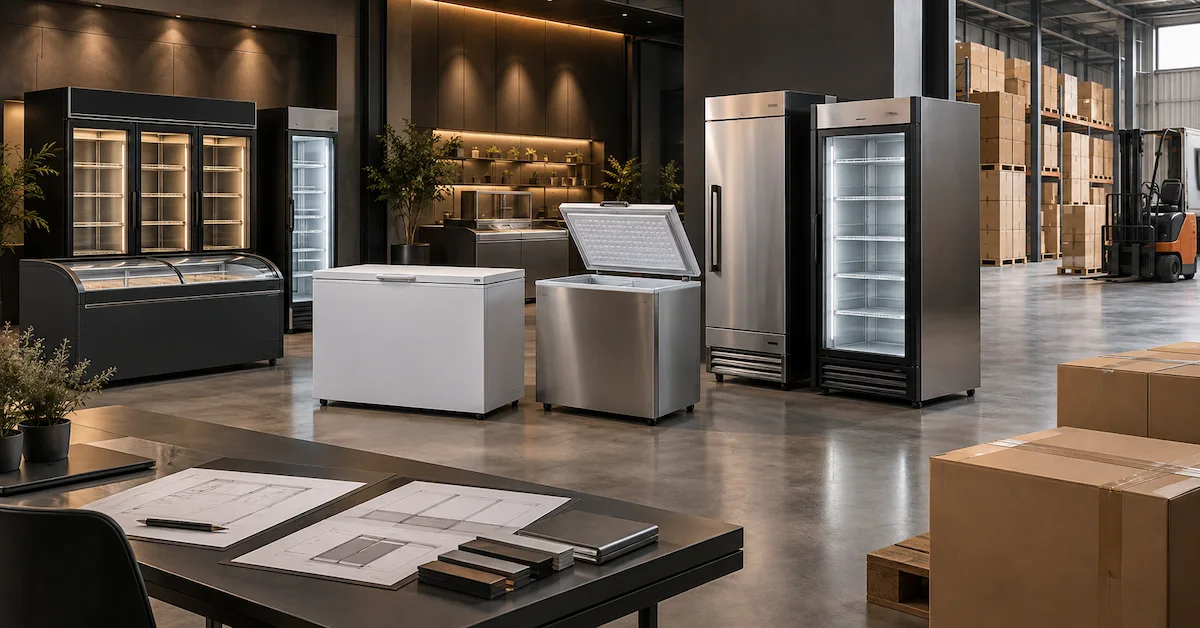
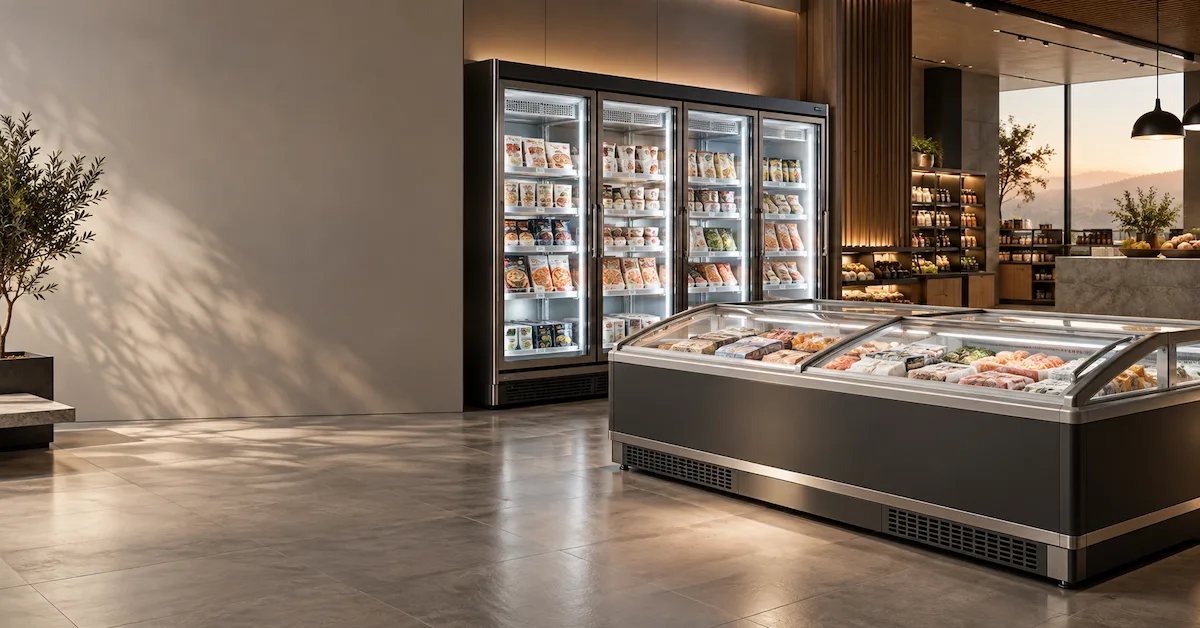
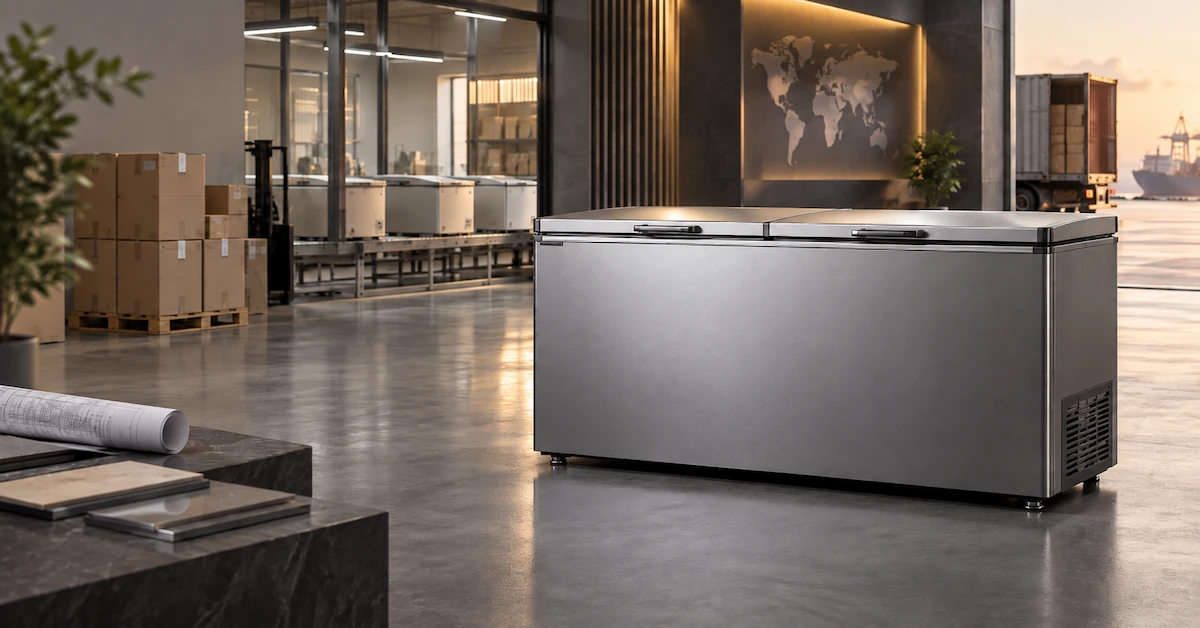
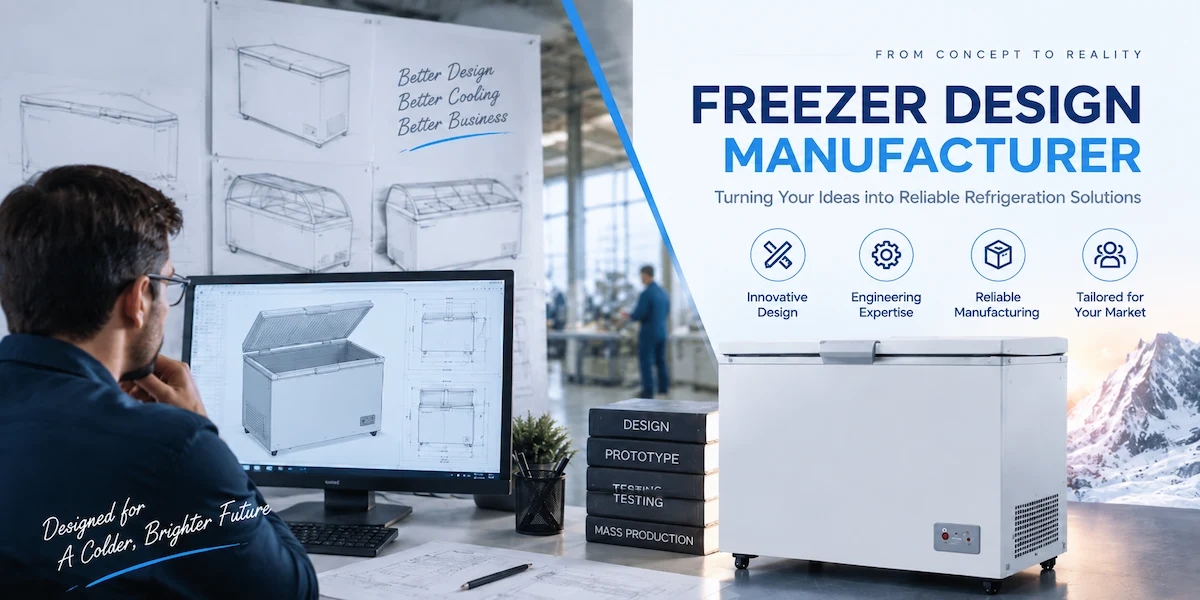
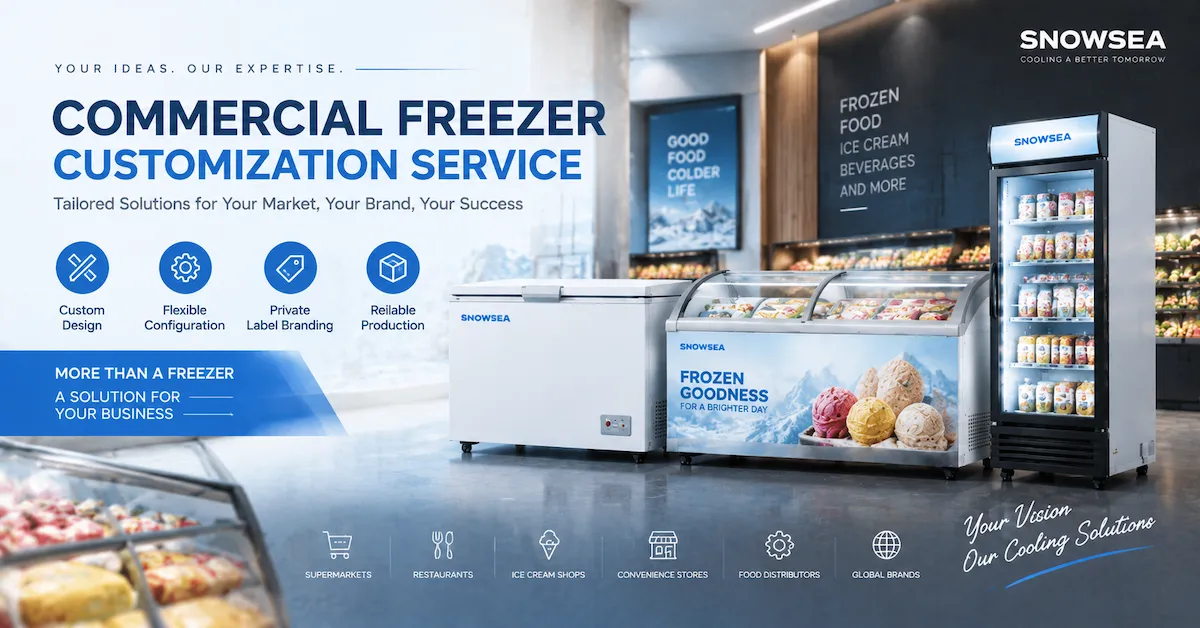
Working with a commercial freezer private label manufacturer gives distributors and refrigeration brands an opportunity to sell equipment under their own identity, but private labeling becomes valuable only when the resulting product line is easy to understand, sell, reorder and support. Adding a logo to several unrelated cabinets may create more SKUs without creating a stronger brand. A better approach is to decide which customers the range will serve, choose a small number of product roles, standardize the brand execution and control the technical specification behind each model. SNOWSEA supplies commercial refrigeration products across freezer, ice cream freezer, refrigerator and showcase categories and supports OEM/ODM projects for overseas distributors, brand owners and project buyers.
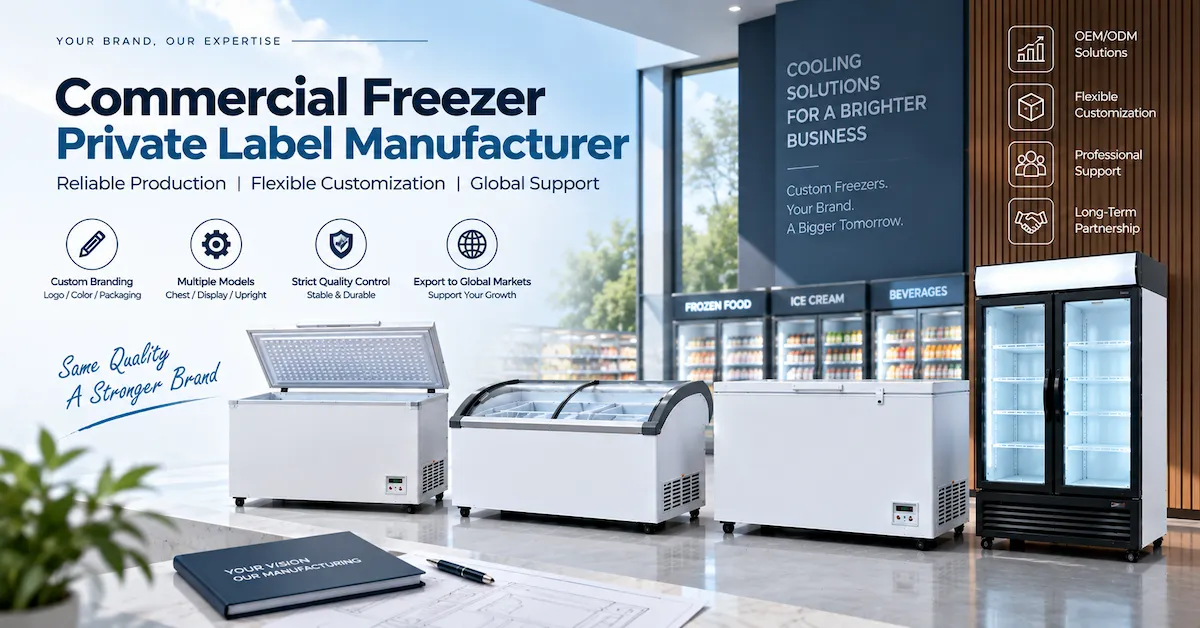
Private Label Manufacturing Is More Than Putting a Logo on a Freezer
A private-label freezer normally starts from a manufacturer’s existing product platform and is marketed under the buyer’s brand.Depending on the project, customization may include the logo, cabinet appearance, model number, rating label, manuals, packaging, electrical version and selected product configuration. More substantial changes to cabinet structure, refrigeration design or controls move the discussion closer to a deeper OEM or ODM project.
The distinction matters commercially. A distributor that mainly needs a recognizable branded range may gain more from consistent appearance, packaging and documentation than from redesigning the refrigeration system. By contrast, a buyer with a requirement that an existing cabinet cannot meet may need technical development instead of private labeling alone. SNOWSEA’s existing private-label product-line guide similarly emphasizes target customers, product categories, branding, packaging and long-term supply rather than logo placement alone.
Who Should Build a Private Label Commercial Freezer Range?
Private labeling is particularly relevant to refrigeration distributors that want to reduce direct price comparison with generic products, importers building a regional equipment brand, supermarket-equipment suppliers that want a standardized range, ice cream or frozen-food brands deploying equipment through retail channels, and established appliance brands adding commercial refrigeration to their portfolio.
It is less attractive when the requirement is a single urgent freezer, when the buyer has no plan for local spare parts or warranty handling, or when annual demand is too fragmented to support consistent stock and packaging. Specialist applications such as laboratory storage, medical cold storage, blast freezing or unverified outdoor operation should also be evaluated separately instead of being automatically included in a standard private-label food refrigeration range.
Build the Product Line Around Customer Jobs, Not Catalog Pages
One of the easiest ways to create SKU chaos is to start by selecting many models and only later decide who will buy them. Reverse the process. Define several recurring customer jobs first, then choose the smallest number of cabinets needed to cover them.
A refrigeration distributor might begin with four roles: a medium storage freezer for restaurants and retailers, a larger chest freezer for higher-volume frozen stock, a differentiated no-frost option, and a glass-top model for packaged ice cream display. Additional models should enter the range only when they solve a customer requirement the existing assortment cannot address.
A useful internal question is:
“If this model disappeared from our catalog tomorrow, which customer requirement could no longer be served?”
If the sales team cannot answer clearly, the SKU may be adding complexity rather than market coverage.
Compare SNOWSEA Base Models Before Creating Private Label SKUs
The following products illustrate how different models can occupy different roles in a branded range. Published capacities are catalog figures; final usable capacity, included accessories and order configuration should be confirmed before approval.
| Model | Published positioning | Potential private-label role | What the buyer should confirm |
|---|---|---|---|
| BD-308 chest freezer | 308L chest freezer | Core medium-size frozen-storage SKU | Usable loading space, baskets,liner and included accessories |
| BD-500 chest freezer | 500L chest freezer with double-lid format | Larger-capacity storage SKU | Actual package loading, accessories and electrical version |
| BD/BC-227WA no-frost freezer | 227L air-cooled no-frost chest freezer | Differentiated maintenance-focused SKU | Controller, defrost configuration and performance data |
| SD/SC-268PM ice cream freezer | 268L flat sliding-glass ice cream freezer | Customer-facing packaged ice cream SKU | Basket layout, package fit,branding surface and glass configuration |
SNOWSEA already publishes BD-308, BD/BC-227WA and SD/SC-268PM as separate platforms serving different storage or display needs.
Do not automatically turn every cabinet size into a private-label model. A range with three well-defined products can be easier to stock, train, market and service than eight overlapping capacities.
Create a SKU Architecture Before Naming the Products
A private-label model number should tell your organization which controlled product it represents. It should not change casually between marketing material, cartons and spare-parts records.
Before deciding product names, create a simple SKU structure covering:
| SKU element | Example decision |
|---|---|
| Product family | Chest freezer, no-frost freezer, ice cream display |
| Capacity class | Small, medium, large or approved numerical reference |
| Door/glass type | Solid lid, sliding glass,curved glass |
| Electrical version | Destination-specific code where needed |
| Brand series | A consistent commercial naming family |
| Revision | Internal revision reference for specification control |
The exact naming method belongs to your brand. The important point is that one private-label model stays linked to one approved product specification. SNOWSEA’s existing private-label factory content also emphasizes keeping the buyer’s model number connected to a controlled factory specification.
Standardize Brand Identity Across Different Cabinets
Private-label branding becomes more effective when several freezer types look as though they belong to the same family. Standardize the elements buyers and service teams see repeatedly: logo position, brand colors, model naming, rating-label style, carton layout, manual cover, warranty information and product photography style.
Do not force identical graphics onto cabinets with different physical layouts. Instead, create brand rules that can adapt. A small chest freezer and a large glass-top display may need different logo sizes and positions, but typography, color references and information hierarchy can remain consistent.
A brand manual for the freezer range can contain a cabinet artwork page, carton artwork page, label rules, model-naming rules and approved color references. This is more reusable than approving every new SKU from scratch.
Separate Brand Customization from Technical Customization
The commercial freezer private label manufacturer should clearly distinguish changes that affect the brand from changes that may affect the product’s engineering.
Brand-related items may include logo, cabinet graphics, product name, rating-label layout, manual language and packaging artwork.
Configuration items may include baskets, locks, lighting, shelves, plugs or other model-dependent options.
Engineering changes may include cabinet dimensions, insulation, refrigeration configuration, compressor selection or controls.
SNOWSEA’s OEM documentation and published commercial freezer material describe both branding requirements and deeper configuration or engineering discussions.
Do not let a design approval automatically authorize a technical change. A correct logo does not prove that the refrigeration specification has been approved.
Use a Private Label Master Specification
The most useful document in the project is not the logo artwork. It is the master specification that links the branded product to the cabinet being manufactured.
| Specification area | What should be controlled |
|---|---|
| Private-label model | Buyer’s model number and product family |
| Factory base model | Manufacturer reference |
| Application | Intended frozen storage or display use |
| Dimensions | Approved cabinet dimensions |
| Capacity | Confirmed published and usable information |
| Refrigeration | Cooling method, refrigerant and relevant components |
| Temperature requirement | Agreed operating or test requirement |
| Electrical | Voltage, frequency, plug and control version |
| Accessories | Baskets, shelves, locks, lighting and other included items |
| Branding | Logo, colors and cabinet artwork |
| Rating label | Model,electrical information and required product identification |
| Documents | Manual language and version |
| Packaging | Carton design, protection and shipping marks |
| Inspection | Appearance, functional and performance acceptance criteria |
| Service | Warranty and spare-parts arrangement |
Give the specification a revision number. Put that revision on sample approval records and repeat purchase orders.
Approve the Private Label Sample in Two Different Ways
A branded sample has to pass both product approval and brand approval.
For product approval, check cabinet dimensions, operation, lid or glass movement, gasket fit, baskets or shelves, electrical configuration and the agreed performance requirements. For retail models, load the actual product packaging where possible.
For brand approval, check logo size and position, cabinet colors, model identification, rating label, manual, carton artwork and accessories.
Do not combine these into a single question such as “Is the sample okay?” A sample can look correct while containing the wrong electrical version. It can also perform correctly while carrying incorrect model or packaging information.
SNOWSEA’s private-label guidance similarly recommends checking technical performance and brand execution on a representative sample before mass production.
Make Packaging Part of the Brand, Not an Afterthought
For distributors, the carton may be the first brand touchpoint seen by a warehouse, dealer or installer. Standardize product name, model number, brand mark, handling symbols, barcode position and document placement.
Packaging also has a physical job. The final solution should protect cabinet corners, handles, controls, lids or glass and loose accessories during the intended transport route.
If private-label artwork changes the carton, request final packed dimensions before confirming container planning. Do not rely on a loading quantity calculated for another packaging version.
Private-label manuals should also match the actual model. Generic instructions can create support problems when control panels, installation requirements or accessories differ.
Match Rating Labels to the Actual Product Specification
The rating label should reflect the equipment being supplied. Depending on the product and destination requirements, information may include model identification, voltage, frequency, refrigerant and other technical data.
Never treat the rating label as merely another branding graphic. Technical information should come from the approved product specification, while logo, layout and language follow the private-label design.
Before production, confirm that the label, manual, carton and purchase specification all identify the same product version. This simple cross-check can prevent downstream confusion for distributors, customs documentation, installers and service technicians.
Connect Private Label Approval to Factory Production
SNOWSEA’s OEM/ODM service describes manufacturing stages including material processing, cabinet assembly, insulation work, refrigeration-system installation, final assembly, testing, inspection and packing. Buyers can use that process to ask how the private-label specification travels through production.
Useful questions include: Which document tells production which branding version is required? How is the correct rating label assigned to the cabinet? Where are accessories verified? How are artwork changes controlled? How is a nonconforming unit identified before packing?
The purpose is not to eliminate every manufacturing issue. It is to ensure that deviations can be found and corrected before shipment.
Keep Compliance Separate from Marketing Claims
Destination-market requirements should be defined early. Request the documents applicable to the exact model and electrical configuration being ordered, and confirm whether private-label naming or technical changes affect the documentation.
Do not copy certification marks from another model, another market or a marketing image onto your private-label carton without confirming applicability.
Similarly, avoid adding performance statements such as “energy saving,” “ultra-low noise,” “fast freezing” or a specific savings percentage unless the claim can be supported for the approved version and relevant test conditions.
A stronger private label is built on claims that can survive customer and distributor questions.
Control MOQ by SKU Before Expanding the Range
Every additional model can create more than one new inventory requirement. Different cabinet sizes, electrical versions, artwork, cartons and spare parts can each increase purchasing complexity.
Before adding an SKU, ask the commercial freezer private label manufacturer how MOQ applies: by base model, color, electrical configuration, carton artwork or other customization grouping.
Then calculate the effect on your own inventory. If five models each require separate stock, slow-moving SKUs may tie up more working capital than the extra catalog coverage produces.
A useful private-label launch often starts narrower and expands after real sales data shows where another product is needed.
Build Lead Time Around Product Approval
Separate development and production timing. A typical private-label workflow may include model selection, artwork preparation, specification confirmation, sample production, sample correction, material preparation, mass production, inspection, packing and shipment readiness.
Ask what starts each stage. A factory may be able to manufacture the cabinet, but production cannot proceed correctly if the buyer has not approved artwork or documentation.
For launch planning, distinguish the factory shipment-ready date from international transit and warehouse availability. Retail launch dates should be based on the complete chain rather than production lead time alone.
Compare Private Label Cost on a Repeat-Order Basis
The first order often contains expenses that may not repeat. Separate them.
| Cost area | First order | Repeat order |
|---|---|---|
| Base freezer | Recurring | Recurring |
| Standard accessories | Recurring | Recurring |
| Logo application | Usually recurring | Usually recurring |
| Custom packaging | Usually recurring | Usually recurring |
| Sample | Often one-time or project-specific | Usually not repeated unless specification changes |
| Artwork/setup | Often one-time | May not repeat |
| Engineering/development | Project-specific | Usually not repeated unless design changes |
| Tooling | Where applicable | Depends on ownership and maintenance terms |
| Testing | Standard or project-specific | Depends on requirement |
| Spare-parts provision | Based on service plan | Replenished as needed |
This view is more useful than calculating margin from the first sample quotation alone.
Also include destination logistics, import costs, warehousing, warranty reserve and local service responsibilities when evaluating the commercial model. A private-label project is profitable only if the channel can support the product after it leaves the factory.
Plan Spare Parts Around the Product Line, Not Individual Shipments
Private-label expansion should simplify after-sales service where possible. Before adding another freezer, check whether it introduces different controllers, gaskets, baskets, glass components or other commonly requested parts.
SNOWSEA’s company information describes spare-parts availability, technical documentation and remote support. Confirm the model-specific arrangement for your market and order.
Maintain a parts cross-reference linking your private-label model to the relevant production version. Avoid asking service teams to identify replacement components from photographs alone.
For dealers, a small, documented spare-parts range can be a stronger selling advantage than offering many overlapping freezer models.
Create a Change-Control Rule for Repeat Orders
Private-label brand consistency depends on technical consistency too. When a component, artwork file, packaging material or specification needs to change, require the change to be disclosed before production.
A simple repeat-order instruction can read:
“Quote and manufacture according to Private Label Specification Revision PL-03. List any proposed deviations separately for approval.”
That protects both sides. The buyer knows which product is being reordered, while the manufacturer has a formal path for proposing necessary changes.
For changes that could affect performance or compliance, confirm whether another sample or additional verification is required.
Protect the Channel by Controlling Product Information
Private-label buyers should also decide how product information will be used across distributors, e-commerce listings, dealers and service documents.
Create one approved source for model specifications, product photographs, dimensions, manuals and warranty conditions. If each reseller creates its own technical information, inaccurate claims can quickly spread through the market.
For custom designs or tooling, discuss ownership, permitted use, confidentiality and any exclusivity expectations separately in writing. Do not assume private labeling automatically provides territorial or design exclusivity.
What Should You Send for a Private Label Freezer Quotation?
A high-quality inquiry allows the manufacturer to recommend a base model and separate standard private-label work from development.
Provide:
- Target country and sales channel
- Main buyer or end-user type
- Required freezer category
- Preferred capacity or package-loading requirement
- Electrical voltage and frequency
- Estimated quantity per model
- Required logo and cabinet branding
- Model-naming preference
- Packaging and manual requirements
- Mandatory market documents
- Target launch or arrival date
- Expected future product-line expansion
SNOWSEA accepts OEM/ODM and private-label project discussions through its contact page.Rather than requesting only “your private label price,” ask for a proposed base model, included customization, sample scope, MOQ by SKU, production milestones and any items that still require technical review.
Frequently Asked Questions
1. What is a commercial freezer private label manufacturer?
A commercial freezer private label manufacturer produces commercial refrigeration equipment that another business sells under its own brand. Depending on the project, customization can include logo, cabinet graphics, model number, labels, manuals, packaging, electrical configuration and selected product options.
2. Is private label the same as OEM?
They overlap, but the commercial purpose can differ. Private labeling often focuses on selling an existing manufacturer platform under the buyer’s brand, while OEM projects can involve broader specification changes. Deeper structural development may require ODM work.
3.What freezer models should a new private-label range start with?
Start with the customer jobs you need to cover. A distributor might select a medium chest freezer, a larger storage model and one differentiated display or no-frost product before expanding. Avoid selecting many capacities that serve nearly identical buyers.
4. Can SNOWSEA add my brand to commercial freezers?
SNOWSEA publishes OEM/ODM and private-label support for distributors, brand owners and project buyers. Final options depend on the selected product and project requirements, so branding and configuration should be confirmed model by model.
5. Can I customize the carton and user manual?
Private-label projects can include packaging and document customization. Approve carton artwork, product model, language and manual version against the final product specification before mass production.
6. What should I check on a private-label freezer sample?
Check technical configuration and brand execution separately.Review dimensions, controls, accessories, operation and relevant performance requirements, then verify logo placement, model number, rating label, manual and packaging.
7. What determines MOQ for private-label commercial freezers?
MOQ can depend on the base model, branding method, artwork, electrical version, color and custom components. Request the minimum for the actual SKU rather than assuming one MOQ applies to the entire range.
8. How can I prevent specifications from changing on repeat orders?
Give every approved private-label product a controlled specification revision and reference it on each purchase order. Require proposed component, artwork or packaging changes to be disclosed before production.
9. Should every private-label freezer use different custom components?
Not necessarily. Where the commercial requirement can be met with existing proven components, excessive customization may increase MOQ, spare-parts complexity and service cost. Customize where it creates measurable market or operating value.
10. What information should I send SNOWSEA for a private-label project?
Provide your target market, customer type, freezer category, quantity, electrical requirements, branding, packaging and documentation needs. Use the SNOWSEA project inquiry page to request suitable base models and a project-specific customization proposal.
Conclusion
Choosing a commercial freezer private label manufacturer is ultimately about building a product line your market can recognize and your business can control. Start with clearly defined customer jobs, select a limited number of suitable base models, standardize branding and documentation, and connect every private-label SKU to an approved technical specification. Sample approval, MOQ, packaging, spare parts and repeat-order change control should be designed before the range becomes large. SNOWSEA offers freezer, ice cream freezer, refrigerator and showcase platforms together with OEM/ODM support for private-label projects. If you are preparing a distributor range or refrigeration brand launch, send SNOWSEA your target market, planned models, quantity and branding requirements and request a model-by-model proposal showing the recommended base cabinet, customization scope, sample plan, MOQ and repeat-order requirements.