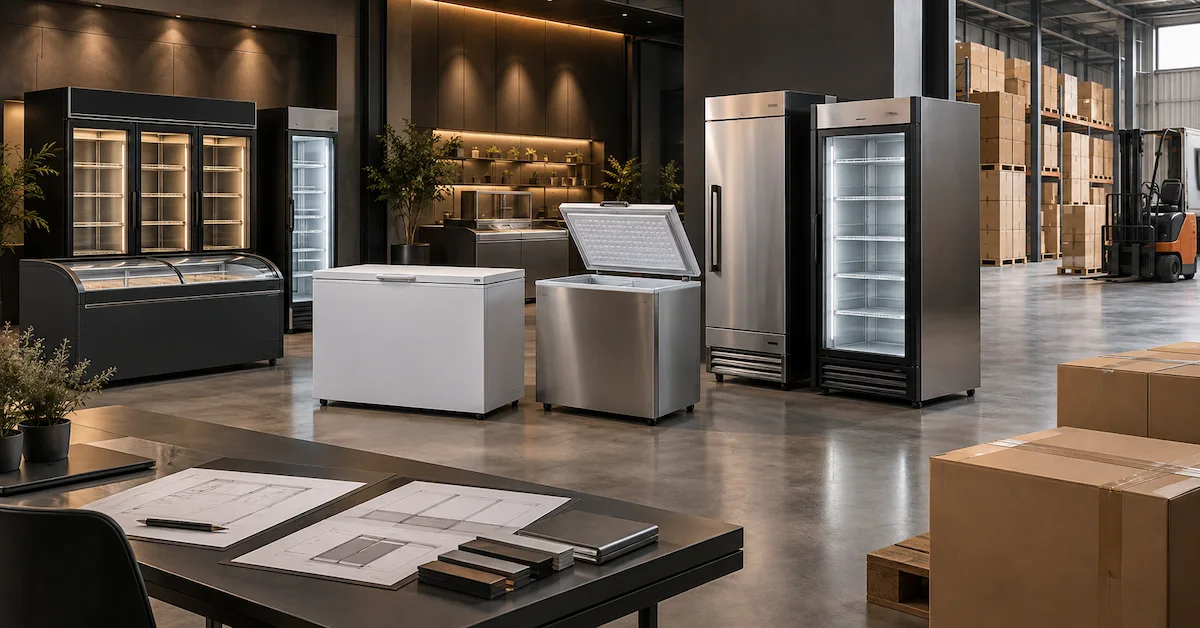
An OEM commercial freezer manufacturer should be evaluated on more than the appearance of a branded sample. For a private-label launch, you need an agreed cabinet configuration, evidence that it meets the intended application, and a way to reproduce that version when you reorder. Start with the product and destination-market requirements; settle branding, testing, packaging and service responsibilities before comparing final prices. The approval framework below is designed for buyers planning a repeatable product range, rather than a one-off purchase with a logo attached.
When OEM Manufacturing Fits Your Business
Consider OEM manufacturing when your business needs its own branded freezer range, a consistent cabinet specification across multiple outlets, or defined configurations for different customers. For a refrigeration distributor, begin with the product your dealers can sell and support. For an ice cream brand, begin with the packaged assortment and store footprint. For a foodservice equipment supplier, begin with storage routines and installation constraints. Compare locally stocked equipment when the need is an urgent single-unit replacement. For laboratory, vaccine, outdoor or blast-freezing projects, request separate application validation rather than treating a standard commercial freezer as an automatic match.
What an OEM Commercial Freezer Manufacturer Should Confirm Before Pricing
Describe the work rather than relying on the OEM/ODM label alone. Specify whether you want an existing cabinet under your brand, an existing design with selected changes, or development of a different cabinet. Keep appearance requests—logo placement, color references and artwork—separate from changes to dimensions, insulation, glass, controls or the refrigeration system. Ask for a written feasibility review of the technical requests and a list of any additional samples or tests needed. SNOWSEA describes branding, appearance, packaging and product-development support in its retail-brand freezer development guide. Treat those areas as a starting point for discussion, not a promise that every option is available on every model. A useful response from an OEM commercial freezer manufacturer should identify what stays standard, what changes, and what remains subject to approval.
Choose the Base Model Around the Job It Must Do
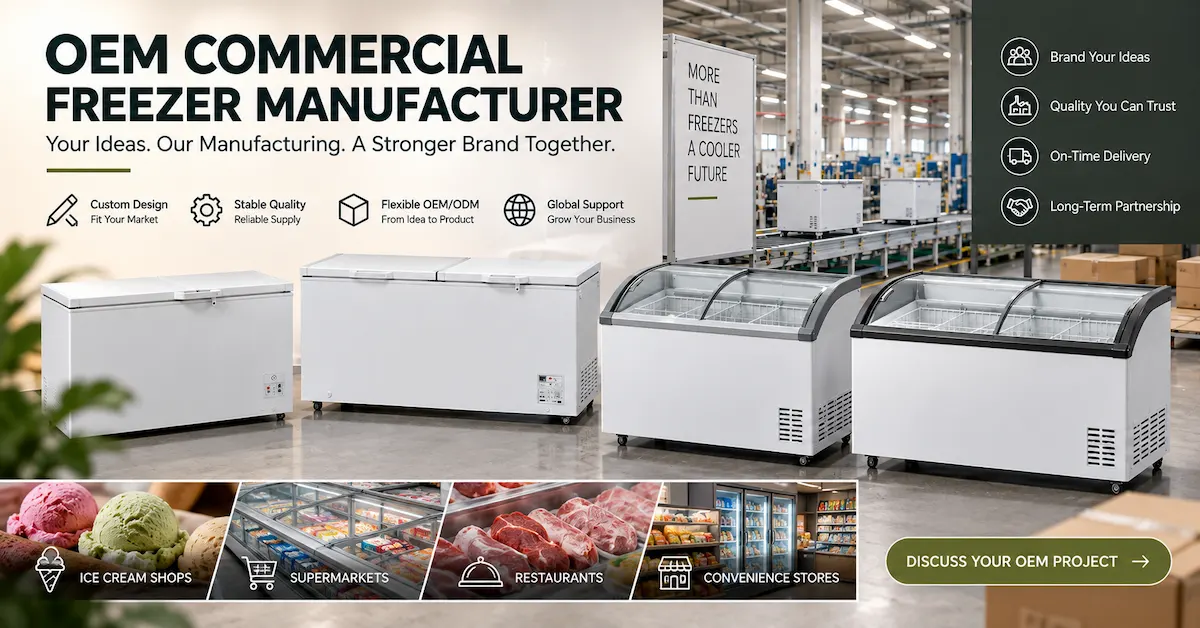
For a first range, shortlist by application before adding cosmetic variations. A frozen-storage cabinet and a customer-facing ice cream display may share your artwork but need separate technical specifications. The following SNOWSEA products provide three starting points. Capacities are published catalog figures, not independently verified net-volume measurements; the purchasing roles and quotation checks are suggested evaluation criteria.
| Model | Published product information | Suggested role in a private-label range | What to resolve in the quotation |
|---|---|---|---|
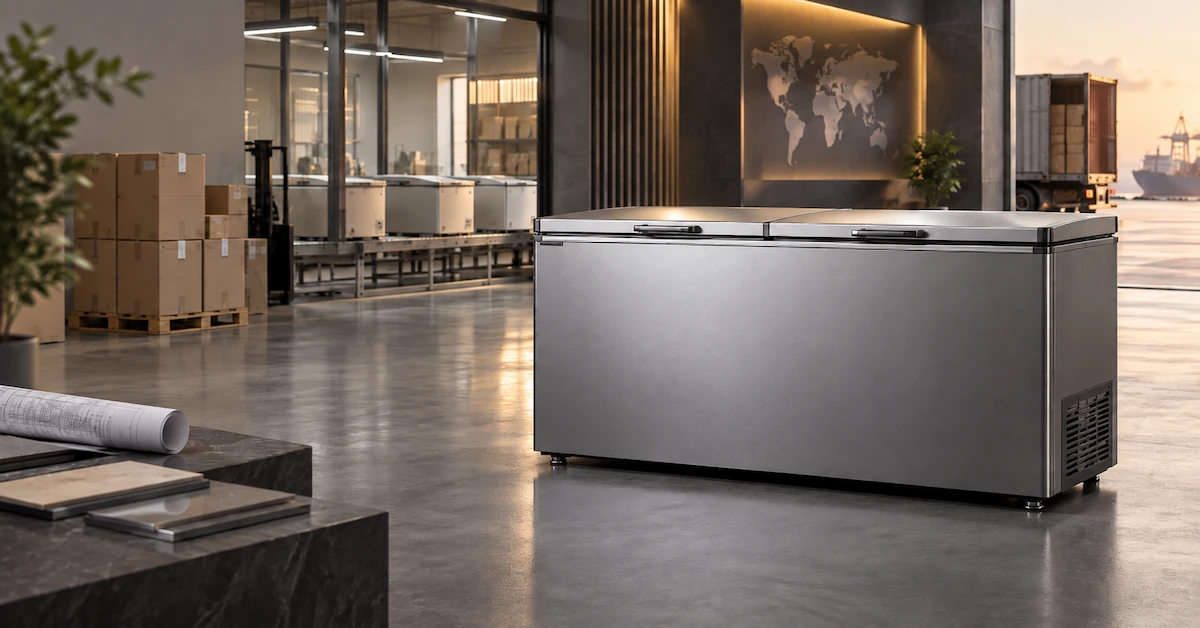
| BD-308 chest freezer | 308L chest freezer. | A storage-focused model for buyers evaluating packaged frozen-stock capacity | Usable dimensions, basket arrangement, finish and included accessories |
| BD/BC-227WA no-frost chest freezer | 227L, air-cooled no-frost design and electronic temperature control. | An alternative for customers prioritizing the defrost routine | Controller version, maintenance requirements and comparable energy-test data |
| SD/SC-268PM ice cream freezer | 268L sliding flat-glass-door ice cream freezer. | A display-focused model for packaged ice cream sales | Actual package fit, retail access, branding layout and holding requirements |
Do not assign a low, medium or premium cost category until the selected configurations have been quoted on the same basis. A capacity figure alone does not tell you which cabinet gives your customer the more useful assortment or loading arrangement.
Create a Specification That Survives the Sample Stage
Before commissioning the final sample, give the product a revision-controlled approval sheet. In plain terms, this is a dated specification with a version number that both parties use. Ask your OEM commercial freezer manufacturer to identify every standard feature and separately priced option. Include the component list, drawings and artwork in the same approval package rather than allowing different versions to circulate in separate messages. Use the following as a buyer-side specification template, not as a statement of universal SNOWSEA operating limits.
| Specification item | What to define for the project | Evidence or confirmation to request |
|---|---|---|
| Application and load | Product type, packaging dimensions, intended storage or display use, replenishment routine | Written application review and loading arrangement |
| Capacity and access | Required usable space, baskets, opening clearance and installation footprint | Confirmed dimensions, drawings and sample loading photos |
| Temperature performance | Required holding conditions, incoming load temperature and measurement locations | Agreed test method, conditions and acceptance limits |
| Electrical configuration | Destination voltage, frequency, plug and any supply concerns | Matching specification, wiring information and nameplate |
| Refrigeration and controls | Cooling method, defrost arrangement, refrigerant and controller version | Approved configuration and relevant performance evidence |
| Materials and components | Liner, glass, seals, handles, baskets and component identifiers | Material descriptions, inspection criteria and approved alternatives |
| Appearance and documents | Logo position, color reference, model name, manual and label language | Approved artwork files and document revisions |
| Packaging and identification | Protective materials, carton dimensions, shipping marks and serial identification | Packing specification, marking proof and agreed transport checks |
Separate Appearance, Performance and Production Approval
Inspect the Sample as a Product, Not a Photograph
Use your actual packaged goods to check access and loading. Inspect the lid movement, basket removal, handle clearance, visible finish, gasket contact and access for cleaning. Compare the logo position and color against the approved reference, not a screen image viewed under unknown settings. Photograph accepted details as well as anything that needs correction. Record a decision for each issue: approved, revise and resubmit, or accepted as a specifically documented exception. Do not leave an unresolved item hidden inside a general “sample looks good” message.
Test Against the Intended Operating Conditions
Ask for a sample test plan before requesting a pass result. Specify the ambient conditions, loading arrangement, incoming product condition, measurement locations and test duration that matter to your application. Include a defined opening or replenishment exercise where relevant. Request energy and noise measurements under stated conditions when those figures will influence purchasing or marketing. For a no-frost model, include the defrost behavior in the discussion. A temperature display photograph should be supporting material, not your entire acceptance record. Keep the results tied to the exact sample configuration.
Release a Documented Production Version
After corrections are complete, agree on a retained reference sample and the specification that governs production. Include approved artwork, components, accessories, packaging and required documents. Ask both parties to identify who may approve changes. For a development project, discuss whether a pilot run is needed before the main order and obtain its quantity, cost and purpose in writing. Production release should mean the product definition is settled—not simply that an invoice has been paid or the exterior has been accepted.
Connect Factory Capability to Your Order
SNOWSEA’s OEM/ODM manufacturing page describes material preparation, cabinet-panel assembly, insulation foaming, refrigeration-system installation, final assembly, performance validation, final checking and packaging, then shipment. When evaluating an OEM commercial freezer manufacturer, follow your proposed model through that sequence. Ask where its specification is checked, how component changes are recorded, and how inspection results are associated with a production batch. Discuss workmanship checks such as panel alignment, lid fit, visible sealing quality and accessory installation. The point is to connect the manufacturing process to an order you can identify and inspect, rather than relying on workshop photographs as evidence that a shipment meets the agreed specification.
Match Compliance Documents to the Private-Label Version
Before approving packaging artwork, request the documents relevant to the destination and ask which model, brand name, electrical version and configuration they cover. Have the applicable requirements reviewed by the party responsible for compliance in that market. Do not print a certification mark or an energy claim simply because it appears on a different product image. Ask the manufacturer to identify any review needed after changes to components, controls or product identification. Keep compliance approval separate from appearance approval: attractive artwork is not confirmation that a label is ready for use. Final document scope must be checked for the quoted product, not inferred from a general company certificate display.
Compare the First Order and Repeat Orders Separately
Request a quotation that separates the base cabinet, recurring options, branding, packaging, samples, development, tooling where applicable, testing, inspection and the agreed delivery scope. Ask which charges recur and which are one-time costs. Assess the first order using a realistic launch quantity rather than spreading development expenses across sales you have not secured. When comparing proposals from an OEM commercial freezer manufacturer, keep the configuration and included services identical. An apparently lower unit price deserves another look when it excludes accessories or responsibilities included elsewhere. Discuss payment milestones, quote validity and what happens to committed materials when the buyer changes the specification. Obtain professional review of contract terms where needed.
Build Lead Time Around Approval Milestones
Ask the OEM commercial freezer manufacturer for MOQ by model and configuration, including any separate requirements for colors, artwork or custom components. Do not assume one quoted minimum applies to the entire range. Then request a schedule showing specification approval, sample completion, corrections, material preparation, production, inspection and shipment readiness. Establish what starts each interval and what information the buyer must supply. Keep manufacturing time separate from transport and destination delivery. For recurring purchases, share a forecast and ask how the proposed volume fits the production plan. Treat a forecast as planning information, not automatically as a purchase commitment, and confirm any material-reservation arrangement separately.
Approve Packaging and After-Sales Support Before Shipment
Make the packaging specification part of the product approval. Review the proposed protection for glass, corners, handles and loose accessories; confirm packed dimensions and agree transport checks appropriate to the route. Request a loading plan for the actual container and packaging configuration rather than estimating from cabinet capacity. At the same time, settle warranty scope, exclusions, claim evidence, parts supply, labor responsibility and freight responsibility. SNOWSEA’s company and service information lists spare-parts availability, technical documentation and remote support. Ask how these services apply to your selected model and destination. Before marketing your own customer warranty, make sure the supplier arrangement and your local service plan support what you intend to promise.
Protect Repeat Orders with a Change-Control Rule
Ask your OEM commercial freezer manufacturer to acknowledge the approved revision when accepting every repeat order. Require proposed changes to components, artwork, packaging or product identification to be reviewed before implementation, and define which changes need another sample or further verification. Do not assume a shared model name makes parts from different production versions interchangeable. Keep your own record connecting purchase orders, serial or batch identifiers, specifications and service information. A practical reorder instruction is: “Quote against the attached approved revision and identify every proposed deviation.” This gives the next order a clear reference instead of relying on someone remembering the first sample.
Start a SNOWSEA Project with a Focused Brief
SNOWSEA describes OEM/ODM support for overseas distributors, brand owners and project buyers, while its contact page provides a route for standard-model and customized-project discussions. To start, send the target country, intended customer, storage or display application, product packaging dimensions, required capacity and temperature conditions, electrical specification, estimated quantity and target arrival date. Separate mandatory requirements from preferences and include available logo or artwork files. Through the SNOWSEA project inquiry page, request a proposal identifying the recommended base model, confirmed options, unresolved technical points, sample scope and commercial terms. This creates a more useful discussion than asking for a price on an undefined “OEM freezer.”
Frequently Asked Questions
What should an OEM commercial freezer manufacturer provide before I place an order?
Request a model-specific quotation, a defined customization scope, an approval specification, sample arrangements and the documents required for your market. Agree how production changes, inspection, packaging and after-sales issues will be handled. Treat these as items to confirm, not services automatically included in every quote.
Can I put my own brand on an existing freezer model?
Discuss an existing-cabinet private-label project with SNOWSEA and submit the proposed logo, appearance and packaging requirements. Its published OEM development content includes branding support. Ask which changes are available for the selected model and which require additional development or approval.
Should I develop a new cabinet or start from a standard model?
Start by identifying the requirement an existing model cannot satisfy. Where a suitable base cabinet meets the application, compare that route with new development on cost, timing, validation and expected volume. Commission additional design work to solve a defined need, not simply to make the product different.
Can cabinet size, controls or refrigerant be changed?
Submit these as technical requests and ask for feasibility, cost and validation requirements. Do not treat them as interchangeable cosmetic options. Request a revised specification and confirmation of the relevant documentation before approving the changed version for production.
What is the MOQ for private-label commercial freezers?
Use the supplier’s current, model-specific quotation. Clarify whether the minimum is counted by cabinet model, color, artwork or custom component. Ask separately about samples, trial quantities and mixed-model shipments; do not assume that any of these arrangements is available without confirmation.
How long does an OEM freezer project take?
Request a schedule for the actual scope, including sample review and correction time. Confirm whether the quoted lead time starts after specification approval, deposit, artwork confirmation or another milestone. Treat production completion and arrival at your warehouse as separate dates.
Can a sample approval replace a pre-shipment inspection?
Use them for different decisions. Sample approval records the product you intend to order; pre-shipment inspection checks the manufactured order against agreed criteria. Define inspection scope, sampling, reporting and the handling of nonconformities before the production run is complete.
Are certifications automatically included with an OEM order?
Do not assume they are. Request the applicable document list, its model and configuration coverage, and any additional work needed for your branded version. Clarify responsibility and cost before printing labels or treating the product as approved for a destination market.
Who owns custom drawings, tooling and product designs?
Make ownership, permitted use, maintenance, storage and any exclusivity arrangements explicit in the project agreement. Do not assume a development payment grants every right you expect. Have the terms reviewed before committing to work involving a design you intend to protect.
How can I keep later orders consistent with the approved sample?
Use an approved specification revision, a retained reference sample, identifiable components and a written change-approval process. Reference the version on each order and require proposed deviations to be disclosed. Keep inspection and service records associated with the relevant production batch.
Conclusion
Choosing an OEM commercial freezer manufacturer is a decision about the product you will sell and the version you need to receive again. Define the application, select a suitable cabinet, approve appearance and performance separately, and put the production configuration in writing. Include packaging, service responsibilities and change control before releasing volume orders. For a SNOWSEA private-label project, request a model-specific OEM freezer proposal with your destination market, product requirements, quantity and customization brief. Ask for the recommended base model, sample plan and order-specific terms so the next step is an actionable project discussion—not another generic price list.