What Does OEM Freezer Custom Energy Label Mean?
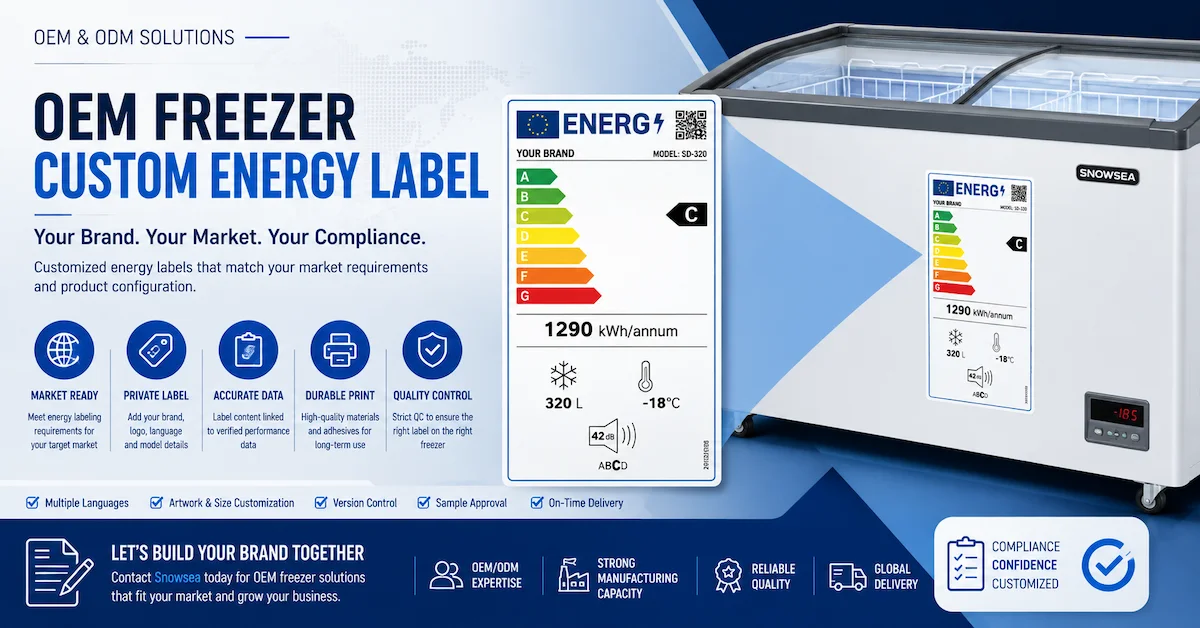
An OEM freezer custom energy label project means preparing or adapting an energy-related label for a specific freezer model, private-label brand, destination market, language, verified technical data, and approved production configuration.
For B2B buyers, this is not simply a graphic-design task.
A project may involve:
- Brand or private-label identity
- Model number
- Language
- Artwork format
- Label dimensions
- Energy-related information
- Market-specific presentation requirements
- Barcode or QR code where required
- Printing material
- Adhesive
- Placement
- Revision control
The most important principle is:
An OEM energy label is not simply a custom sticker. Its content must correspond to the correct product configuration, verified data, destination market, and approved artwork.
Snowsea can evaluate requested labeling together with the selected commercial refrigeration configuration through its OEM and ODM solutions.
Confirm the Destination Market Before Designing the Label
One of the first questions in an OEM energy-label project should be:
Where will the freezer be sold?
Energy-label requirements can differ according to product category and destination market. Therefore, buyers should confirm the applicable current requirements for the specific freezer and sales region before final artwork approval.
This article does not prescribe a universal country-specific label format because those requirements should be checked against the applicable current official rules for the target market.
For an OEM RFQ,buyers should ideally provide:
| Buyer Input | Why It Matters |
|---|---|
| Destination country or region | Defines the market version |
| Freezer model | Connects label to the correct product |
| Product category | Supports requirement review |
| Private-label brand | Determines artwork identity |
| Required language | Defines label version |
| Verified energy data | Supports technical content |
| Required template | Controls artwork structure |
| Label dimensions | Supports printing and placement |
| Order quantity | Supports production planning |
| Approval deadline | Affects project schedule |
The destination market should be confirmed before the energy-label artwork is finalized.
Energy Label vs Rating Plate: What Is the Difference?
OEM buyers should not automatically treat these as the same label.
Energy Label
An energy-related label is generally intended to communicate approved energy-performance information in the format required for the relevant product and market.
Its content may relate to:
- Energy performance
- Consumption information
- Efficiency information
- Product identification
- Market-specific presentation
Rating Plate or Product Nameplate
A rating plate normally serves a different product-identification and technical purpose and may contain information such as:
- Model
- Voltage
- Frequency
- Electrical information
- Refrigerant information
- Serial or production identification
The exact required fields depend on the project.
The procurement lesson is:
A freezer energy label and a freezer rating plate may serve different purposes and should be specified separately when necessary.
Label Customization Is Not Energy-Performance Customization
This distinction is critical.
A buyer may want to change:
- Logo
- Brand name
- Language
- Artwork layout
- Label dimensions
These are primarily label or artwork requirements.
Changing actual energy-performance data is different.
| Requested Change | Mainly Label Related? | Engineering Review Needed? |
|---|---|---|
| Brand/logo | Yes | Usually limited |
| Language | Yes | Usually limited |
| Artwork layout | Yes | Production review |
| Label dimensions | Yes | Placement review |
| Model identity | Documentation review | May be required |
| Energy value | No | Technical verification required |
| Compressor change | No | Yes |
| Controller change | No | Yes |
| Cabinet structure change | No | Yes |
The key principle is:
Changing the label is different from changing the freezer's actual energy performance.
An OEM project should never treat verified technical values as editable marketing text.
Why the Label Must Match the Exact Freezer Configuration
Two freezers that look similar externally may not necessarily have the same technical configuration.
Energy-related performance can be influenced by project changes involving components or specifications such as:
- Compressor
- Controller
- Cabinet dimensions
- Door construction
- Insulation
- Temperature settings
- Lighting
- Refrigeration system configuration
For example, if an OEM buyer requests a different compressor, the project should not automatically reuse energy-related information from another configuration merely because the cabinet appearance remains unchanged.
For related specification planning, see:
A useful rule is:
An energy label should be linked to a defined production configuration—not merely to a cabinet appearance or marketing model name.
Who Provides the Energy-Label Data?
There are several common OEM project situations.
Buyer Provides Approved Information
A distributor or private-label brand may already have:
- Approved artwork
- Existing label files
- A market template
- Relevant technical documentation
- Product data
The manufacturer should still check whether the information corresponds to the requested freezer configuration.
Existing Product Data Is Available
If relevant technical data already exists, the first question should be whether it applies to the exact requested model and configuration.
It should not be reused solely because the products appear similar.
A New Configuration Requires New Verification
If significant energy-related components or operating specifications change, the technical configuration may need to be reviewed before final label information is approved.
Therefore:
Artwork approval should follow technical-data confirmation—not replace it.
Can Buyers Provide Their Own Energy-Label Artwork?
Yes. OEM buyers can provide their required artwork or template for evaluation.
Useful files and information include:
- Editable artwork
- PDF reference
- Brand assets
- Required wording
- Language
- Dimensions
- Technical data source
- Placement drawing
- Revision number
The artwork should then go through appropriate technical and production review before use.
A supplied file should not automatically be considered ready for mass production simply because its visual design has been approved.
Label Material, Printing and Adhesive
The label must remain suitable for the surface and operating environment.
Depending on the project, buyers and manufacturers may need to consider:
- Cabinet or door surface
- Moisture exposure
- Cleaning
- Abrasion
- Temperature environment
- Transport
- Required service life
- Print clarity
Snowsea should evaluate the requested label specification according to the particular freezer platform and project requirements rather than treating one material as universally suitable.
Label material and adhesive should be selected according to the mounting surface, operating environment, durability requirement, and production specification.
Why Label Placement Must Be Controlled
Correct information on the wrong location can still become a production-quality problem.
The approved specification should define where necessary:
- Mounting surface
- Position
- Orientation
- Distance from an edge or reference point
- Visibility
- Alignment
For repeat OEM orders, a placement drawing or approved sample can help maintain consistency.
An approved label with inconsistent placement is still a production-quality problem.
Energy-Label Version Control for OEM Projects
Version control becomes especially important when a distributor manages multiple:
- Brands
- Markets
- Languages
- Models
- Product configurations
- Artwork revisions
A useful internal control relationship is:
Freezer Model → Destination Market → Brand → Artwork Version → Production Order
Without clear version management,risks can include:
- Wrong brand
- Wrong language
- Wrong model
- Old artwork
- Wrong technical data
- Wrong market version
This is why label management should be included in the OEM production specification rather than handled as an informal final-stage task.
Can One Freezer Platform Use Labels for Multiple Markets?
A freezer platform may potentially be sold through different brands or regions, but buyers should not assume that one label can automatically be used everywhere.
| Project Structure | Label-Control Priority |
|---|---|
| One model / one market | Basic version control |
| One model / multiple brands | Separate artwork versions |
| One model / multiple languages | Language control |
| Multiple configurations | Technical-data matching |
| Multiple markets | Market-specific review |
For multi-market OEM programs, each version should be clearly identified before production.
What Should Be Approved Before Mass Production?
The approval process can include both digital artwork and physical implementation.
Buyers should verify relevant items such as:
- Brand name
- Model number
- Language
- Technical information
- Artwork revision
- Label dimensions
- Printing clarity
- Color where relevant
- Barcode or QR code where applicable
- Label material
- Placement
- Adhesion
- Physical appearance on the freezer
When appropriate, checking the label on the actual sample gives the buyer more information than reviewing a PDF alone.
How Does Custom Energy Labeling Affect OEM Cost?
The label itself may appear to be a small component,but project cost can be influenced by:
- Artwork preparation
- Different label versions
- Printing setup
- Material
- Adhesive
- Special printing requirements
- Multiple languages
- Multiple brands
- Small production batches
- Sample approval
- Technical verification requirements
The more useful purchasing question is not simply:
“How much does the sticker cost?”
It is:
What is required to ensure the correct approved label is applied to the correct freezer and shipment?
A low-cost label can become an expensive problem if the wrong model, technical data, brand, or market version reaches a customer.
Does a Custom Energy Label Affect MOQ or Lead Time?
It can, depending on the project.
MOQ may be influenced by:
- Printing supplier requirements
- Number of artwork versions
- Label material
- Special printing
- Order quantity
Lead time may be influenced by:
- Missing technical data
- Artwork preparation
- Multiple language revisions
- Late model changes
- Buyer approval
- Label production
- Product-configuration changes
A practical OEM workflow is:
Market Confirmation → Product Configuration → Technical Data → Artwork → Buyer Approval → Label Production → Sample/QC → Mass Production
Early data and artwork confirmation can reduce avoidable delays.
OEM Energy-Label QC Checklist
Once the label is approved, production should control the approved version consistently.
Useful checkpoints include:
- Correct freezer model
- Correct destination market
- Correct brand
- Correct language
- Correct artwork revision
- Correct approved technical information
- Correct label dimensions
- Correct material
- Printing clarity
- Correct placement
- Adhesion
- Barcode/QR readability where applicable
- Approved-sample conformity
- Packing-order consistency
For broader production controls, see Snowsea's commercial freezer quality testing procedure.
Common OEM Energy-Label Risks
| Risk | Common Cause | Control Point |
|---|---|---|
| Wrong technical data | Configuration mismatch | Match data to exact model |
| Wrong market version | Poor version control | Separate market artwork |
| Wrong brand | Multiple OEM projects | Order-level verification |
| Wrong language | Mixed production | Language/version check |
| Wrong placement | No placement standard | Approved drawing/sample |
| Poor adhesion | Material mismatch | Physical validation |
| Old artwork | Revision confusion | Artwork revision control |
| Shipment mismatch | Mixed models | Final QC verification |
The goal is not simply to customize a label. It is to make the label traceable, repeatable, and controllable in mass production.
How to Compare OEM Freezer Suppliers for Energy-Label Projects
| Evaluation Area | What Buyers Should Verify |
|---|---|
| Destination market | Does the supplier ask where the product will be sold? |
| Product configuration | Is the label tied to the correct model? |
| Technical data | Is verified information controlled? |
| Artwork | Is buyer approval required? |
| Version control | Are brands, languages and markets separated? |
| Sample approval | Can physical placement be checked? |
| Production QC | Is the correct label verified before shipment? |
| MOQ | Are label-printing implications explained? |
| Lead time | Is approval included in the schedule? |
| OEM support | Can buyer artwork and specifications be evaluated? |
A stronger OEM supplier should understand both the artwork requirement and the risk of applying the wrong version to mass-produced equipment.
What Should Buyers Send Snowsea for a Quote?
For an efficient OEM freezer custom energy label evaluation, provide:
- Freezer type and model
- Destination country or region
- Product category
- Private-label brand
- Required model name or number
- Required language
- Existing energy-label template
- Editable artwork, if available
- Available verified energy/performance data
- Relevant technical documents,if available
- Required label dimensions
- Placement requirement or drawing
- Barcode/QR requirement where applicable
- Material requirement, if specified
- Number of label versions
- Initial order quantity
- Annual purchasing forecast
- Target artwork-approval date
- Target shipment schedule
You can first review Snowsea commercial refrigeration products and then send the project specification through the Snowsea contact page.
FAQ
Can the energy label on an OEM freezer be customized?
Buyers can submit branding, language, dimensions, artwork, placement, and other label requirements for evaluation. The final content must correspond to the product configuration and applicable project requirements.
Is an energy label the same as a freezer rating plate?
Not necessarily. They may serve different purposes and contain different information, so buyers should specify each requirement separately.
Can I add my private-label brand to the energy label?
Private-label branding can be submitted as part of the OEM artwork requirement, subject to the final approved label specification.
Can the language be customized?
Language versions can be evaluated according to the destination market, buyer artwork, and project requirements.
Can I provide my own artwork?
Yes. Buyers can provide editable artwork, templates, dimensions, technical information, and placement instructions for review.
Can the energy value be changed for an OEM order?
Energy-performance values should not be treated as editable marketing content. They should correspond to the verified performance of the applicable product configuration.
Does changing freezer components affect the energy label?
It can. Changes to energy-related components or operating specifications may require technical review before final label data is approved.
Does custom energy labeling affect MOQ or lead time?
It may, depending on printing quantity, number of versions, material, artwork approval, technical verification, and production planning.
How can manufacturers prevent the wrong label from being used?
Clear model, market, brand, language and artwork-version control combined with production QC can reduce label-mix risks.
What information does Snowsea need for an energy-label quotation?
Provide the freezer model, destination market, private-label brand, language, artwork or template, available verified data, dimensions, placement, quantity, and project schedule.
Conclusion
An OEM freezer custom energy label should be treated as part of product configuration and production control—not as a decorative sticker added immediately before shipment.
B2B buyers should confirm:
- Destination market
- Freezer model and configuration
- Verified technical information
- Private-label brand
- Language
- Artwork
- Label dimensions
- Material
- Placement
- Revision control
- Sample approval
- MOQ
- Lead time
- Production QC
Most importantly, customizing the presentation of an energy label should not be confused with arbitrarily changing the freezer's verified energy-performance data.
Send Snowsea your freezer model, destination market, private-label brand, language, label template or artwork, available verified product data, label dimensions, placement requirements, number of versions, order quantity, and project schedule through the contact page.
Snowsea can evaluate the product-configuration match, artwork implementation, label specification, version control, sample requirements, MOQ, production schedule, and overall OEM feasibility before preparing a technical proposal and quotation.