Why an OEM Refrigeration Equipment Supplier Matters for B2B Buyers
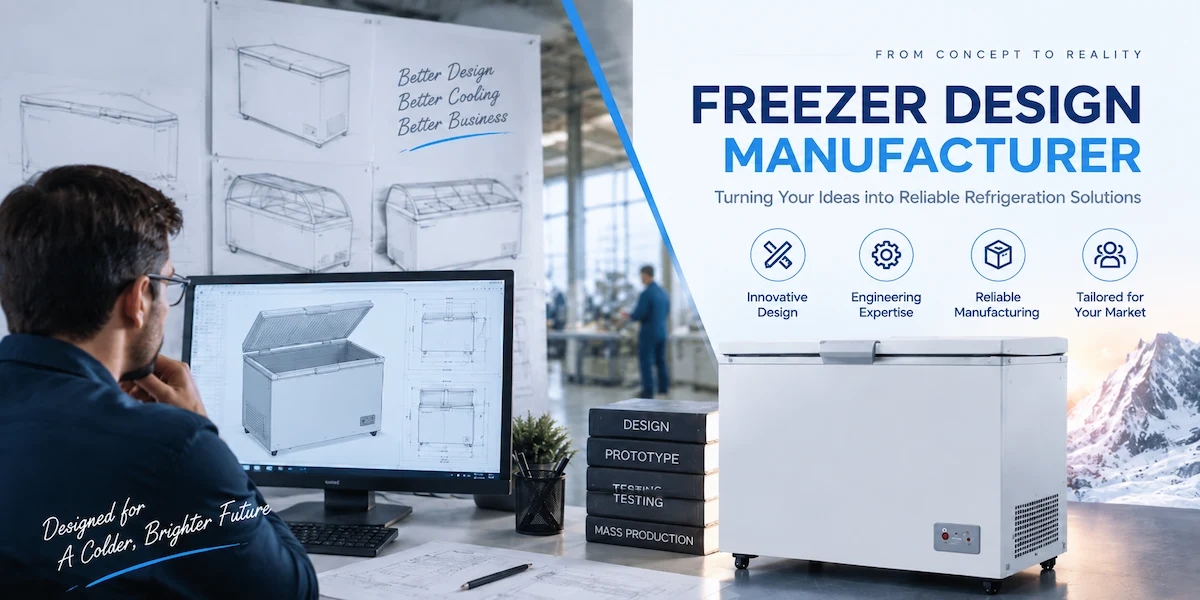
Choosing an OEM refrigeration equipment supplier is not simply about finding a factory that can manufacture refrigerators or freezers at a competitive price. For distributors, supermarket groups, foodservice equipment companies and private-label brands, the supplier must support a complete commercial program: suitable product platforms, market-specific configurations, controlled customization, quality verification, documentation, production planning and repeat-order consistency.
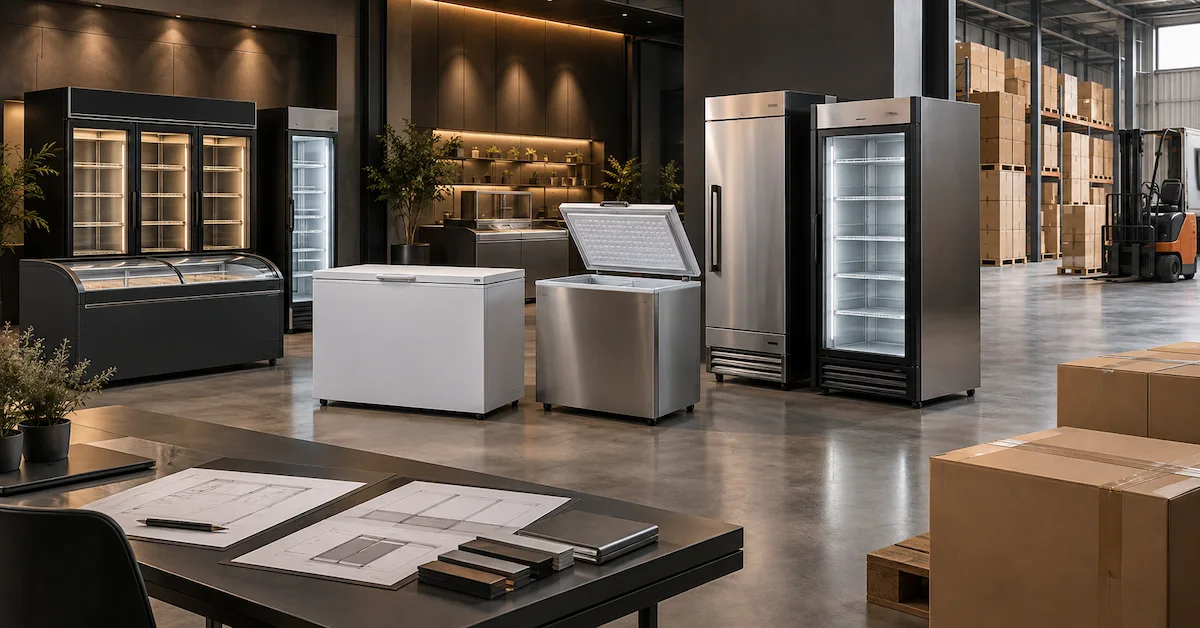
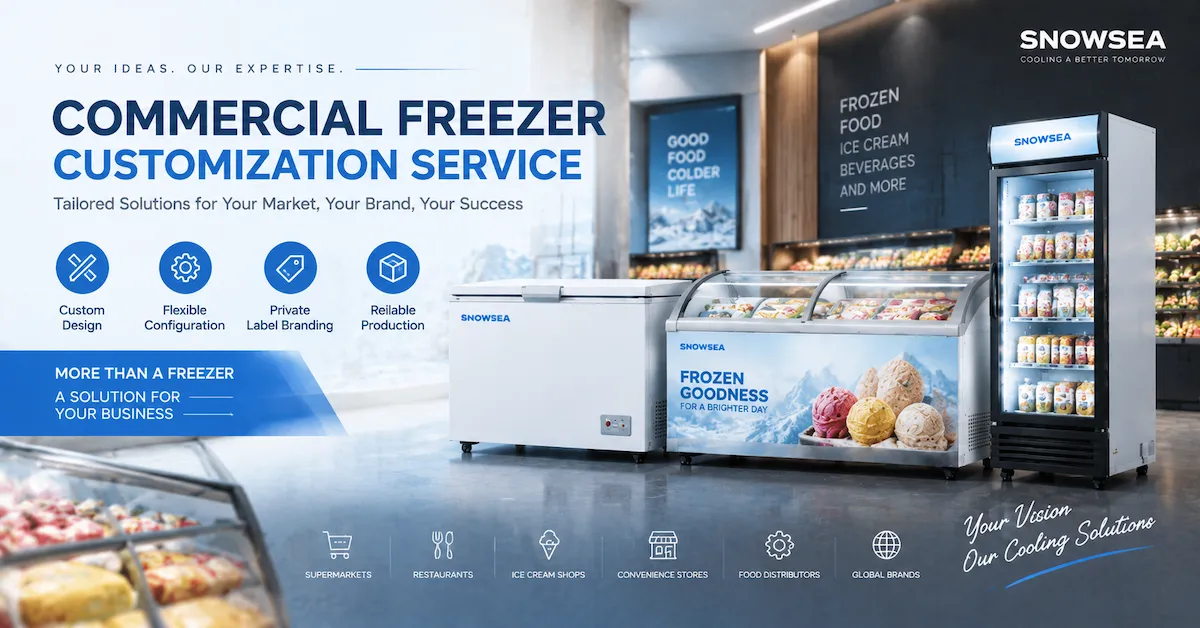
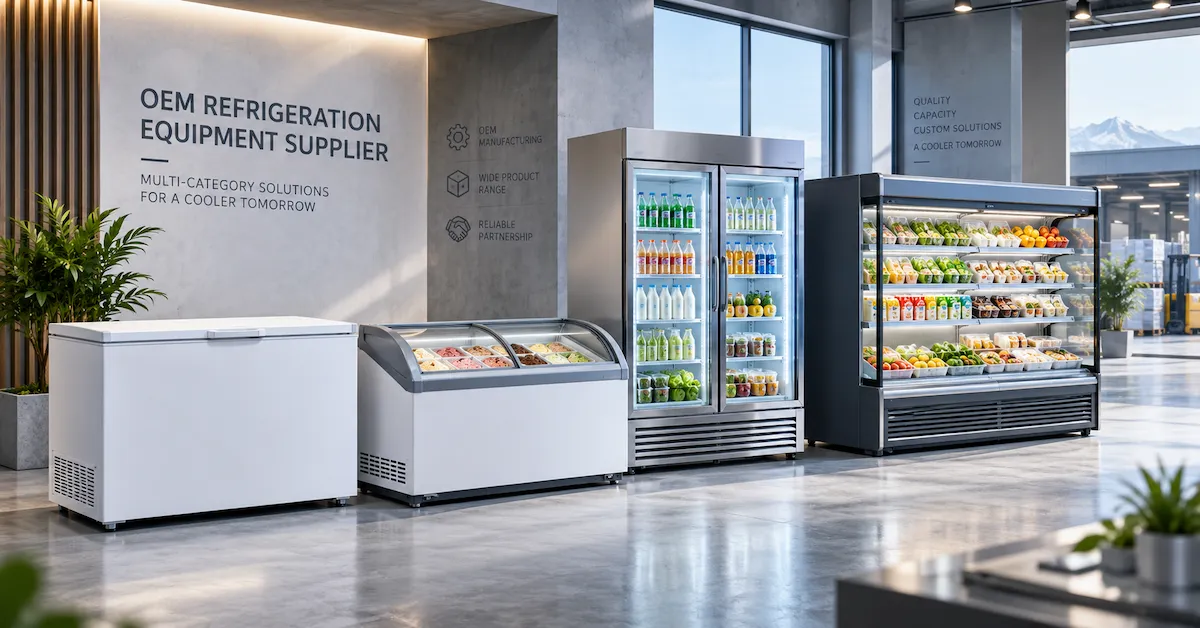
The purchasing risk increases when a project contains several refrigeration categories. A chest freezer, ice cream display freezer, upright refrigerator and commercial showcase may all carry the same private-label brand, but they perform different refrigeration tasks and should not be evaluated with one generic specification. SNOWSEA currently organizes its commercial refrigeration portfolio across Freezer, Ice Cream Freezer, Refrigerator and Showcase, while its OEM/ODM service supports customized B2B projects.
A reliable OEM refrigeration equipment supplier should therefore help buyers answer three questions before mass production: Which existing platform best matches the application? What genuinely needs to be customized? How will the approved version remain consistent when production scales?
Who Needs OEM Refrigeration Equipment Supply?
OEM supply is most relevant to businesses that need repeatable refrigeration products rather than one-time equipment purchases. Typical customers include refrigeration distributors, appliance importers, supermarket-equipment suppliers, restaurant-equipment companies, beverage brands, frozen-food companies and private-label commercial refrigeration brands.
These buyers normally need equipment that can be sold through a channel, documented under their own model system, stocked in a warehouse, supported with spare parts and reordered later. That makes supplier capability more important than simply obtaining one technically acceptable sample.
Typical B2B Customer Requirements
A refrigeration distributor may need several models covering different customer segments while keeping packaging, model naming and service information consistent. A supermarket group may need freezers and showcases standardized for several store formats. A frozen-food brand may need display freezers with specific merchandising layouts and branding. A private-label company may require different electrical versions for different regional markets.
The right supplier should understand these commercial differences instead of treating every inquiry as a request for another logo.
Start With Applications Before Selecting Product Models
One of the most common sourcing mistakes is beginning with a product catalog rather than the end-use requirement. The application should determine the product family.
| Application | Main Purchasing Requirement | Relevant SNOWSEA Category |
|---|---|---|
| Frozen food storage | Capacity, loading, access and frozen holding | Freezer |
| Ice cream retail display | Visibility, glass access, basket layout | Ice Cream Freezer |
| General refrigeration | Internal layout, temperature requirement, market fit | Refrigerator |
| Chilled retail display | Shelves, lighting, glass doors, merchandising | Showcase |
An OEM refrigeration equipment supplier should first identify the closest suitable standard platform. Customization should begin only after the buyer and supplier understand which requirement the standard model cannot satisfy.
Why Existing Platforms Should Come First
Starting from a proven platform can reduce unnecessary engineering work, shorten sample development and simplify service. It can also make product documentation and repeat-order control easier because much of the underlying production system is already established.
A buyer does not gain commercial value merely because more parts have been customized. The strongest OEM program customizes where the market requires differentiation and keeps proven elements standard where they already meet the application.
Compare Product Platforms by Their Commercial Role
SNOWSEA’s product range provides different starting points for storage, frozen display and chilled merchandising. The following models illustrate why products should be compared by application rather than only by nominal capacity.
| Model | Published Starting Point | Potential OEM Role | Buyer Verification |
|---|---|---|---|
| BD-500 Chest Freezer | 500L double-lid chest freezer | Larger frozen-storage SKU | Loading, cabinet footprint, accessories, electrical version |
| BD/BC-227WA No-Frost Freezer | 227L air-cooled no-frost platform | No-frost differentiated SKU | Controller, airflow, defrost configuration |
| SD/SC-268PM Ice Cream Freezer | 268L flat sliding-glass freezer | Branded ice cream display | Basket layout, package fit, glass configuration |
| BC-190 Refrigerator | 190L single-door refrigerator | Refrigerator-channel model | Interior configuration, electrical version, documents |
| LC-208 Display Refrigerator | 208L display refrigerator | Compact retail showcase | Shelf layout, lighting, controller, merchandising |
The table is a purchasing starting point rather than a universal model recommendation. Final suitability depends on the real operating conditions and the exact version quoted for the project.
Build a Controlled OEM Specification Before Pricing the Final Order
A quotation should eventually become a product specification. Important requirements should not remain scattered across emails, instant messages and artwork files.
A controlled OEM specification can connect the buyer’s private-label model with the supplier’s production reference.
| Specification Area | Buyer Defines | Supplier Confirms |
|---|---|---|
| Private-label model | Buyer model number | Corresponding factory model |
| Application | Storage or display function | Suitable platform |
| Capacity/loading | Product dimensions and quantity | Usable arrangement |
| Cabinet | Dimensions, doors, lids or glass | Final construction |
| Cooling | Required refrigeration/defrost approach | Final configuration |
| Controller | Required functions | Approved version/settings |
| Electrical | Voltage, frequency and plug | Market version |
| Accessories | Baskets, locks, shelves, lights | Included vs. optional |
| Branding | Logo, cabinet graphics | Approved artwork |
| Label | Technical/product identification | Final revision |
| Manual | Language and product information | Approved document |
| Packaging | Branding and protection | Final packing specification |
| QC | Acceptance requirements | Inspection plan |
Give the specification a revision number. If the project changes, update the controlled revision rather than relying on memory.
Separate Branding, Configuration and Engineering Changes
Not every OEM requirement carries the same risk.
Branding Changes
Brand-related customization can include logo placement, model name, cabinet graphics, labels, manuals and cartons. These usually affect commercial identity more than refrigeration performance, although they still require strict version control.
Configuration Changes
Configuration requests may include baskets, shelves, locks, lighting, plugs or approved controller options. These should be checked for compatibility with the selected base model.
Engineering Changes
Cabinet dimensions, insulation, refrigeration components, glass structure, airflow or controller logic can affect performance and should be evaluated as engineering work.
A supplier that treats all three levels as simply “OEM customization” can make project responsibilities unclear.
Review the Supplier’s Manufacturing Process
The buyer needs to know how the approved custom version reaches normal factory production. SNOWSEA’s OEM/ODM manufacturing process includes material preparation, cabinet assembly, insulation, refrigeration-system installation, main assembly, testing, inspection and packing.
For OEM projects, ask how customer-specific information is controlled at each relevant stage.
Questions to Ask During Production Review
- How is the private-label model linked to the base model?
- How is the correct electrical version identified?
- How are custom accessories issued to production?
- How are labels and manuals controlled?
- What document tells QC which configuration to inspect?
- How is the final packaging version identified?
- What happens if a component must change?
These questions provide more purchasing value than simply asking whether the factory has “strict quality control.”
Evaluate Component Change Control
Commercial refrigeration equipment contains many components that can affect performance or service. The buyer does not need to approve every minor item, but important controlled components should be identifiable.
Depending on the product, those can include the controller, compressor, sensors, fan motors, glass assemblies, gaskets, baskets and other application-specific components.
What Happens When a Component Changes?
A strong supplier should have a defined route for substitutions. If a controller becomes unavailable, the factory should determine whether the replacement affects sensor logic, temperature control, defrost, documents or previous test results before introducing it into production.
For private-label brands, silent component changes can become especially problematic because the external model name may remain unchanged while replacement-parts requirements change underneath it.
Use Sample Approval as a Technical Gate
A sample should represent the product the buyer intends to manufacture, not just an attractive cabinet for photography.
Technical Sample Approval
Review the cabinet dimensions, refrigeration configuration, controller, electrical version, accessories, operating requirements and actual product loading.
Commercial Sample Approval
Review the logo, colors, model identity, rating label, manual and packaging.
Keeping these approvals separate makes corrections easier to manage. A technically correct freezer can still have wrong artwork, while a visually perfect branded cabinet may still contain the wrong electrical configuration.
Test the Product According to Its Actual Commercial Job
Different refrigeration categories require different validation priorities.
Chest Freezer
Check loading, lid operation, gasket contact, temperature behavior, controls and storage access.
Ice Cream Freezer
Check package fit, basket organization, sliding glass, customer access, frozen holding and product visibility.
Refrigerator
Check internal layout, door operation, controls and the required refrigeration condition.
Showcase Refrigerator
Check shelf arrangement, glass-door movement, lighting, merchandising visibility and chilled operating performance.
An OEM refrigeration equipment supplier should not use one generic sample checklist for every product category.
Define Performance Testing Before Mass Production
“Tested before shipment” is too broad for technical purchasing. Ask what is actually checked and under which conditions.
A performance plan can identify:
- Exact model
- Controller version
- Ambient condition
- Product or simulated load
- Target temperature
- Measurement positions
- Test duration
- Temperature stability
- Recovery where relevant
- Defrost behavior where relevant
- Electrical configuration
- Acceptance criteria
Production QC and model-level development validation should also be separated. A detailed engineering test may not be repeated on every unit.
Review Destination-Market Requirements Early
Market documentation should be connected to the exact product and electrical configuration. Do not assume a certificate or report associated with one model automatically covers another category or modified OEM version.
A private-label program may contain freezers, refrigerators and showcases under one brand, but their technical documents should remain model-specific.
Resolve documentation requirements before final label and carton approval so compliance-related information is not added at the last minute.
Evaluate MOQ by Product Version
MOQ should not be discussed only at company level.
It can vary according to:
- Base model
- Electrical version
- Color
- Branding
- Carton artwork
- Unique glass
- Controller
- Special shelves or baskets
- Custom components
A total order of several hundred units does not necessarily eliminate a minimum for one low-volume custom SKU.
Why This Matters for Distributors
Too many customized versions can tie up working capital and create slow-moving inventory. A focused product range with clear customer roles can be commercially stronger than a catalog containing many lightly differentiated models.
Ask Whether Mixed Product Categories Can Be Coordinated
A distributor may need chest freezers, ice cream displays and showcases within the same purchasing program.
The supplier should clarify whether these products can be produced and shipped within the same overall schedule, whether they have different MOQ structures and whether mixed loading is commercially practical.
Do not build the product assortment around unused container space. Start with customer demand and then optimize logistics.
Break Lead Time Into Real Project Stages
Instead of accepting one number such as “30 days,” separate the project into:
Pre-Production
Requirement confirmation, engineering evaluation, artwork approval and sample validation.
Production
Material preparation, assembly, testing, inspection and packing.
Logistics
Shipment readiness, international transport, import clearance and local warehouse delivery.
This distinction lets buyers identify whether a delay comes from artwork, sample revision, materials, factory scheduling or transport.
Compare Total OEM Program Cost
The cheapest factory unit price does not necessarily represent the lowest total sourcing cost.
| Cost Area | What Buyers Should Include |
|---|---|
| Base equipment | Product purchase price |
| Options | Model-specific configuration |
| Branding | Logo, labels and graphics |
| Packaging | Private-label and export packing |
| Sample | Initial validation |
| Engineering | Where customization requires it |
| Tooling | If required |
| Testing | Standard and additional validation |
| Freight/import | Logistics cost |
| Inventory | Working-capital exposure |
| Spare parts | Local support stock |
| Warranty | Service responsibility |
The correct comparison asks what commercial value the customization produces and what long-term complexity it adds.
Plan Spare Parts Before Launching the Product
The customer normally contacts the distributor or brand when equipment requires service, not the original production line.
Create a cross-reference linking:
Private-label model → factory model → production revision → spare-parts references
Depending on the product, useful service parts might include controllers, sensors, gaskets, baskets, handles, lighting or fan-related components.
SNOWSEA’s About Us describes technical documentation and spare-parts support. Buyers should still confirm the order-specific support arrangement for each private-label model.
Define Warranty Responsibilities Before Selling the Equipment
The factory warranty and the distributor’s customer-facing warranty are not automatically identical.
Clarify:
- Warranty start point
- Covered failures
- Exclusions
- Claim evidence
- Diagnosis procedure
- Spare-parts responsibility
- Parts freight
- Local labor
- Replacement conditions
- Technical support process
This should happen before the product enters the market rather than after the first failure.
Control Repeat Orders With Product Revisions
The first successful shipment should create a repeatable reference for later purchasing.
Reference the approved specification revision on future purchase orders and ask the supplier to identify proposed deviations before production.
A useful instruction is:
Manufacture according to the approved OEM refrigeration equipment specification revision and disclose any proposed technical, component, electrical, artwork or packaging change before implementation.
This protects both parties. The buyer knows what is being reordered, and the supplier has a formal route for proposing necessary changes.
How to Compare OEM Refrigeration Equipment Suppliers
A practical supplier-selection scorecard can focus on the areas that actually affect the business.
| Evaluation Area | Main Question |
|---|---|
| Product range | Are suitable refrigeration platforms available? |
| Application knowledge | Does the supplier understand the customer use case? |
| Engineering | Can customization be evaluated technically? |
| Specification control | Can the approved version be clearly defined? |
| Sample process | Can technical and commercial approval be managed? |
| Manufacturing | Can the factory reproduce the product? |
| Testing | Are performance checks meaningful? |
| Documentation | Does evidence match the market/model? |
| MOQ | Does the supply structure fit expected demand? |
| Lead time | Is the schedule realistic? |
| Packaging | Does it protect and identify the product? |
| After-sales | Can the channel service the equipment later? |
A strong OEM refrigeration equipment supplier should perform well across the complete system rather than relying on one advantage such as low price or a large catalog.
What Should You Send SNOWSEA for an OEM Project?
Provide enough information for the supplier to recommend product platforms rather than guess.
Send:
- Target market
- Customer type
- Required equipment categories
- Application
- Product/package dimensions
- Capacity requirement
- Installation limits
- Temperature requirement
- Ambient environment
- Electrical specification
- Branding requirements
- Packaging requirements
- Quantity by model
- Required documentation
- Sample expectations
- Launch schedule
- Annual forecast
- Spare-parts and service expectations
Use SNOWSEA Contact Us to submit the project and request a model-by-model proposal that separates standard products, options, OEM customization and engineering changes.
Frequently Asked Questions
1. What is an OEM refrigeration equipment supplier?
An OEM refrigeration equipment supplier manufactures refrigeration products according to agreed buyer-specific requirements and can support branding, configurations, packaging, market adaptations and recurring supply.
2. Which refrigeration equipment can be supplied through OEM projects?
SNOWSEA currently provides freezer, ice cream freezer, refrigerator and showcase product categories. OEM feasibility depends on the selected platform and project requirements.
3. How is an OEM supplier different from a standard manufacturer?
A standard manufacturer primarily produces existing models. An OEM supplier additionally coordinates buyer-specific configurations, branding, packaging and supply requirements.
4. How is OEM different from ODM?
OEM normally starts from an existing platform. ODM involves deeper product-development work when a new or substantially modified design is required.
5. Should buyers always customize refrigeration equipment?
No.Customization should solve a measurable market, operating or branding requirement. Keeping suitable standard elements can reduce cost, MOQ and after-sales complexity.
6. Should OEM refrigeration equipment be sampled before production?
A representative sample is useful for new private-label versions or modified configurations because it lets buyers verify technical requirements, branding and packaging before mass production.
7. What affects OEM refrigeration equipment MOQ?
MOQ can be affected by model, electrical version, packaging, branding, color and unique components. Request the MOQ for each actual product version.
8. Can different refrigeration equipment categories be combined in one purchasing program?
Potentially. Buyers should confirm model-specific MOQ, production schedules, packaging and shipping arrangements before planning a mixed-category order.
9. How should repeat OEM orders be controlled?
Use an approved specification revision and require important technical, component, electrical or artwork changes to be disclosed before implementation.
10. How can I request an OEM refrigeration equipment proposal from SNOWSEA?
Send the applications, required product categories, quantities, electrical requirements, branding and project schedule through SNOWSEA Contact Us and request a model-specific OEM supply proposal.
Conclusion
Selecting an OEM refrigeration equipment supplier should be treated as choosing a long-term product and supply partner rather than simply sourcing cabinets with private-label logos. Begin with real applications, choose the closest proven freezer, ice cream freezer, refrigerator or showcase platforms, define only the customization that creates commercial value, and connect approved specifications to manufacturing, testing, documentation, packaging and spare-parts support. For distributors and private-label brands, the strongest OEM program is one that remains understandable and repeatable on the second, third and later orders. SNOWSEA provides commercial refrigeration products and OEM/ODM support across several equipment categories. If you are planning a multi-category private-label range or commercial refrigeration project, send SNOWSEA your applications, model requirements, quantities and target markets and request a structured OEM proposal covering platform selection, customization scope, sample approval, production control and long-term supply.