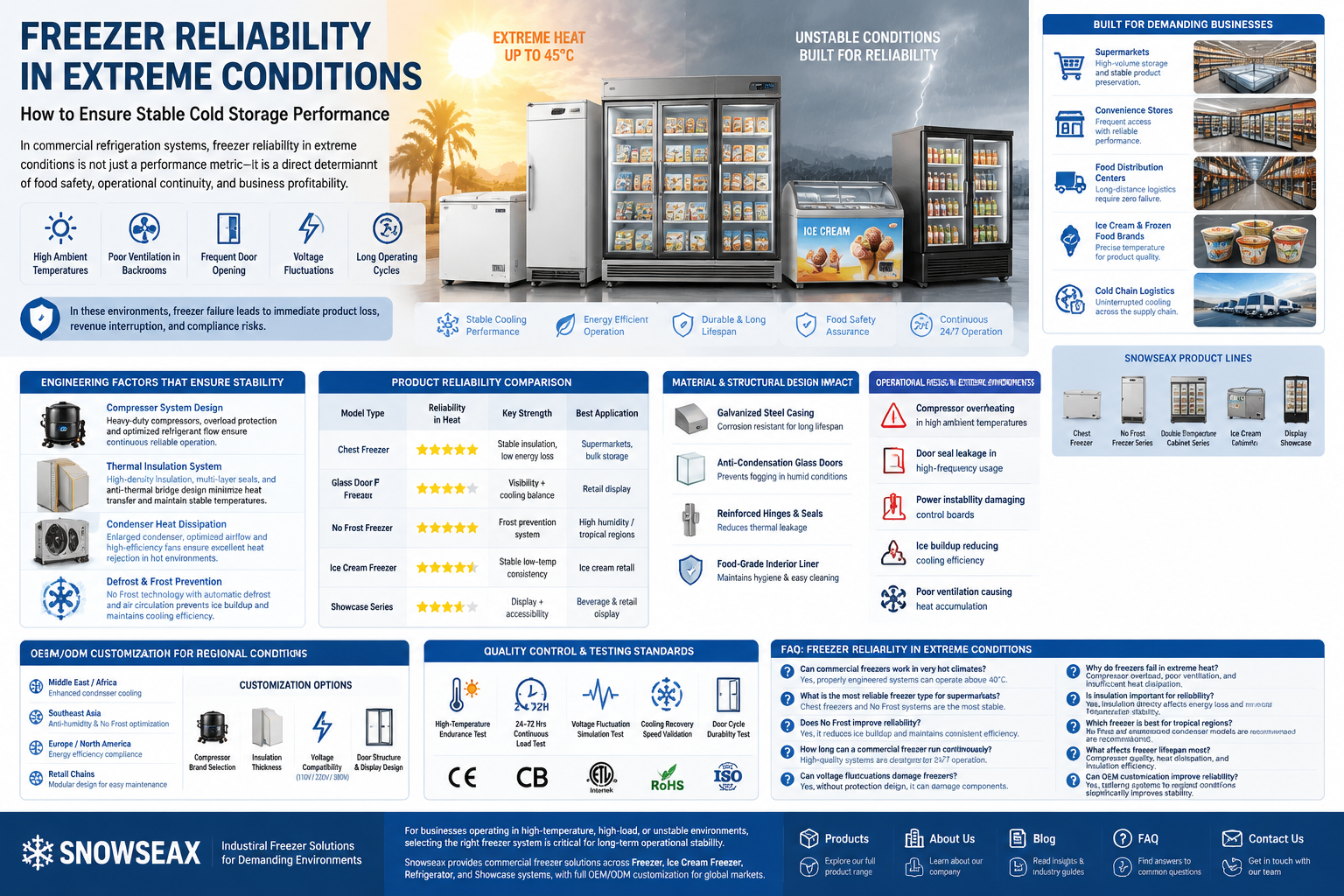
In commercial refrigeration systems, freezer reliability in extreme conditions is not just a performance metric—it is a direct determinant of food safety, operational continuity, and business profitability.
For supermarkets, convenience stores, food distribution centers, and cold chain logistics, freezers are often exposed to unstable environments such as:
- High ambient temperatures (tropical or summer conditions)
- Poor ventilation in retail backrooms
- Frequent door opening in high-traffic stores
- Voltage fluctuations in developing markets
- Long operating cycles with minimal downtime
In these environments, freezer failure leads to immediate product loss, revenue interruption, and compliance risks.
Snowsea commercial refrigeration systems are engineered specifically for such demanding conditions, covering product lines including Chest Freezer, No Frost Freezer Series, Double Temperature Cabinet Series, Ice Cream Freezer, and Display Showcase systems. To learn more about our company and manufacturing capabilities, visit our About Us page.
Buyer Types and Search Intent Analysis
Primary Buyer Segments
- Supermarket procurement managers
- Convenience store chain operators
- Cold chain logistics companies
- Ice cream and frozen food brands
- Wholesale distributors and importers
- OEM/ODM refrigeration brand owners
Search Intent Classification
- Information Intent: “How do freezers perform in extreme heat?”
- Commercial Investigation: “Most reliable commercial freezer for hot climates”
- Transactional Intent: “Industrial freezer supplier for tropical regions”
For more answers to common buyer questions, see our FAQ page.
Core Buyer Questions
- How does a freezer maintain performance in high ambient temperature?
- What causes freezer failure in commercial environments?
- Which freezer types are best for unstable power conditions?
- How long can a commercial freezer operate continuously?
- What design features improve long-term reliability?
What Defines Freezer Reliability in Extreme Conditions?
Freezer reliability is determined by the system’s ability to maintain stable internal temperatures under external stress.
Key engineering indicators include:
- Temperature stability range (±1°C to ±3°C fluctuation tolerance)
- Compressor endurance under continuous load
- Heat exchange efficiency in high ambient environments
- Defrost system effectiveness
- Electrical stability under voltage fluctuation
- Insulation performance (thermal resistance stability)
A high-reliability freezer is not defined by cooling speed alone—but by long-term thermal consistency under stress. For specific models and their performance, check our Products page.
Engineering Factors That Ensure Stability
Compressor System Design
The compressor is the core of freezer reliability.
High-performance systems use:
- Heavy-duty compressors designed for continuous duty cycles
- Overload protection for voltage instability
- Optimized refrigerant flow control
This ensures stable operation even during peak load conditions in commercial environments.
Thermal Insulation System
Extreme environments require insulation systems that reduce external heat penetration:
- High-density polyurethane foam insulation
- Multi-layer cabinet sealing structures
- Anti-thermal bridge cabinet design
This minimizes energy loss and stabilizes internal temperature even in 35°C–45°C ambient environments.
Condenser Heat Dissipation Efficiency
In hot climates, heat rejection becomes critical.
Reliable systems incorporate:
- Enlarged condenser surface area
- Optimized airflow channels
- High-efficiency cooling fans
This prevents overheating and compressor overwork.
Defrost and Frost Prevention Systems
For long-term reliability, frost accumulation must be controlled.
Snowsea No Frost systems reduce performance degradation through:
- Automatic defrost cycles
- Air circulation optimization
- Evaporator frost prevention design
Product-Level Reliability Comparison
| Model Type | Reliability in Heat | Key Strength | Best Application |
|---|---|---|---|
| Chest Freezer | High | Stable insulation, low energy loss | Supermarkets, bulk storage |
| Glass Door Freezer | Medium-High | Visibility + cooling balance | Retail display |
| No Frost Freezer | Very High | Frost prevention system | High humidity/tropical regions |
| Ice Cream Freezer | High | Stable low-temp consistency | Ice cream retail |
| Showcase Series | Medium | Display + accessibility | Beverage & retail display |
Explore all options on our Products page.
Material and Structural Design Impact
Material selection plays a critical role in extreme-condition reliability:
- Galvanized steel outer casing → corrosion resistance
- Anti-condensation glass doors → prevents fogging in humid environments
- Reinforced hinges and seals → reduces thermal leakage
- Food-grade interior liner → maintains hygiene under long operation cycles
These materials extend operational lifespan and reduce maintenance frequency.
Operational Risks in Extreme Environments
Without proper engineering design, freezers typically fail due to:
- Compressor overheating in high ambient temperatures
- Door seal leakage in high-frequency usage environments
- Power instability damaging control boards
- Ice buildup reducing cooling efficiency
- Poor ventilation causing heat accumulation
Understanding these risks is critical for selecting the correct freezer type. Learn more about our services on the OEM/ODM page.
OEM/ODM Customization for Regional Conditions
Different markets require different reliability configurations:
- Middle East / Africa → enhanced condenser cooling system
- Southeast Asia → anti-humidity and No Frost optimization
- Europe / North America → energy efficiency compliance
- Retail chains → modular design for standardized maintenance
Snowsea OEM/ODM capability allows customization in:
- Compressor brand selection
- Insulation thickness
- Voltage compatibility (110V / 220V / 380V)
- Door structure and display design
Check our OEM/ODM page for full details.
Quality Control and Testing Standards
To ensure reliability in extreme conditions, each unit undergoes:
- High-temperature endurance testing
- Continuous 24–72 hour load operation test
- Electrical safety and voltage fluctuation simulation
- Cooling recovery speed validation
- Door cycle durability testing
For more FAQs about operational standards, see our FAQ page.
FAQ: Freezer Reliability in Extreme Conditions
- Can commercial freezers work in very hot climates?
- Yes, properly engineered systems can operate in ambient temperatures above 40°C with stable cooling performance.
- What is the most reliable freezer type for supermarkets?
- Chest freezers and No Frost systems are generally the most stable under heavy usage.
- Why do freezers fail in extreme heat?
- Main reasons include compressor overload, poor ventilation, and insufficient heat dissipation.
- Does No Frost improve reliability?
- Yes, it reduces ice buildup and maintains consistent cooling efficiency.
- How long can a commercial freezer run continuously?
- High-quality systems are designed for 24/7 continuous operation.
- Is insulation important for reliability?
- Yes, insulation directly determines energy loss and temperature stability.
- Can voltage fluctuations damage freezers?
- Yes, unstable power can damage compressors and control systems without protection design.
- Which freezer is best for tropical regions?
- No Frost and enhanced condenser models are recommended.
- What affects freezer lifespan most?
- Compressor quality, heat dissipation, and insulation efficiency.
- Can OEM customization improve reliability?
- Yes, tailoring systems to regional conditions significantly improves performance stability.
Industrial Freezer Solutions for Demanding Environments
For businesses operating in high-temperature, high-load, or unstable environments, selecting the right freezer system is critical for long-term operational stability.
Snowsea provides commercial freezer solutions across Freezer, Ice Cream Freezer, Refrigerator, and Showcase systems, with full OEM/ODM customization for global markets.
Explore more on our Products page, learn about our company at About Us, check additional guidance in our Blog page, or get direct support through our Contact Us page.